Many people get confused between yeast infection and STD. Both can cause itching, discharge, or discomfort in private areas, which makes them easy to mix up in conversation and writing.
But the truth is — these two terms mean very different things. One refers to a fungal overgrowth, while the other means a sexually transmitted disease.
This easy guide will explain the meanings, main differences, correct usage, and simple examples. By the end, even a 4th-grade student will be able to confidently tell the difference between a yeast infection and an STD.
What Does Each Term Mean?
Yeast Infection
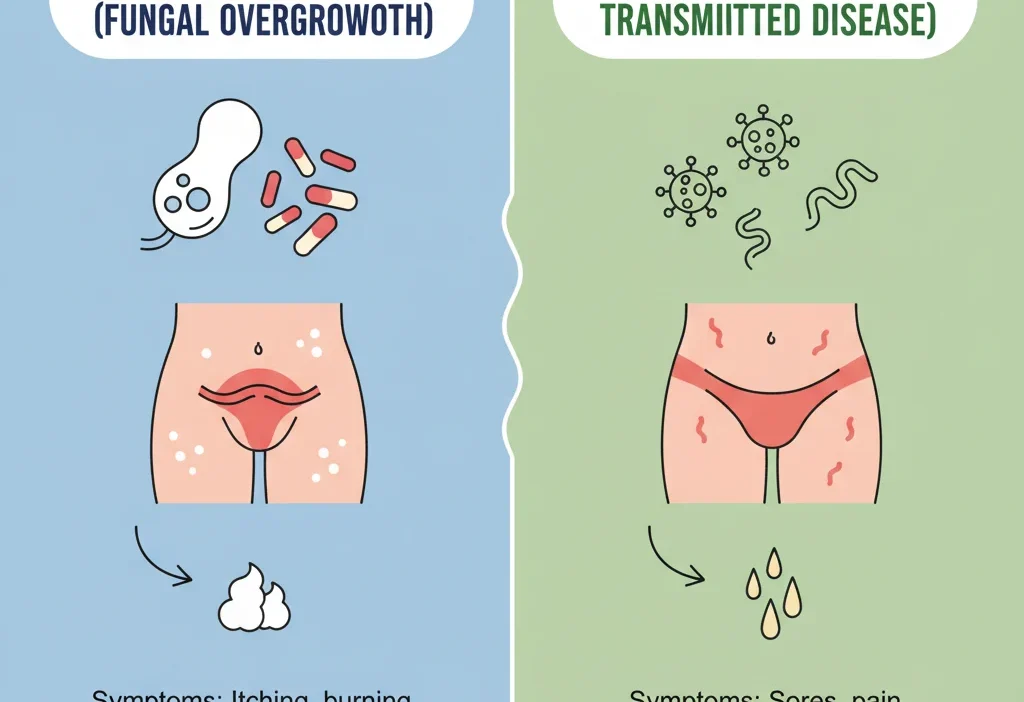
A yeast infection happens when a natural fungus in the body, called Candida, grows too much.
It often affects warm, moist areas like the vagina or genitals.
Part of speech: noun phrase
Simple meaning:
An overgrowth of yeast that causes itching, redness, burning, or thick white discharge.
Easy examples:
- “She got a yeast infection after taking antibiotics.”
- “Tight clothes and sweat can sometimes cause a yeast infection.”
- “The doctor said it was just a yeast infection, not an STD.”
Think of it like this: everyone has some yeast, but when it grows too much, it causes trouble — just like too much sugar in a recipe.
STD (Sexually Transmitted Disease)
An STD is a disease spread from one person to another through sexual contact.
It can be caused by bacteria, viruses, or parasites.
Part of speech: noun (abbreviation for “sexually transmitted disease”)
Simple meaning:
An infection passed through sexual activity that may cause symptoms like discharge, pain, sores, or burning.
Easy examples:
- “He went for a check-up because he thought he might have an STD.”
- “Using protection can help prevent STDs.”
- “Some STDs don’t show symptoms but still need treatment.”
The Key Difference Between Yeast Infection and STD
Here’s a simple table to understand how yeast infection and STD differ:
| Term | What It Means | How You Get It | Common Symptoms | Example Sentence |
|---|---|---|---|---|
| Yeast Infection | Fungal overgrowth (Candida) | Not usually sexually transmitted | Itching, burning, thick white discharge | “I think it’s a yeast infection, not an STD.” |
| STD | Disease spread by sexual contact | Through sexual activity | Sores, colored discharge, pain while urinating | “He tested positive for an STD.” |
Quick Tip to Remember:
👉 Yeast grows; STDs spread.
If it’s from fungus overgrowth, it’s a yeast infection.
If it’s passed between people, it’s an STD.
Common Mistakes and How to Avoid Them
❌ Mistake 1: Calling every infection an STD
Wrong: “I must have an STD because I feel itchy.”
Right: “It could be a yeast infection — not all infections are STDs.”
Why it happens:
People assume any irritation in private areas means an STD. But yeast infections are common and not always related to sexual activity.
❌ Mistake 2: Thinking partners always need treatment
Wrong: “If I have a yeast infection, my partner automatically needs medicine.”
Right: “A yeast infection isn’t always contagious, so the partner may not need treatment.”
Why it happens:
The word “infection” sounds like something you “catch,” but yeast infections usually come from imbalance inside your own body.
❌ Mistake 3: Ignoring testing because symptoms seem mild
Wrong: “It’s just a yeast infection; I don’t need a test.”
Right: “Some STDs look similar — testing helps to be sure.”
Why it happens:
Yeast infections and STDs can both cause discharge or itching, so it’s important to confirm what’s really happening.
When to Use “Yeast Infection”
You should use yeast infection when:
- The cause is an overgrowth of yeast, not sexual contact.
- There’s white, thick discharge and itching.
- Symptoms often appear after antibiotics, tight clothes, or dampness.
Example sentences:
- “After swimming all day, she got a yeast infection.”
- “The doctor said yeast infections are common in warm weather.”
- “I think the rash is from a yeast infection.”
- “Yeast infections often clear up with antifungal treatment.”
Memory Hack:
“Yeast = bread = grows.”
If it’s something that grows too much, think yeast infection.
When to Use “STD”
You should use STD when:
- The infection is spread by sexual activity.
- There’s unprotected sex or multiple partners.
- Symptoms include sores, unusual discharge, or strong odor.
Example sentences:
- “He got tested for STDs after noticing pain when urinating.”
- “Using condoms helps reduce STD risk.”
- “She had no symptoms but tested positive for an STD.”
- “STDs can affect both individuals”
Memory Hack:
“STD = Sexually Transmitted Disease.”
If sex spreads it, call it an STD.
Quick Recap: Yeast Infection vs STD
✅ Yeast Infection
- Caused by fungus
- Not usually spread by sex
- Common symptoms: itching, burning, thick discharge
✅ STD
- Spread through sexual contact
- Can be bacterial, viral, or parasitic
- May cause sores, colored discharge, or pelvic pain
Simple Rule:
If it’s caused by fungus → Yeast Infection
If it’s passed by people → STD
Advanced Tips
- Word origins:
- Yeast infection comes from “yeast,” the same fungus used in baking.
- STD was first called “venereal disease” (VD) in older English but later changed to STD for clarity.
- Formal writing:
In essays or reports, write “yeast infection (vaginal candidiasis)” or “sexually transmitted disease (STD)” the first time you use them. - Online writing tip:
Don’t use “STD” when you mean “yeast infection.” It can sound alarming or misleading. Use the correct term for accuracy and professionalism. - Health awareness:
Even though both cause discomfort, STDs are contagious and often require medical testing. Yeast infections can often be treated easily with antifungal creams or tablets.
Mini Quiz
Fill in the blanks with yeast infection or STD:
- After taking antibiotics, she got a ________.
- He was worried about a ________ after unprotected sex.
- White, thick discharge is often a sign of a ________.
- Blisters and sores can point to an ________.
- The doctor said it’s not an ________, it’s just a ________.
(Answers: 1. yeast infection, 2. STD, 3. yeast infection, 4. STD, 5. STD, yeast infection)
FAQs
1. Can a yeast infection be an STD?
No. Yeast infections are caused by fungus, not by sexual transmission.
2. Can men get yeast infections too?
Yes. Though less common, men can also have yeast infections on the genitals.
3. How can I tell if it’s an STD or a yeast infection?
If you’ve had recent sexual contact or symptoms like sores or colored discharge, get tested for STDs.
4. Do I need to see a doctor for a yeast infection?
If it’s your first time or symptoms keep coming back, yes. It’s best to confirm.
5. Can I treat a yeast infection at home?
Mild yeast infections often respond to antifungal creams or tablets, but always confirm before self-treating.
Conclusion
Now you know the clear difference between a yeast infection and an STD.
A yeast infection comes from fungus growing too much.
An STD is an infection passed from one person to another through sex.
Using the right term avoids confusion and helps you talk about health accurately.
Keep learning, keep asking questions, and remember — every small step makes your English (and understanding) stronger every day!

Oliver Thorne is a passionate digital storyteller and content strategist at WordContrast.com. With years of experience in SEO writing and online marketing, he specializes in transforming complex ideas into clear, engaging articles. Oliver loves exploring the latest trends in technology, productivity, and digital culture—helping readers stay informed and inspired in today’s fast-moving world.