Have you ever paused while writing and wondered — is it worshipped or worshiped? Don’t worry, you’re not alone! These two spellings look almost the same, and both sound exactly alike. Many people get confused when typing essays, emails, or even social media posts.
In this article, you’ll learn the difference between “worshipped” and “worshiped”, their correct usage, and how to remember the right one every time. By the end, you’ll understand not just how to spell it correctly, but also why both forms exist.
This simple, friendly guide makes it easy — even for beginners or young learners — to get it right every single time.
What Does Each Word Mean?
Both “worshipped” and “worshiped” come from the verb “worship,” which means to show great love, respect, or devotion to someone or something, often to God or a divine figure.
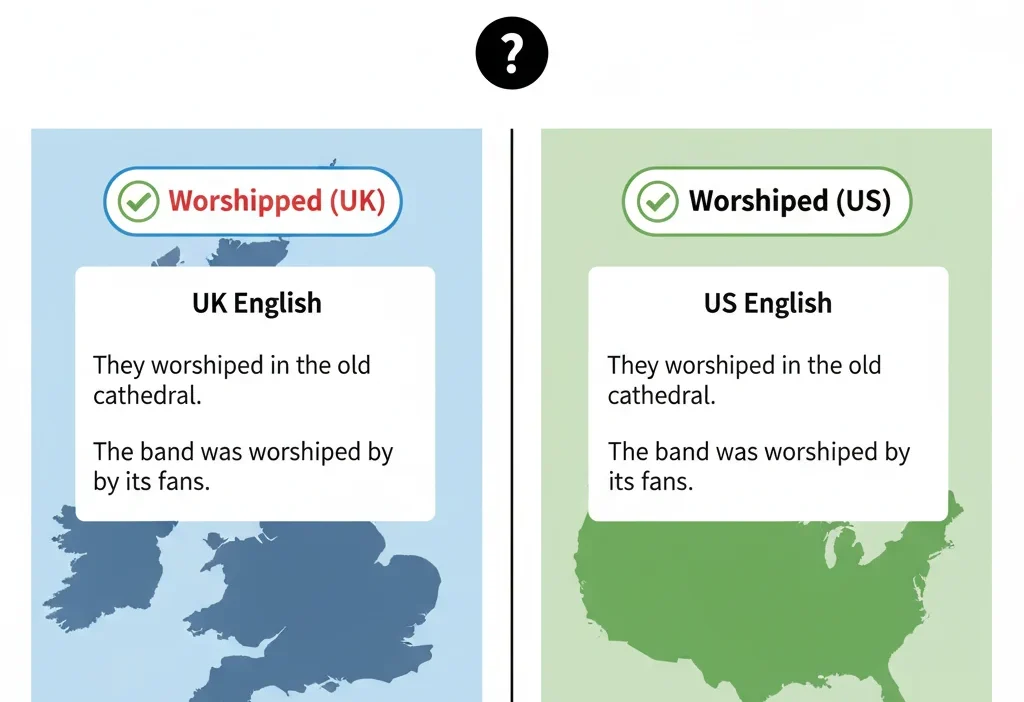
🟦 Worshipped (with double “p”)
- Meaning: The past tense and past participle of “worship” (used mainly in British English).
- Part of speech: Verb (past form).
Examples:
- The villagers worshipped the sun every morning.
- She worshipped her grandmother for her kindness.
- They worshipped together in the old church.
🟥 Worshiped (with single “p”)
- Meaning: Also the past tense of “worship,” but used in American English.
- Part of speech: Verb (past form).
Examples:
- The community worshiped at the new temple.
- He worshiped his teacher as a role model.
- Many people worshiped quietly from home.
💡 In short:
Both mean the same thing — the only difference is in spelling, not meaning or pronunciation.
The Key Difference Between Worshipped and Worshiped
Here’s a quick look at the main difference:
| Feature | Worshipped | Worshiped |
|---|---|---|
| Used In | British English | American English |
| Spelling Rule | Double the final “p” before adding “-ed” | Keep single “p” before adding “-ed” |
| Meaning | Same: past tense of worship | Same: past tense of worship |
| Example Sentence | They worshipped in silence. | They worshiped in silence. |
✅ Quick Tip to Remember:
If you write colour, favourite, or travelled, use worshipped (British English).
If you write color, favorite, or traveled, use worshiped (American English).
Common Mistakes and How to Avoid Them
Many learners mix up “worshipped” and “worshiped” because of English’s tricky spelling rules.
Let’s fix that confusion with a few examples.
| ❌ Incorrect | ✅ Correct | Explanation |
|---|---|---|
| We worshipped in the US church. | We worshiped in the US church. | American English uses single “p.” |
| She worshiped the gods of ancient Rome. | She worshipped the gods of ancient Rome. | British English doubles the “p.” |
| They worshipped their idols every Sunday (in an American context). | They worshiped their idols every Sunday (if writing for US readers). | Match spelling to your audience. |
💡 Grammar Tip:
Always match the spelling style of your entire text. Don’t mix British and American spellings in the same piece of writing.
When to Use “Worshipped”
Use “worshipped” if:
- You’re writing in British English.
- Your audience is from the UK, Australia, India, or other Commonwealth countries.
- You already use British spellings like favourite or travelled.
Examples:
- The monks worshipped at the temple at dawn.
- She worshipped her teacher’s wisdom.
- They worshipped quietly before the ceremony.
- The villagers worshipped rain gods for a good harvest.
- The king was worshipped as a hero.
🧠 Memory Hack:
Think of “double p” for “Proper British.” — That’s how you remember that worshipped belongs to British English!
When to Use “Worshiped”
Use “worshiped” if:
- You’re writing in American English.
- Your readers are from the United States or Canada.
- You use other American spellings like color, honor, or traveled.
Examples:
- They worshiped together at church.
- The poet worshiped the beauty of nature.
- People worshiped at home during the holidays.
- He worshiped his parents deeply.
- The artist worshiped creativity itself.
🧠 Memory Trick:
“One p” for “US” — simple, short, and easy, just like American spelling!
Quick Recap: Worshipped vs Worshiped
Here’s everything in a nutshell:
- Both mean the same thing — the past tense of “worship.”
- Worshipped = British English (double “p”)
- Worshiped = American English (single “p”)
- Choose one style and stay consistent throughout your writing.
- Pronunciation = same for both.
✅ Summary:
- UK readers: write worshipped
- US readers: write worshiped
Advanced Tips
- Origin: The word “worship” comes from Old English weorthscipe, meaning “worthiness” or “honor.”
- In formal writing: Always match the spelling style of your essay or publication (British or American).
- In texting or online posts: Either is acceptable, but staying consistent makes your writing look professional.
- In exams or official documents: Check which spelling system your school or exam board follows (e.g., IELTS = British English, TOEFL = American English).
Mini Quiz: Test Your Understanding
Fill in the blanks with the correct form — worshipped or worshiped.
- The ancient people __________ the sun and the moon.
- In Britain, it’s usually written as __________.
- Americans often use the shorter spelling, __________.
- She __________ her mother’s patience and kindness.
- The villagers __________ their local deity every week.
(✅ Answers: 1. worshiped / worshipped (both correct), 2. worshipped, 3. worshiped, 4. worshiped/worshipped, 5. worshipped)
FAQs
1. Which is correct: worshipped or worshiped?
Both are correct. Worshipped is British English; worshiped is American English.
2. Is there any difference in meaning?
No. They have the exact same meaning and pronunciation.
3. Why does British English double the “p”?
British English doubles the consonant when adding “-ed” to verbs ending in a short vowel + consonant (like worship → worshipped).
4. Can I use both forms in one text?
It’s best not to. Choose one style (British or American) and stay consistent.
5. Which spelling is used in exams like IELTS or TOEFL?
IELTS prefers British English (worshipped), while TOEFL prefers American English (worshiped).
Conclusion
Now you know the clear difference between worshipped and worshiped — it’s all about location, not meaning!
Whether you choose the British or American version, both are correct as long as you stay consistent in your writing.
Keep practicing, notice which spelling your country or school uses, and soon this will feel natural.
Remember: English isn’t about perfection — it’s about progress.

Oliver Thorne is a passionate digital storyteller and content strategist at WordContrast.com. With years of experience in SEO writing and online marketing, he specializes in transforming complex ideas into clear, engaging articles. Oliver loves exploring the latest trends in technology, productivity, and digital culture—helping readers stay informed and inspired in today’s fast-moving world.