English can be tricky — especially when two words look almost the same but mean completely different things. One such confusing pair is “wont” and “won’t.”
Many people mix them up because they sound similar and differ by just one tiny letter. However, the meanings are totally different!
In this guide, you’ll learn:
- What “wont” and “won’t” really mean
- How to use each one correctly in sentences
- Simple tricks to remember the difference
- Common grammar mistakes and how to avoid them
By the end, even a 4th grader will be able to confidently choose the right word every time. Let’s make English simple — together!
💡 What Does Each Word Mean?
Let’s start by understanding both words clearly.
1. “Won’t” – The Contraction
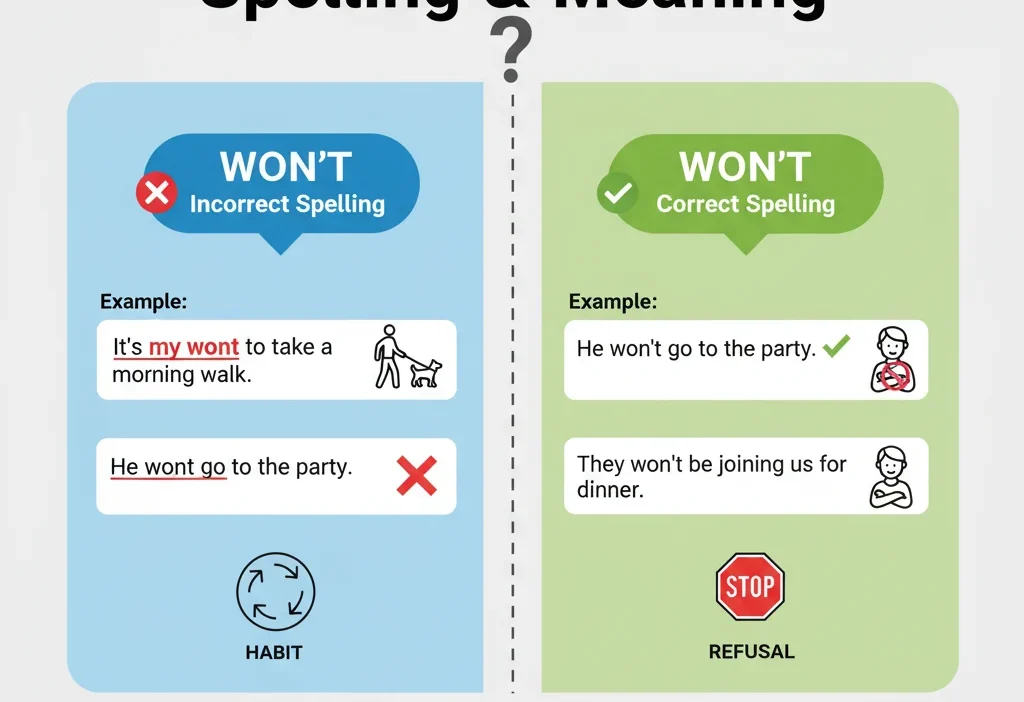
“Won’t” is a contraction (a shortened form) of “will not.”
It’s used when you want to say that someone refuses or doesn’t plan to do something in the future.
Part of Speech: Auxiliary verb (helping verb)
Meaning: Will not / Refuses to / Not going to happen
Examples:
- I won’t go to school today. (= I will not go to school today.)
- She won’t eat vegetables. (= She refuses to eat vegetables.)
- It won’t rain this evening. (= It will not rain.)
✅ Simple Trick:
“Won’t” always has an apostrophe (’) because it’s short for “will not.”
2. “Wont” – The Habit
“Wont” (without the apostrophe) is an old-fashioned word that means “a habit” or “something you usually do.”
Part of Speech: Noun or adjective
Meaning: Custom, habit, usual behavior
Examples:
- She woke up early, as was her wont. (= as she usually did.)
- He smiled, as was his wont, when he saw his friends.
- The teacher, wont to start early, arrived before everyone else.
✅ Simple Trick:
“Wont” = “Habit.”
Think of “W” for “Way” — it’s the way you usually do things.
⚖️ The Key Difference Between “Wont” and “Won’t”
Here’s a quick and easy comparison table:
| Feature | Wont | Won’t |
|---|---|---|
| Part of Speech | Noun / Adjective | Contraction (verb phrase) |
| Meaning | Habit, usual behavior | Will not |
| Apostrophe? | ❌ No | ✅ Yes |
| Example | She reads every night, as was her wont. | She won’t read tonight. |
| Tone | Old-fashioned or formal | Everyday modern English |
🧠 Quick Tip to Remember
If it has an apostrophe (’) → It’s “won’t.”
If it talks about habit → It’s “wont.”
🚫 Common Mistakes and How to Avoid Them
Let’s look at some common errors people make:
| ❌ Wrong | ✅ Correct | 💬 Why |
|---|---|---|
| She won’t to go. | She won’t go. | “Won’t” already means “will not.” Don’t add “to.” |
| As was her won’t, she smiled. | As was her wont, she smiled. | “Wont” means “habit,” not “will not.” |
| I am wont go. | I won’t go. | “Wont” doesn’t mean “will not.” Use “won’t.” |
How to Avoid Mistakes
- Always check for the apostrophe.
- Ask yourself: “Am I talking about refusing something (use won’t) or a habit (use wont)?”
- In most modern writing, you’ll use “won’t” far more often than “wont.”
✏️ When to Use “Won’t”
Use “won’t” when you mean “will not.”
It’s used for:
- Talking about the future
- Showing refusal
- Making negative promises
Examples:
- I won’t forget your birthday.
- He won’t eat spicy food.
- My car won’t start.
- They won’t believe this story!
- The teacher won’t allow phones in class.
Real-Life Example:
If your mom says, “I won’t buy you ice cream if you don’t finish dinner,” she means she will not — it’s a promise (or a warning!).
🧠 Memory Hack:
Remember “won’t” = will not.
The apostrophe replaces the missing “o” in “not.”
📚 When to Use “Wont”
Use “wont” when you’re talking about a habit or usual way someone behaves.
It’s often used in formal or literary writing, not daily speech.
Examples:
- She checked her phone, as was her wont.
- He greeted everyone warmly, as was his wont.
- The king, wont to rise early, began his day at dawn.
- It rained again, as was the weather’s wont.
- The old man took his walk every morning, as was his wont.
Memory Trick:
Think: Wont = Way (of doing something).
If you replace “wont” with “habit” and it still makes sense, you’re right!
🔁 Quick Recap: Wont vs Won’t
Here’s an easy summary to remember:
- ✅ “Won’t” = “Will not.” (Refusal or future negative)
- ✅ “Wont” = “Habit.” (Old-fashioned way of saying “usual behavior”)
- ❗ Apostrophe = Modern word “won’t.”
- ❗ No apostrophe = Old word “wont.”
In One Line:
“Won’t” shows what you won’t do, and “wont” shows what you usually do.
🎓 Advanced Tips (For Curious Learners)
- Origin:
- “Won’t” comes from Old English “wynnot” → “will not.”
- “Wont” comes from the old verb “wonen,” meaning “to be used to.”
- Modern Usage:
“Wont” is rarely used in daily conversation now. You’ll mostly see it in books, literature, or formal essays. - In Writing:
Use “won’t” in everyday writing, texting, or speech.
Use “wont” if you’re writing something poetic, historical, or literary. - In Exams or Essays:
Using “won’t” is acceptable and common.
Only use “wont” if you’re sure it fits the formal or descriptive tone.
🧩 Mini Quiz: Test Yourself!
Fill in the blanks with “wont” or “won’t.”
- She ________ come to the party if it rains.
- As was his ________, he drank tea before bed.
- I ________ eat junk food anymore.
- The teacher, as was her ________, arrived early.
- He ________ stop until he finishes the work.
- She smiled, as was her ________, when she saw the gift.
- They ________ believe such a silly rumor!
(Answers: 1. won’t, 2. wont, 3. won’t, 4. wont, 5. won’t, 6. wont, 7. won’t)
📜 FAQs About Wont vs Won’t
1. What is the difference between wont and won’t?
→ “Won’t” means “will not,” while “wont” means “habit” or “usual behavior.”
2. Is “wont” still used today?
→ Rarely. It’s mostly found in older or literary writing.
3. Does “won’t” always have an apostrophe?
→ Yes! It’s a contraction, so the apostrophe is necessary.
4. Can “wont” be used as a verb?
→ No. It’s used as a noun (“her wont”) or adjective (“he is wont to do that”).
5. Which is more common: wont or won’t?
→ “Won’t” is far more common in modern English.
🌈 Conclusion
Now you know the clear difference between “wont” and “won’t.”
- Use “won’t” for “will not.”
- Use “wont” for “habit.”
Keep an eye on the apostrophe — it’s the key to knowing which one to use!
With practice, you’ll never confuse them again. Remember: every small step improves your English confidence.

Celeste Rowan is a creative writer and editor at WordContrast.com, crafting compelling stories across topics like motivation, education, and personal development. She combines a warm narrative voice with data-driven insight to make her writing both relatable and reliable. Celeste believes words can spark change—and she writes to make that change happen.