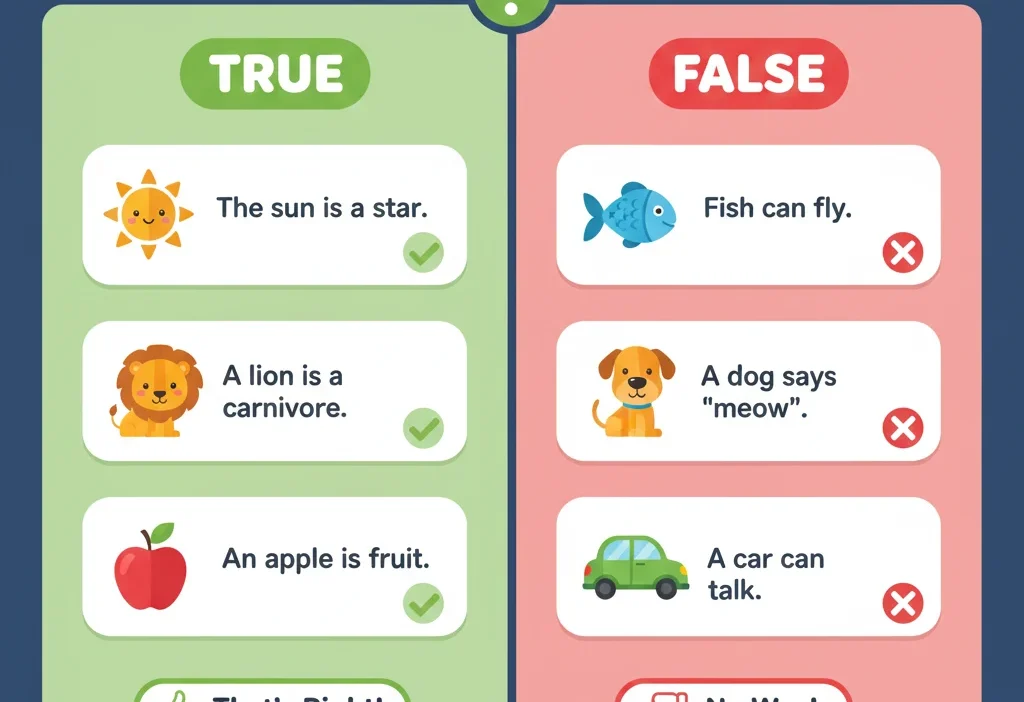
“True or false questions for kids” are one of the most common ways to test knowledge in schools and at home. Yet, many people get confused about how to make or answer them correctly. Are these questions easy? Yes! But the trick is understanding the words true and false, knowing when to use them, and avoiding common mistakes.
In this guide, you’ll learn the simple meaning of true and false, see clear examples, discover common errors, and get tips for creating your own questions. By the end, even beginners or young learners will feel confident using them. Let’s make learning fun and simple!
What Does Each Word Mean?
True
- Meaning: Something that is correct, real, or a fact.
- Part of Speech: Adjective
- Examples:
- The sun rises in the east. → True
- Cats can fly. → False
- Water is wet. → True
False
- Meaning: Something that is wrong, incorrect, or not real.
- Part of Speech: Adjective
- Examples:
- Dogs can talk. → False
- The Earth is flat. → False
- Fire is cold. → False
Tip: Think of true as “correct fact” and false as “wrong fact.”
The Key Difference Between True and False
| Feature | True | False |
|---|---|---|
| Meaning | Correct, real, fact | Wrong, not real, incorrect |
| Usage | To confirm facts | To deny facts |
| Example Sentence | The sky is blue. → True | The sky is green. → False |
Quick Tip: True = ✔️, False = ❌
Common Mistakes and How to Avoid Them
- Incorrect: The moon is made of cheese. → True
Correct: The moon is made of cheese. → False
Why: People sometimes guess or misread the fact. Always check carefully. - Incorrect: Fish can live out of water. → True
Correct: Fish can live out of water. → False
Why: Remember, “true” is only for correct facts.
When to Use True
- Use true when confirming a fact or correct statement.
- Examples:
- My name is Anna. → True
- Summer comes after spring. → True
- 2 + 2 = 4. → True
- Birds have wings. → True
- The sky is blue. → True
Memory Hack: Think “True = Truth.”
When to Use False
- Use false when pointing out an incorrect statement.
- Examples:
- Elephants can fly. → False
- Ice is hot. → False
- Cats bark. → False
- The sun sets in the north. → False
- Fish walk on land. → False
Visual Trick: False statements are “❌” or wrong facts.
Quick Recap: True vs False
- True: Correct fact ✔️, can be used in school quizzes or everyday statements.
- False: Incorrect fact ❌, always double-check before marking true or false.
- Use these tips to avoid mistakes and confidently create questions for kids.
Advanced Tips
- Origin: “True” comes from Old English triewe (faithful, trustworthy), “false” from fals (deceptive).
- Formal Writing: True or false questions are common in exams, worksheets, and educational games.
- Online Usage: Misusing true or false in texting can confuse others, so always be clear.
Mini Quiz
Fill in the blanks with true or false:
- The sun sets in the west. → ___
- Fish can talk. → ___
- 5 + 3 = 8. → ___
- Trees can move. → ___
- Water boils at 100°C. → ___
FAQs
- What are true or false questions for kids?
Questions where kids choose if a statement is correct (true) or incorrect (false). - Why are true or false questions important?
They help test knowledge quickly and improve reading comprehension. - How do I create a true or false question?
Write a statement, then decide if it’s fact (true) or not (false). - Can kids get confused with true or false questions?
Yes, especially with tricky or similar statements. Always explain clearly. - Are true or false questions only for school?
No, they can be fun games at home, in quizzes, or learning apps.
Conclusion
Now you understand true or false questions for kids clearly. You can confidently make and answer statements, avoid common mistakes, and even teach others. Practice often, use simple examples, and soon marking true or false will become second nature. Keep learning, and enjoy improving your English every day!

Oliver Thorne is a passionate digital storyteller and content strategist at WordContrast.com. With years of experience in SEO writing and online marketing, he specializes in transforming complex ideas into clear, engaging articles. Oliver loves exploring the latest trends in technology, productivity, and digital culture—helping readers stay informed and inspired in today’s fast-moving world.