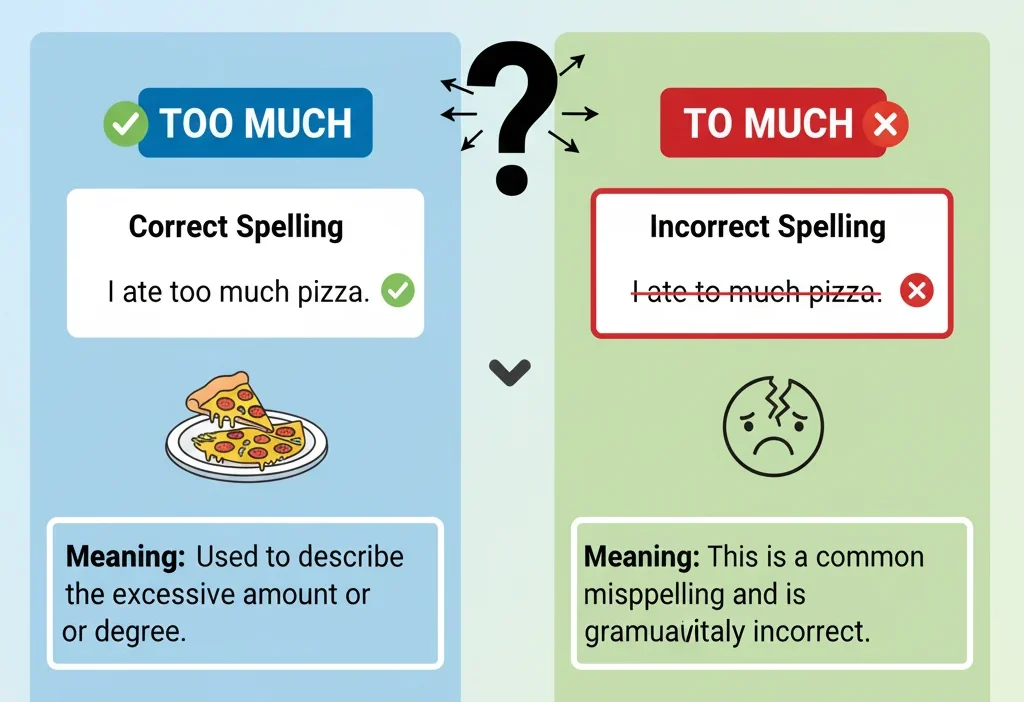
Have you ever typed “to much” and wondered if it looked right? You’re not alone!
Many people — even native English speakers — confuse “too much” and “to much.” They sound almost the same, but only one of them is correct.
In this simple guide, you’ll learn:
- The meaning of too much and why to much is a mistake.
- The difference between them with examples.
- How to remember the correct form every time.
💬 What Does Each Word Mean?
Let’s break it down step-by-step.
✅ “Too Much” — Correct Phrase
Meaning:
“Too much” means more than what is needed or an excessive amount of something.
- Part of Speech:
It’s made of two parts:
- Too – an adverb meaning “more than enough” or “excessively.”
- Much – a determiner referring to a large quantity (usually of uncountable nouns).
Examples:
- She ate too much chocolate. 🍫
- There is too much noise in this room.
- He works too much and never rests.
👉 In short: “Too much” describes something that’s more than it should be.
❌ “To Much” — Incorrect Phrase
Meaning:
The phrase “to much” is always incorrect in English.
It happens because people confuse the words “to” and “too.”
Why it’s wrong:
- “To” is a preposition (shows direction, purpose, or action).
- “Much” is a quantifier (describes quantity).
They do not work together grammatically in this form.
Incorrect examples:
- ❌ She talks to much.
- ❌ I have to much homework.
- ❌ It’s to much for me.
Corrected versions:
✅ She talks too much.
✅ I have too much homework.
✅ It’s too much for me.
⚖️ The Key Difference Between “Too Much” and “To Much”
| Aspect | Too Much (✅ Correct) | To Much (❌ Incorrect) |
|---|---|---|
| Meaning | More than enough; excessive | No meaning; grammatically wrong |
| Part of Speech | “Too” = adverb, “Much” = quantifier | “To” = preposition (wrong usage) |
| Example | She spends too much time online. | ❌ She spends to much time online. |
| Used With | Uncountable nouns (money, water, sugar) | Never used |
| Tip | If you mean “excessive,” use too | Never use “to” with “much” |
💡 Quick Tip to Remember:
“Too” has an extra ‘o’ — think of it as “too much of something extra!”
❗ Common Mistakes and How to Avoid Them
Many learners write “to much” because “to” and “too” sound alike.
Here are common mistakes and how to fix them:
| Wrong Sentence | Correct Sentence | Why? |
|---|---|---|
| I ate to much pizza. | I ate too much pizza. | “Too” means excessive. |
| She talks to much. | She talks too much. | “Too” modifies how much she talks. |
| It’s to much work! | It’s too much work! | “To much” is not a valid phrase. |
👉 Memory Hack:
If you mean “a lot” or “more than enough,” always use too with two “o’s.”
Think: OO = Overload!
🕐 When to Use “Too Much”
Use “too much” when talking about something that is excessive, over the limit, or more than comfortable.
Examples:
- You put too much sugar in the tea. ☕
- She spends too much money on clothes. 👗
- Don’t eat too much junk food. 🍔
- He worries too much about small things.
- That movie was too much for me — it made me cry!
In short:
👉 Use too much to talk about something that’s more than necessary or healthy.
🚫 When to Use “To Much”
Never! ❌
There’s no situation in English where “to much” is grammatically correct.
If you find yourself writing it, stop and check:
You probably meant “too much.”
📋 Quick Recap: Too Much vs To Much
- ✅ Too much = correct (means excessive or more than needed)
- ❌ To much = incorrect (never used)
🧠 Easy Rules to Remember
- “Too” means extra or more than enough.
- “To” means direction or purpose.
- If you mean excessive, always pick too with double “o.”
🧾 Examples Recap
- Correct: He drinks too much coffee.
- Wrong: He drinks to much coffee.
- Correct: Don’t spend too much time online.
- Wrong: Don’t spend to much time online.
💡 Advanced Tips
1. Word Origins
- “Too” comes from Old English tō, meaning “in excess.”
- “To” comes from the same root but means “toward” or “in direction of.”
Over time, “too” became the adverb form used for excess.
2. Formal Writing Tip
In essays, reports, or exams, use “too much” carefully — it’s informal.
In academic writing, you can often replace it with:
- “an excessive amount of”
- “more than necessary”
Example:
Formal → “The study found an excessive amount of data errors.”
Informal → “There were too much errors.” ❌
3. Texting and Online Use
People often type “to much” online out of speed or habit.
But remember — even in casual writing, “too much” is the right choice!
🧩 Mini Quiz: Test Yourself!
Fill in the blanks with too much or to much:
- She drinks _______ coffee every morning.
- Don’t put _______ salt in the soup.
- He talks _______ during class.
- That movie was _______ for me.
- You spend _______ time on your phone.
✅ Answers: 1) too much, 2) too much, 3) too much, 4) too much, 5) too much
❓ FAQs: Too Much or To Much
1. Which is correct — too much or to much?
✅ Too much is correct. To much is always wrong.
2. What does “too much” mean?
It means more than enough or excessive.
3. Can I say “to much” in any case?
No. English never uses to much.
4. What’s the difference between “too” and “to”?
Too means “also” or “more than enough.”
To shows direction or purpose.
5. Is “too much” formal or informal?
It’s mostly informal but fine in conversation or friendly writing.
🌟 Conclusion
Now you know the clear difference between too much and to much!
Remember, “too much” means something is more than enough, while “to much” doesn’t exist in English grammar.
Next time you write or speak, think of the extra “o” in too as meaning “extra amount.”
Keep practicing — because every small grammar fix makes your English stronger! 💪

Celeste Rowan is a creative writer and editor at WordContrast.com, crafting compelling stories across topics like motivation, education, and personal development. She combines a warm narrative voice with data-driven insight to make her writing both relatable and reliable. Celeste believes words can spark change—and she writes to make that change happen.