If you’ve ever mixed up “to” and “too,” you’re not alone! These two small words sound the same but mean very different things. English learners — and even native speakers — often get confused about when to use to and when to use too.
In this guide, you’ll learn:
- The meanings of to and too
- The difference between them
- Simple examples anyone can understand
- Grammar tips to help you remember easily
By the end, you’ll never mix them up again. Let’s make English simple together!
📘 What Does Each Word Mean?
Let’s start with the basics — what each word actually means.
What Does “To” Mean?
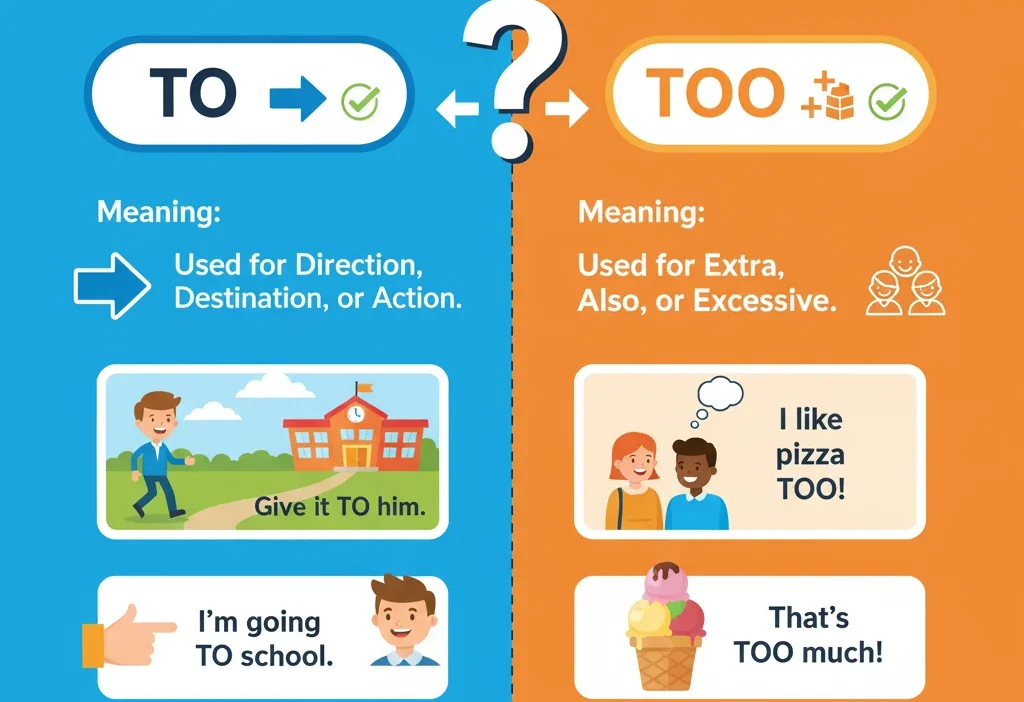
“To” is one of the most common words in English. It’s a preposition that usually shows direction, purpose, or relationship.
Think of to as a little arrow 🚀 — it shows movement or connection.
Meaning of “to”:
Used to show direction (“go to school”), purpose (“listen to music”), or an infinitive verb (“to run,” “to eat”).
✅ Examples of “to”:
- I’m going to the park.
- She wants to learn English.
- Please give this to your teacher.
👉 Quick story: Imagine you have a gift. You walk to your friend and hand it to them. That’s what to does — it connects one thing to another!
What Does “Too” Mean?
“Too” is an adverb, and it means “also” or “more than enough.”
Think of too as a word that adds extra — either more people, things, or quantity.
Meaning of “too”:
Used to mean also or excessively.
✅ Examples of “too”:
- I like ice cream too. (also)
- It’s too hot today! (more than enough)
- That bag is too heavy for me.
👉 Quick tip: If you can replace the word with also or very, then use too.
⚖️ The Key Difference Between “To” and “Too”
Here’s a simple comparison to help you remember forever:
| Feature | To | Too |
|---|---|---|
| Part of Speech | Preposition | Adverb |
| Main Meaning | Shows direction or purpose | Means also or more than enough |
| Example 1 | I’m going to school. | I’m going to school too. |
| Example 2 | Give it to him. | That’s too much! |
| Example 3 | She likes to dance. | It’s too cold today. |
💡 Quick Tip to Remember:
If it means movement or purpose, use to.
If it means also or very, use too (with two o’s — because it has too much of “o”!).
❌ Common Mistakes and How to Avoid Them
Even fluent speakers mix these up! Let’s fix some common errors.
| ❌ Wrong Sentence | ✅ Correct Sentence | 💬 Why It’s Wrong |
|---|---|---|
| I’m going too school. | I’m going to school. | “To” shows direction. |
| That’s to expensive! | That’s too expensive! | “Too” means “very” here. |
| She likes too sing. | She likes to sing. | The infinitive form uses “to.” |
🧠 Tip:
If your sentence talks about movement, purpose, or an action verb — it’s to.
If it shows “extra” or “also” — it’s too.
🧭 When to Use “To”
Use to when you are:
- Showing direction
- Indicating purpose
- Talking about infinitive verbs (to + verb)
✅ Examples:
- I’m traveling to London.
- She came to help us.
- He wants to play football.
- Send the message to your brother.
- Let’s go to the zoo.
💡 Memory Hack:
Think of to as an arrow (→) that points where you’re going or what you’re doing.
🌈 When to Use “Too”
Use too when you want to say:
- “Also” or “as well”
- “More than needed” or “excessively”
✅ Examples:
- I love that song too.
- It’s too cold to go outside.
- He ate too many cookies.
- Can I come too?
- This bag is too heavy for me.
💡 Memory Hack:
Remember: “Too” has too many O’s! It means “extra” — extra hot, extra big, extra included.
🧩 Quick Recap: To vs Too
Here’s an easy summary you can memorize:
- To → Direction or purpose (Go to school, Want to eat)
- Too → Also or excessive (Me too, Too much sugar)
- Trick: If it feels like extra, it’s too. If it feels like going somewhere, it’s to.
✅ Mini Chart:
| Use | Word | Example |
|---|---|---|
| Direction | to | Go to bed |
| Purpose | to | She wants to help |
| Also | too | I want pizza too |
| Excess | too | That’s too loud! |
📘 Advanced Tips: Formal & Writing Use
Even in essays or professional writing, the same rules apply.
- Always check if your sentence means movement/purpose (to) or extra/also (too).
- Avoid using too in formal writing when you can use very instead (e.g., It’s too expensive → It’s very expensive).
- In texting, people often forget one “o” in too — but remember, one “o” changes the meaning completely!
🧠 Mini Quiz: Test Yourself!
Fill in the blanks with to or too.
- I want ___ learn English.
- That dress is ___ long for me.
- Can I come ___?
- We’re going ___ the library.
- It’s ___ cold outside today.
- Give this book ___ Sara.
- He eats ___ many chocolates!
(Answers: 1. to, 2. too, 3. too, 4. to, 5. too, 6. to, 7. too)
❓ FAQs
1. What is the main difference between “to” and “too”?
“To” shows direction or purpose, while “too” means also or excessively.
2. Can I use “too” instead of “to”?
No. They sound the same but mean very different things. Mixing them changes the meaning completely.
3. How do I remember the difference easily?
Think of “too” as having “too many O’s,” showing something extra.
4. What part of speech are they?
“To” is a preposition, and “too” is an adverb.
5. Why do people confuse them?
Because they sound exactly the same (homophones), even though their meanings are different.
🏁 Conclusion
Now you know the real difference between to and too!
- To is for direction, purpose, or action.
- Too is for “also” or “extra.”
Practice using them in your daily sentences. The more you write and read, the more natural it will feel. Keep learning — every small step makes your English stronger! 🌟

Oliver Thorne is a passionate digital storyteller and content strategist at WordContrast.com. With years of experience in SEO writing and online marketing, he specializes in transforming complex ideas into clear, engaging articles. Oliver loves exploring the latest trends in technology, productivity, and digital culture—helping readers stay informed and inspired in today’s fast-moving world.