Do you ever get confused about whether to use then or than? You’re not alone! These two tiny words look similar and sound almost the same, but they have completely different meanings and uses.
In this simple guide, we’ll learn:
- What then and than really mean,
- The difference between them,
- Easy examples and quick tips to remember the right one.
By the end, you’ll never mix them up again — even if English grammar usually feels tricky. Let’s make it simple!
📖 What Does Each Word Mean?
1. “Then” – Time or Order
Part of speech: Adverb (sometimes noun or adjective)
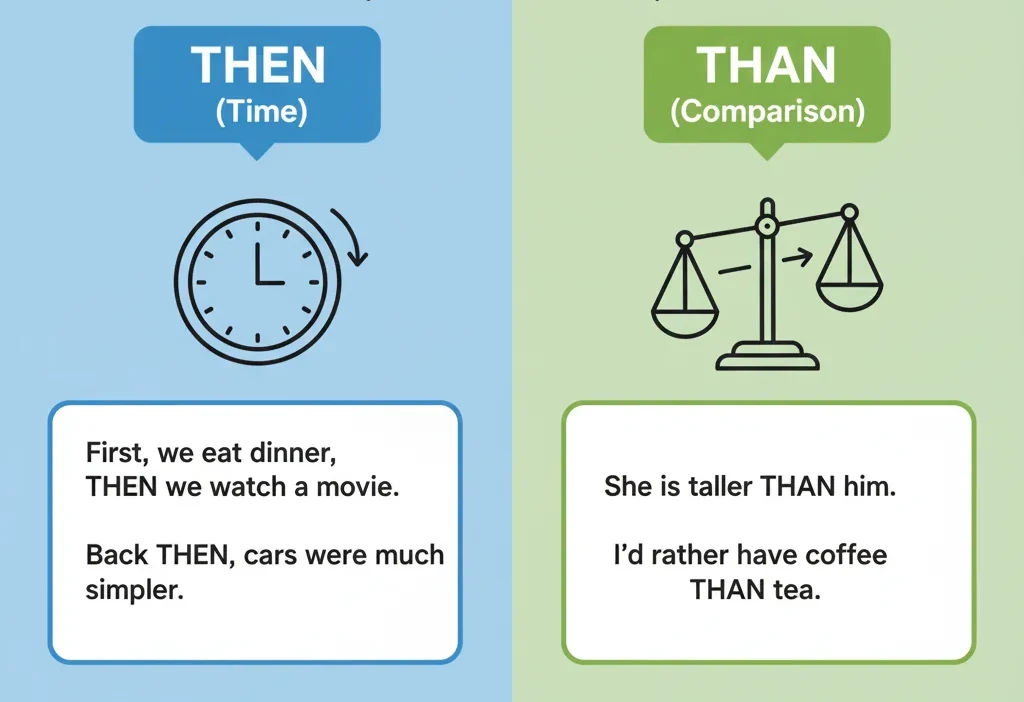
Meaning: “Then” tells us when something happened or what comes next in time or order.
Think of then as the time word — it connects events in sequence.
Examples:
- I finished my homework, then I watched TV.
- If you study, then you’ll pass the test.
- Back then, we didn’t have smartphones.
👉 Quick Story:
Imagine you’re baking cookies — first you mix the dough, then you bake it. “Then” helps you tell what happens next.
2. “Than” – Comparison
Part of speech: Conjunction (sometimes preposition)
Meaning: “Than” is used when we compare two things — one is more, less, bigger, smaller, or different than another.
Think of than as the comparison word.
Examples:
- My bag is heavier than yours.
- She runs faster than her brother.
- This movie is better than the last one.
👉 Quick Story:
When you compare two friends — “Ali is taller than Sara” — you’re using than to show a difference.
⚖️ The Key Difference Between Then and Than
| Feature | Then | Than |
|---|---|---|
| Meaning | Refers to time, sequence, or result | Used for comparison |
| Part of Speech | Adverb, sometimes noun/adjective | Conjunction or preposition |
| Question it Answers | When? What happens next? | Which one? How different? |
| Example | We ate dinner, then went for a walk. | She is taller than me. |
| Memory Tip | “Then = Time” | “Than = Comparison” |
💡 Quick Tip to Remember:
If you’re talking about time, use then.
If you’re making a comparison, use than.
60+Church Trunk or Treat Ideas: Faith-Based Inspiration 2025
❌ Common Mistakes and How to Avoid Them
Many people mix these up because they sound similar. Let’s fix that!
| ❌ Wrong Sentence | ✅ Correct Sentence | 💬 Why It’s Wrong |
|---|---|---|
| I’m older then you. | I’m older than you. | You’re comparing ages — use “than.” |
| First we’ll eat, than we’ll play. | First we’ll eat, then we’ll play. | You’re talking about time — use “then.” |
| She’s smarter then me. | She’s smarter than me. | “Smarter” is a comparison word. |
👉 Fix Tip:
If your sentence includes words like more, less, better, faster, older, you almost always need than.
🕓 When to Use “Then”
Use then when:
- Talking about time or order of events
- Showing a result (if… then…)
- Referring to the past time
Examples:
- I woke up early, then made breakfast.
- If you’re ready, then let’s go.
- We lived in London back then.
- Study hard, and then you’ll succeed.
- He looked around, then smiled.
🧠 Memory Hack:
“Then” sounds like “when.”
If your sentence answers when, use then.
⚖️ When to Use “Than”
Use than when:
- You’re comparing two people, things, or ideas.
- Using comparative adjectives (better, older, more, less, etc.)
Examples:
- My house is bigger than yours.
- She’s kinder than before.
- This book is more interesting than that one.
- I’d rather walk than take the bus.
- He’s taller than his father.
🧠 Memory Hack:
“Than” rhymes with “compare.”
If your sentence compares, use than.
🔁 Quick Recap: Then vs Than
✅ Then
- Talks about time or order
- Means next, after that, or at that time
- Example: “We’ll go to the park, then get ice cream.”
✅ Than
- Used for comparisons
- Means in contrast to or compared with
- Example: “Ice cream is better than cake.”
💡 Easy Trick to Remember:
“If it’s about when, use then.
If it’s about compare, use than.”
📚 Advanced Tips
- Origin:
- “Then” comes from Old English thanne, meaning “at that time.”
- “Than” comes from thanne too but evolved to show comparison.
- That’s why they look similar today!
- In formal writing:
Always double-check “then” vs “than” in essays, emails, or exams — a single letter can change the meaning completely. - In texting or online chats:
People often type “then” instead of “than” because phones autocorrect. Always reread before sending!
🧩 Mini Quiz: Test Your Understanding
Fill in the blanks with then or than:
- I’d rather eat pizza _____ burgers.
- First we’ll shop, _____ we’ll go home.
- This bag is heavier _____ that one.
- If you’re done, _____ submit your homework.
- She’s taller _____ her sister.
- Back _____, we had no internet.
- He’s more patient _____ I expected.
(Answers: 1. than, 2. then, 3. than, 4. then, 5. than, 6. then, 7. than)
❓ FAQs About “Then” and “Than”
1. What is the main difference between “then” and “than”?
👉 “Then” is about time, while “than” is for comparison.
2. Can I use “than” to show time?
❌ No. Only “then” talks about time or order.
3. Is “than me” or “than I” correct?
Both can be correct! “She’s taller than me” (informal). “She’s taller than I” (formal).
4. Why are “then” and “than” confusing?
They sound similar and differ by one letter, so people often mix them up while writing.
5. How can I remember the difference easily?
Remember: “Then = Time” and “Than = Comparison.”
Now you know the clear difference between then and than!
🎯 Conclusion
- Use then for time or sequence.
- Use than for comparisons.
With a little practice, you’ll never hesitate again. Keep reading, writing, and practicing — every small step makes your English stronger and more confident.

Henry Vale is a tech-savvy content creator at WordContrast.com, known for his in-depth guides and how-to articles. With a background in digital media and a passion for innovation, Henry focuses on simplifying technology for everyday users. His mission is to empower readers with clear, actionable knowledge they can use to improve their digital lives.