
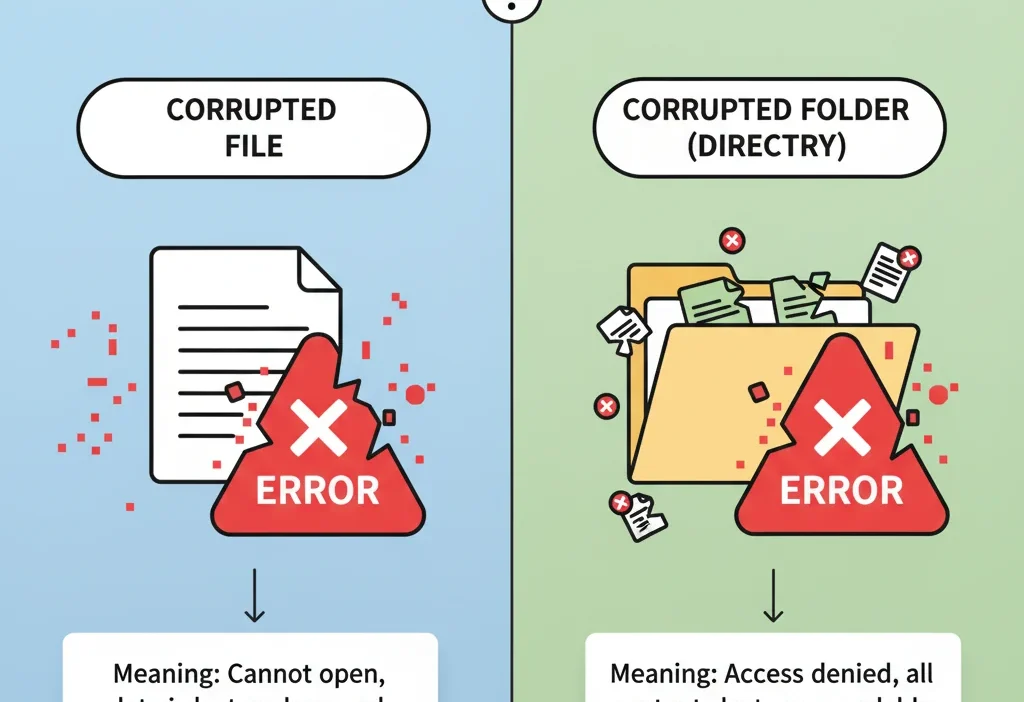
Have you ever seen the scary message on your screen that says: “The file or directory is corrupted and unreadable”?
It’s a common Windows error, but it often confuses people. What exactly is a file? What is a directory? And why are they called corrupted or unreadable?
Don’t worry — you’re not alone! Many computer users, especially beginners, see this message and panic. But the truth is, understanding it is easier than you think.
In this simple guide, we’ll explain:
- What “file” and “directory” mean,
- What “corrupted” and “unreadable” mean in plain English,
- The difference between a file and a directory,
- Why this message appears, and
- How to use these terms correctly (with examples anyone can understand).
By the end, you’ll know exactly what’s going on when you see this message — and what to do next.
💾 What Does Each Word Mean?
Before we understand the full message, let’s break it into parts: file, directory, corrupted, and unreadable.
🔹 What Is a File?
A file is like a digital piece of paper where information is stored.
It can be a picture, a song, a video, a document, or even a game.
- Part of speech: Noun
- Meaning: A container that holds data on your computer.
- Examples:
- “I saved my school project as a Word file.”
- “This photo file is too big to send.”
- “My video file won’t open properly.”
💡 Quick Tip: Think of a file as a single item — like one book in a library.
🔹 What Is a Directory?
A directory (also called a folder) is a place that holds many files.
It’s used to organize your computer’s data neatly.
- Part of speech: Noun
- Meaning: A storage location that contains files or other folders.
- Examples:
- “All my photos are saved in the Pictures directory.”
- “This directory has 10 documents inside.”
- “I created a new directory for my school work.”
💡 Quick Tip: Think of a directory as a bookshelf — it holds many books (files).
🔹 What Does “Corrupted” Mean?
The word corrupted means something is damaged or broken.
In computers, it means the data inside a file or directory is mixed up or missing, so the computer can’t understand it.
- Examples:
- “The video file is corrupted, so it won’t play.”
- “A virus corrupted my homework file.”
- “The corrupted directory won’t open anymore.”
💡 Simple meaning: Something went wrong with the data.
🔹 What Does “Unreadable” Mean?
Unreadable means your computer can’t open or understand the file or folder.
It’s like trying to read a book with missing pages — the information isn’t clear.
- Examples:
- “This document is unreadable on my laptop.”
- “The file system became unreadable after a power cut.”
- “My flash drive shows unreadable files.”
💡 Simple meaning: The computer can’t read the data properly.
⚖️ The Key Difference Between “File” and “Directory”
| Feature | File | Directory (Folder) |
|---|---|---|
| Meaning | A single item that stores data (text, image, etc.) | A container that holds multiple files or folders |
| Example | photo.jpg | My Pictures |
| Used For | Saving specific data | Organizing groups of files |
| Visual Tip | One paper sheet | A binder or box that holds many papers |
| Common Error Message | “The file is corrupted” | “The directory is corrupted” |
🧩 Quick Tip to Remember:
A file is one piece of data.
A directory is where files live.
So when your computer says, “The file or directory is corrupted and unreadable,” it means:
“Something inside your computer’s storage is broken or unreadable — it might be one file, or it might be the whole folder.”
🚫 Common Mistakes and How to Avoid Them
Here are some common misunderstandings and how to fix them:
| ❌ Wrong Understanding | ✅ Correct Understanding |
|---|---|
| “File and directory mean the same thing.” | A file is inside a directory. They are not the same. |
| “Unreadable means my computer screen is broken.” | Unreadable refers to data, not the screen. |
| “I can fix a corrupted file by renaming it.” | Renaming doesn’t fix corruption — you need repair tools. |
Why These Mistakes Happen:
People often confuse digital terms because they sound similar or appear together. Remember: just like a paper file and a filing cabinet are different, so are a file and a directory.
🗂️ When to Use “File”
Use file when you are talking about a single piece of stored data — like one document, image, or song.
✅ Examples:
- “I downloaded a file from the internet.”
- “This file contains my resume.”
- “The file won’t open because it’s corrupted.”
- “Please send the PDF file by email.”
- “I accidentally deleted the file.”
💡 Memory Hack:
Think ‘one file = one item.’ If it’s a single document or picture, it’s a file.
60+Is Odor a Physical or Chemical Property? Easy Definition 2025
📁 When to Use “Directory”
Use directory when you’re referring to a folder or group of files.
✅ Examples:
- “The photos are stored in the Vacation directory.”
- “I moved all the files to a new directory.”
- “This directory is unreadable due to damage.”
- “Each project has its own directory.”
- “The directory path is too long to open.”
💡 Memory Hack:
Think ‘directory = a container.’ It’s where files are kept.
🔍 Quick Recap: File vs Directory
Here’s an easy way to remember:
- 📄 File: One piece of data
- 📁 Directory: A folder that holds files
- ⚠️ Corrupted: Damaged or broken data
- 🚫 Unreadable: Computer can’t understand or open it
✅ Shortcut Rule:
File = Item
Directory = Container
Corrupted = Broken
Unreadable = Can’t be opened
🧰 Why You See the Error “The File or Directory Is Corrupted and Unreadable”
This message often appears when something goes wrong with your computer’s storage drive, USB, or SD card.
Here are common reasons:
- Removing a drive without ejecting it safely
- Power cuts while transferring data
- Viruses or malware
- Bad sectors on the hard drive
- File system errors
💡 Simple Example:
Imagine writing an essay, but the power goes out before you hit save.
When you turn your computer back on, the file may be “corrupted and unreadable” — meaning it was damaged before being saved properly.
🧠 Advanced Tips: Using These Terms in Context
Even though these are computer terms, they follow normal English grammar rules.
| Word | Part of Speech | Example Sentence | Use In Writing |
|---|---|---|---|
| File | Noun | “The file is missing.” | Everyday use |
| Directory | Noun | “Create a new directory for photos.” | Technical writing |
| Corrupted | Adjective | “The corrupted data was lost.” | Computer and academic writing |
| Unreadable | Adjective | “The file is unreadable on this system.” | Technical or report writing |
📚 Word Origin
- File comes from the Latin word filum, meaning “thread” — like things strung together.
- Directory comes from direct, meaning “to guide or organize.”
- Corrupted comes from corrumpere, meaning “to break.”
- Unreadable simply means “cannot be read.”
🧩 Mini Quiz: Test Your Understanding
Fill in the blanks with the correct word: file, directory, corrupted, or unreadable.
- The _______ contains all my photos.
- This video _______ won’t play anymore.
- I saved the report as a Word _______.
- The folder became _______ after the power went out.
- Please don’t remove the USB drive while a _______ is being copied.
Answers:
- directory
- file
- file
- corrupted
- file
📖 FAQs About “The File or Directory Is Corrupted and Unreadable”
1. What does “The file or directory is corrupted and unreadable” mean?
It means your computer can’t open the file or folder because the data is damaged or incomplete.
2. Is a directory the same as a folder?
Yes! “Directory” is the technical word for “folder.” They mean the same thing.
3. Can a corrupted file be fixed?
Sometimes, yes. You can try repairing it with tools like CHKDSK (in Windows) or file recovery programs.
4. Why does corruption happen?
Corruption usually happens due to power loss, viruses, or sudden removal of a storage device.
5. How can I avoid this error?
Always safely eject drives, use antivirus software, and back up your files regularly.
🏁 Conclusion
Now you know exactly what the message “The file or directory is corrupted and unreadable” means.
You’ve learned the difference between file and directory, what corrupted and unreadable mean, and how to use these words correctly.
The next time this message appears, don’t panic — you’ll understand it and know what to do.
Remember, every mistake is just a step toward becoming more confident with computers and English!

Oliver Thorne is a passionate digital storyteller and content strategist at WordContrast.com. With years of experience in SEO writing and online marketing, he specializes in transforming complex ideas into clear, engaging articles. Oliver loves exploring the latest trends in technology, productivity, and digital culture—helping readers stay informed and inspired in today’s fast-moving world.