Have you ever written a quick message and stopped to wonder — is it “thankyou” or “thank you”? You’re not alone!
This is one of the most common English confusions, especially in emails, texts, and social media posts.
Both look right at first glance, but only one is grammatically correct in standard English. Using the wrong one can make your message look informal or incorrect — especially in professional writing.
In this simple guide, you’ll learn:
- What “thank you” really means.
- Why “thankyou” is often mistaken as correct.
- Easy examples to help you remember which one to use.
By the end, you’ll never mix them up again — promise!
🧐 What Does Each Word Mean?
Let’s look at both forms one by one.
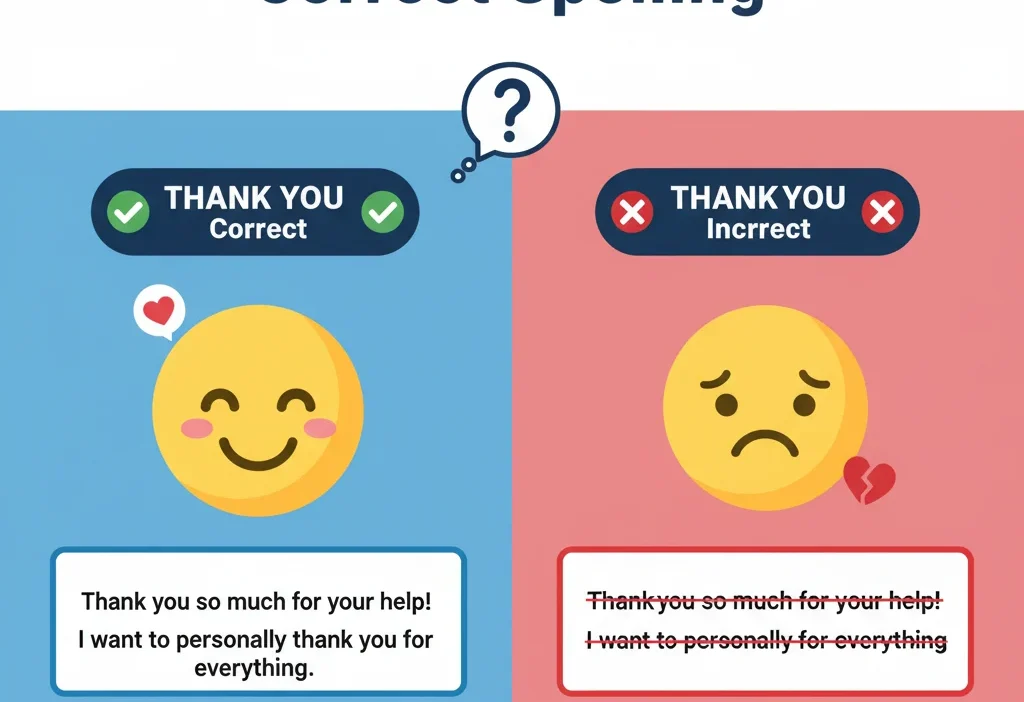
✅ “Thank You” – The Correct Form
- Part of speech: phrase (a combination of a verb and a pronoun)
- Meaning: used to show gratitude or appreciation to someone.
- Structure: “thank” (verb) + “you” (pronoun)
Examples:
- Thank you for helping me with my homework.
- I just wanted to say thank you for your kindness.
- Thank you for inviting me to your party!
Think of it this way: when you’re saying thank you, you’re thanking a person directly. The two words need space to work together.
❌ “Thankyou” – The Incorrect Form
- Part of speech: ❌ not a real English word (misspelling)
- Meaning: none — it’s a spelling mistake of “thank you.”
However, you might see it written as one word in casual online posts, creative logos, or brand names.
For example, a company might name itself “Thankyou™” (like the Australian social enterprise brand).
Examples (incorrect in normal writing):
- I want to thankyou for your help. ❌
- Thankyou so much for coming! ❌
Remember: unless it’s part of a brand name, always write thank you as two words.
🔍 The Key Difference Between “Thank You” and “Thankyou”
Here’s a quick comparison to make it super clear:
| Feature | Thank You | Thankyou |
|---|---|---|
| Type | Correct English phrase | Incorrect / informal spelling |
| Parts of Speech | Verb (“thank”) + Pronoun (“you”) | None (not recognized in grammar) |
| Meaning | Expression of gratitude | No grammatical meaning |
| Example (Correct) | Thank you for your time. | ❌ Thankyou for your time. |
| Usage | Everyday writing, speaking, professional communication | Branding or casual online posts only |
💡 Quick Tip to Remember:
If you can replace it with “I thank you”, then it should always be two words!
🚫 Common Mistakes and How to Avoid Them
❌ Mistake 1: Writing “thankyou” in emails
Incorrect: Thankyou for your quick reply.
Correct: Thank you for your quick reply.
👉 Why it’s wrong: “Thankyou” isn’t a recognized word in English grammar.
❌ Mistake 2: Using “thankyou” in formal writing
Incorrect: We would like to express our sincere thankyou to our team.
Correct: We would like to express our sincere thanks to our team.
👉 Why it’s wrong: In this case, you need a noun form (“thanks”), not the phrase “thank you.”
❌ Mistake 3: Confusing “thank you” (phrase) with “thank-you” (adjective)
Correct: She gave me a thank-you card.
👉 When used as an adjective before a noun, you can add a hyphen (thank-you).
So, we have three forms:
- thank you → phrase (used in sentences)
- thank-you → adjective (before a noun)
- thanks → noun (general gratitude)
✨ When to Use “Thank You”
Use thank you whenever you are directly expressing gratitude to someone.
Examples:
- Thank you for waiting patiently.
- Thank you for your message — I appreciate it.
- Thank you for helping me clean the room.
- Thank you so much for your advice!
- Thank you for reading this article. 😊
💭 Memory Hack:
Imagine giving someone a gift — you need two hands (just like the two words, “thank” and “you”) to show kindness properly!
🌼 When to Use “Thankyou”
Normally, you don’t use “thankyou” in writing or speech.
The only time it’s acceptable is when it’s part of a name, logo, or brand, such as:
- “Thankyou™” water (a real company name)
- “Thankyou App” (a brand name in creative writing)
Outside of these cases, always write thank you separately.
78+This or That Questions for Adults: Fun Challenges to Play 2025
🔁 Quick Recap: Thank You vs Thankyou
- ✅ Thank you → Correct phrase meaning “I appreciate you.”
- ❌ Thankyou → Incorrect spelling (not a word).
- ✍️ Use thank-you (with a hyphen) only when describing something (e.g., “thank-you card”).
- 💬 Use “thanks” as a casual noun: “Many thanks for your help.”
📘 Advanced Tips for Grammar Lovers
- The phrase “thank you” dates back to the 14th century, from “I thank you.”
- In formal letters or emails, always use “Thank you” instead of “Thanks” — it sounds more polite.
- In texting, people sometimes write “thankyou” or “thx,” but in academic or business English, that’s considered a grammar mistake.
- When writing essays, official messages, or social media captions, use Thank you for clarity and professionalism.
🧠 Mini Quiz: Test Your Knowledge!
Fill in the blanks with the correct form.
- ________ for your help today!
- She gave me a beautiful ________ card.
- I want to say ________ to everyone who came.
- ________ is not a real English word.
- We would like to express our ________ to the teachers.
✅ Answers:
- Thank you
- thank-you
- thank you
- Thankyou
- thanks
💬 5 Common FAQs
1. Is “thankyou” ever correct?
Only if it’s part of a brand name or logo. In normal English, it’s incorrect.
2. Which one should I use in emails — “thankyou” or “thank you”?
Always use “thank you.” It’s grammatically correct and polite.
3. Can I say “thank-you card” with a hyphen?
Yes! Use a hyphen when the phrase describes a noun (e.g., “thank-you note”).
4. Is “thanks” the same as “thank you”?
They both mean gratitude, but “thank you” is more formal. Use “thanks” in friendly or casual situations.
5. Why do people write “thankyou” online?
Mostly out of habit or speed while typing. It’s still a spelling mistake in standard English.
🌈 Conclusion
Now you know the clear difference between thankyou and thank you!
Remember — “thank you” is always two words when you want to show gratitude.
If you’re describing something like a card or note, use “thank-you” with a hyphen.
Avoid writing “thankyou” unless it’s a brand name or logo.
The next time you write an email, message, or caption, you’ll know exactly which one to use.
Keep practicing small grammar details like this — every correction makes your English stronger, clearer, and more confident.

Oliver Thorne is a passionate digital storyteller and content strategist at WordContrast.com. With years of experience in SEO writing and online marketing, he specializes in transforming complex ideas into clear, engaging articles. Oliver loves exploring the latest trends in technology, productivity, and digital culture—helping readers stay informed and inspired in today’s fast-moving world.