
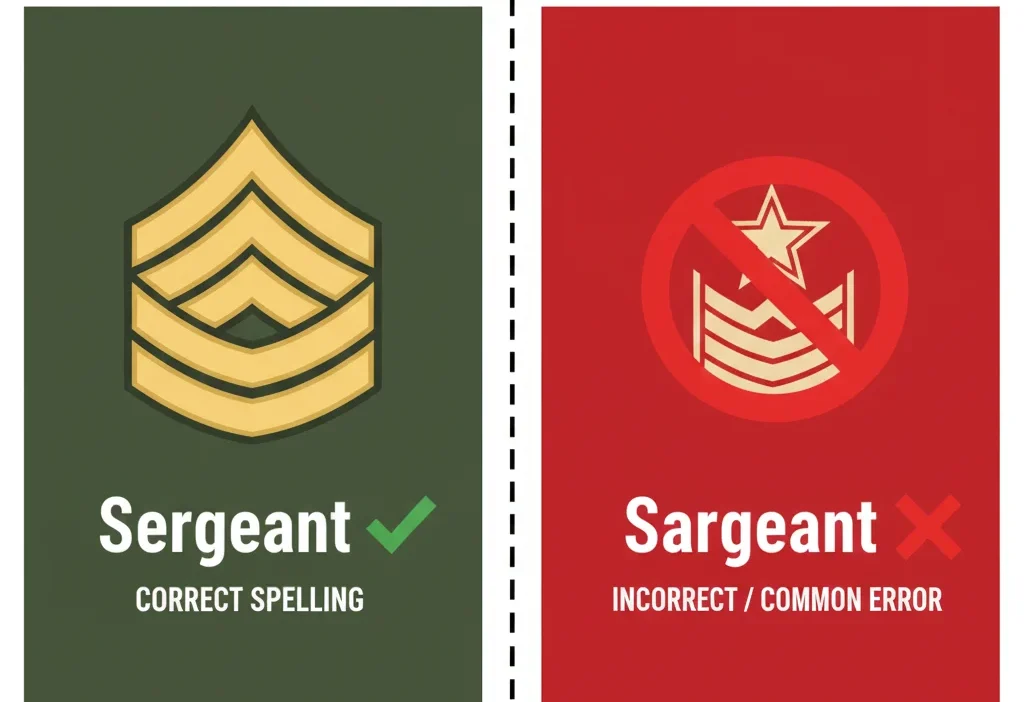
“Sergeant” is the correct spelling.
“Sargeant” is a common mistake and not standard English.
Now let’s begin the full, easy, beginner-friendly article
Many English learners get confused between “sergeant” or “sargeant.” These two words look similar, sound similar, and often appear in online posts or casual writing. Because of this, people start thinking both spellings are correct — but they are not.
In this guide, you will learn the meaning, the difference, the correct usage, and easy examples of each word. We will also cover the most common mistakes, a simple memory hack, and a comparison table for fast learning. Even a child in 4th grade can understand every explanation, because everything is written in clear, simple English.
By the end, you will always know when to use sergeant and why sargeant is wrond.
✅ Sergeant — Meaning (Correct Word)
“Sergeant” is a noun.
It refers to a rank in the military, police, or similar uniformed forces. A sergeant is someone who has authority and leads a team.
Easy Examples of “Sergeant”
- The sergeant trained the new soldiers.
- My uncle is a sergeant in the police force.
- The sergeant gave clear orders during the drill.
Think of a sergeant as a leader who guides and teaches others.
❌ Sargeant — Meaning (Incorrect Word)
“Sargeant” is NOT a correct English word.
It is only a misspelling of “sergeant.” You might see it written mistakenly in social media posts, but it is never correct in school, exams, official writing, or professional communication.
Examples (Incorrect)
- ❌ The sargeant arrived early.
- ❌ My brother wants to become a sargeant.
- ❌ The sargeant shouted commands.
You must always replace sargeant → sergeant.
The Key Difference Between Sergeant and Sargeant
Here is a simple way to understand it:
| Word | Correct or Incorrect? | Meaning | Example |
|---|---|---|---|
| Sergeant | ✅ Correct spelling | A military or police rank | The sergeant led the team. |
| Sargeant | ❌ Incorrect spelling | Not a word in English | (Never used correctly) |
🔍 Quick Tip to Remember
**“Sergeant” has “gean” in the middle — remember it like:
Ser-GE-ant (sounds like “sur-jent”).”
Or think:
👉 “Sergeant has NO ‘a’ after the ‘g’.”
🎓 Are Net Costs or Sticker Prices Lower for Higher Education? The Hidden Truth 2025
Common Mistakes and How to Avoid Them
Here are mistakes people make and how to fix them:
❌ Incorrect:
- “He is a sargeant in the army.”
✅ Correct:
- “He is a sergeant in the army.”
❌ Incorrect:
- “The sargeant will speak to the class.”
✅ Correct:
- “The sergeant will speak to the class.”
Why these mistakes happen:
Because the word “sergeant” sounds like “sar-jent,” people assume it is spelled with an a, like “sargeant.” But English does not always spell words how they sound.
How to avoid the mistake:
Use this simple memory hack:
👉 Ser-GE-ant — Focus on “GE,” not “GA.”
When to Use “Sergeant” (Correct Word)
Use sergeant when talking about:
- the military
- the police
- authority figures
- leadership roles
- official ranks
- job titles
Easy Example Sentences
- The sergeant helped the new officer.
- A sergeant must be responsible and disciplined.
- The class listened to the sergeant’s instructions.
- My cousin became a sergeant after many years of hard work.
- The sergeant guided the team during training.
Memory Hack
👉 Think of the word “SERIAL” → starts with SER.
👉 Think of “AGENT” → ends like “geant.”
Combine: SER + GEANT = Sergeant
It’s not perfect, but it helps many learners.
When to Use “Sargeant”
Very Simple Answer:
❌ Never use “sargeant.”
It is always a spelling mistake.
If you see it online, it is wrong.
If someone writes it in an exam, it will be marked incorrect.
If you use it in a resume or official document, it looks unprofessional.
Small Visual Trick:
Imagine a red “X” over the letter A after the “G.”
This tells your brain:
👉 “The A does NOT belong there.”
Quick Recap: Sergeant vs Sargeant
- Sergeant = correct spelling
- Sargeant = wrong spelling
- Remember: Ser-GE-ant
- Use sergeant for military or police ranks
- Never use sargeant in writing or exams
Short and simple — that’s all!
Advanced Tips (Optional but Helpful)
🔎 Origin of the Word
“Sergeant” comes from an old French word meaning “servant” or someone who serves and protects. Over time, it became a military title.
✍️ Use in Formal Writing
In essays, reports, police documents, resumes, and job titles, ALWAYS use the correct word — sergeant.
📱 Online Writing
People on social media often write fast and might use “sargeant.” Do not copy this spelling. It is still wrong.
📘 Exam Tip
If your English exam asks for the correct spelling between “sergeant or sargeant,” the answer is always sergeant.
Mini Quiz: Test Yourself
Fill in the blanks with the correct word: sergeant.
- The ______ trained the new officers.
- My father became a ______ last year.
- The ______ ordered the team to stop.
- Every ______ must follow strict rules.
- The students listened to the ______ carefully.
(Answer key: All are “sergeant.”)
5 Useful FAQs
1. Which is correct: sergeant or sargeant?
Sergeant is correct. Sargeant is always a misspelling.
2. Why do people confuse these two spellings?
Because “sergeant” sounds like “sar-jent,” people think it contains “a.”
3. Is sargeant ever acceptable?
No. It is not used in any standard English dictionary or official writing.
4. How do I remember the correct spelling?
Think: Ser-GE-ant — focus on “GE,” not “GA.”
5. What does sergeant mean in simple English?
A sergeant is a leader in the military or police who guides and trains others.
Conclusion
Now you clearly understand the difference between sergeant or sargeant, why only sergeant is correct, and how to use it properly in everyday writing. You learned simple examples, easy memory tricks, and common mistakes to avoid. With a little practice, you will never confuse these two spellings again.
Keep improving your English one small step at a time — every new word makes you better and more confident.

Marianne Solace is a lifestyle and personal-growth writer for WordContrast.com. Her work blends inspiration with practicality, offering thoughtful insights on wellness, creativity, and mindful living. When she’s not writing, Marianne enjoys journaling with a cup of coffee, exploring art museums, and helping others find balance through the written word.