
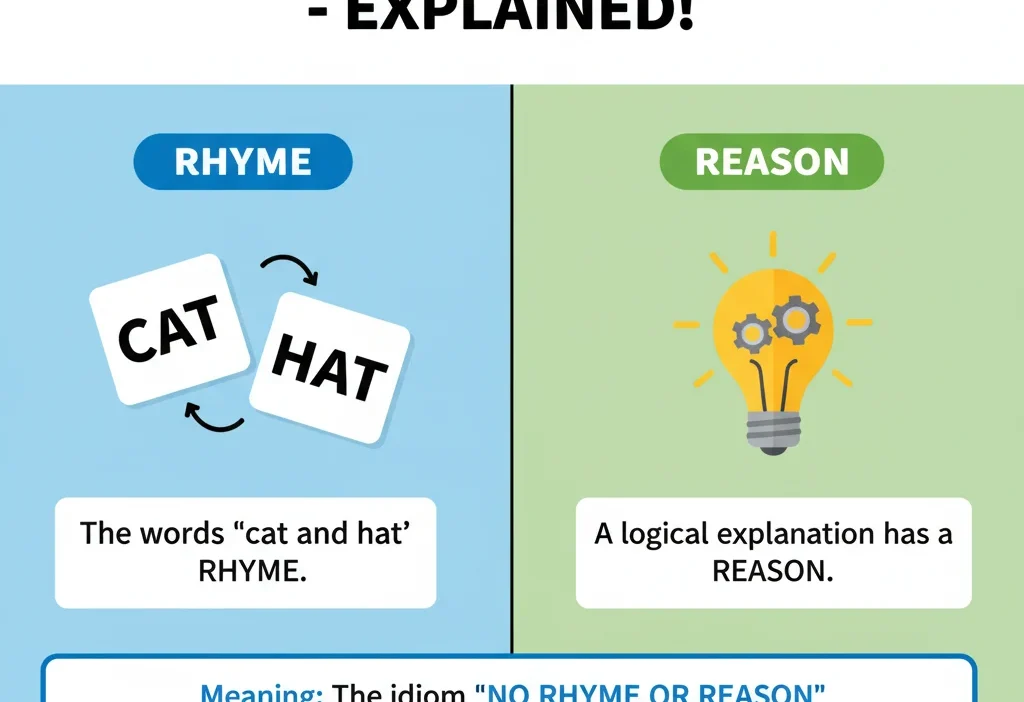
What Does “Rhyme or Reason” Really Mean?
Have you ever heard someone say, “There’s no rhyme or reason to this”?
If you have, you might have wondered what on earth rhyme and reason have to do with anything!
The phrase “rhyme or reason” is an old English expression people use when something seems confusing, messy, or makes no sense at all. It’s not about poems or logic tests — it’s about saying, “This doesn’t make any sense!”
People often mix up how and when to use it. In this article, we’ll explain the meaning, difference, and correct usage of “rhyme or reason” in simple English. You’ll also learn how to use it in your own writing or conversations — even if you’re just starting to learn English.
By the end, you’ll never be confused about this phrase again!
What Does Each Word Mean?
Before understanding the whole phrase, let’s look at the two words separately — rhyme and reason.
1. Rhyme – The Sound Connection
Meaning:
A rhyme is when two or more words sound the same at the end.
Example: “Cat” rhymes with “hat.” “See” rhymes with “tree.”
Part of Speech: Noun (sometimes verb)
Examples:
- The words “moon” and “spoon” rhyme.
- I like poems that have a happy rhyme.
- Can you rhyme “day” with “say”?
Think of rhyme as sound harmony — words that match in tone.
2. Reason – The Logic or Explanation
Meaning:
A reason is the cause, explanation, or logic behind something.
It tells us why something happens.
Part of Speech: Noun
Examples:
- There’s a good reason why she’s late.
- What’s your reason for laughing?
- You need a reason to make a big change.
So, reason is about thinking, not sounding.
The Key Difference Between “Rhyme” and “Reason”
Now that we know what each word means, let’s see how they work together in the phrase “no rhyme or reason.”
| Feature | Rhyme | Reason |
|---|---|---|
| Meaning | Words that sound alike | Logic or explanation |
| Type | Related to sound and poetry | Related to thought and logic |
| Example Word Pair | Cat–Hat, See–Tree | Because, Therefore |
| Simple Example | “I love when songs rhyme.” | “There’s a reason for everything.” |
| Quick Tip | Rhyme = Sound | Reason = Sense |
When used together, “rhyme or reason” means both sound and sense — and the phrase “no rhyme or reason” means something that has neither.
🧠 Quick Tip to Remember:
If something has “no rhyme or reason,” it has no sound pattern (rhyme) and no logical pattern (reason). It’s just random!
Meaning of “No Rhyme or Reason”
The phrase “no rhyme or reason” means something makes no sense at all.
It’s used when something seems random, without logic, or impossible to explain.
Examples:
- There’s no rhyme or reason to how my little brother arranges his toys.
- The teacher gave extra homework for no rhyme or reason.
- This story jumps from one topic to another — it has no rhyme or reason!
So, whenever you see something messy, silly, or unplanned, you can say it has no rhyme or reason.
Common Mistakes and How to Avoid Them
❌ Mistake 1: Thinking it’s about poetry only
Some people think “rhyme or reason” is used only when talking about songs or poems.
✅ Fix: It’s actually about logic and order, not just words that rhyme.
Example:
- ❌ “This poem has no rhyme or reason” (you mean it doesn’t make sense, not that it doesn’t rhyme).
- ✅ “The rules of this game have no rhyme or reason!” (perfect usage)
❌ Mistake 2: Saying “rhyme and reason”
The correct phrase is “rhyme or reason,” not “rhyme and reason.”
✅ Fix: Always use or, not and.
Example:
- ❌ “There’s no rhyme and reason to it.”
- ✅ “There’s no rhyme or reason to it.”
❌ Mistake 3: Using it for people
It’s not polite to say a person has “no rhyme or reason.”
✅ Fix: Use it for situations, actions, or systems — not people.
Example:
- ❌ “He has no rhyme or reason.”
- ✅ “His decisions have no rhyme or reason.”
When to Use “Rhyme”
You should use rhyme when talking about words that sound similar, poems, songs, or creative writing.
Examples:
- Can you make a rhyme with the word “love”?
- “Light” and “bright” rhyme nicely.
- The kids made up a funny rhyme about their teacher.
- She wrote a poem that rhymes in every line.
- Nursery rhymes are fun to sing!
Memory Hack:
➡️ Rhyme = Chime.
If the words “chime” together, they rhyme!
When to Use “Reason”
Use reason when talking about logic, explanations, or causes behind something.
Examples:
- What’s the reason for your smile?
- There’s no reason to worry.
- Give me one good reason to believe you.
- She had a reason to be upset.
- For some reason, my phone won’t turn on.
Memory Hack:
➡️ Reason = Why.
If you can ask “why,” you’re looking for a reason.
Quick Recap: Rhyme vs Reason
Here’s a short and simple summary:
- Rhyme → Words that sound alike (cat–hat).
- Reason → Logic or explanation (why something happens).
- “No rhyme or reason” → Something that doesn’t make sense.
Remember:
“Rhyme” is about sound.
“Reason” is about sense.
So, when you hear “no rhyme or reason,” think of something that has neither sound nor sense!
Advanced Tips and Fun Facts
- The phrase “no rhyme or reason” comes from a 15th-century English writer named William Shakespeare.
He used it in his play The Comedy of Errors:
“He is stark mad, or wonderful foppish, there is no more rhyme nor reason in him, than in a dog.” - Over time, people started using the phrase in everyday speech to mean “makes no sense.”
- In modern writing and speech, it’s common in news articles, blogs, and everyday talk.
Example: “The weather changes with no rhyme or reason these days!” - In essays or exams, using idioms like this can make your English sound more natural and expressive.
- Be careful not to overuse it — it’s best for informal or descriptive writing, not for very formal essays.
Mini Quiz: Test Yourself!
Fill in the blanks with rhyme or reason (or the full phrase no rhyme or reason).
- The words “light” and “night” __________ with each other.
- I can’t find any __________ why the lights went out.
- There’s __________ to how he chooses his clothes!
- Do you know the __________ for her sudden anger?
- That poem doesn’t __________ — the last words sound totally different!
Answers:
- rhyme
- reason
- no rhyme or reason
- reason
- rhyme
FAQs About “Rhyme or Reason”
1. What does “rhyme or reason” mean?
It means something that doesn’t make sense or has no clear pattern or explanation.
2. Can I say “rhyme and reason”?
No. The correct phrase is “rhyme or reason.”
3. Is it an idiom or a phrase?
Yes, it’s an idiom, meaning its meaning isn’t literal — it’s figurative.
4. Can I use it in writing?
Yes, you can use it in casual writing or storytelling, but not in very formal essays.
5. Where did it come from?
It was first used in the 1400s and became popular through Shakespeare’s plays.
Conclusion
Now you know the full story behind “rhyme or reason.”
You learned that:
- Rhyme is about sound.
- Reason is about logic.
- And if something has no rhyme or reason, it just doesn’t make sense!
Keep practicing by spotting this phrase in movies, songs, or daily conversations. The more you notice it, the easier it becomes to remember.
Remember — every time you learn a new phrase, your English becomes stronger and more natural. Keep going, and soon, you’ll be speaking with rhyme and reason!

Oliver Thorne is a passionate digital storyteller and content strategist at WordContrast.com. With years of experience in SEO writing and online marketing, he specializes in transforming complex ideas into clear, engaging articles. Oliver loves exploring the latest trends in technology, productivity, and digital culture—helping readers stay informed and inspired in today’s fast-moving world.