
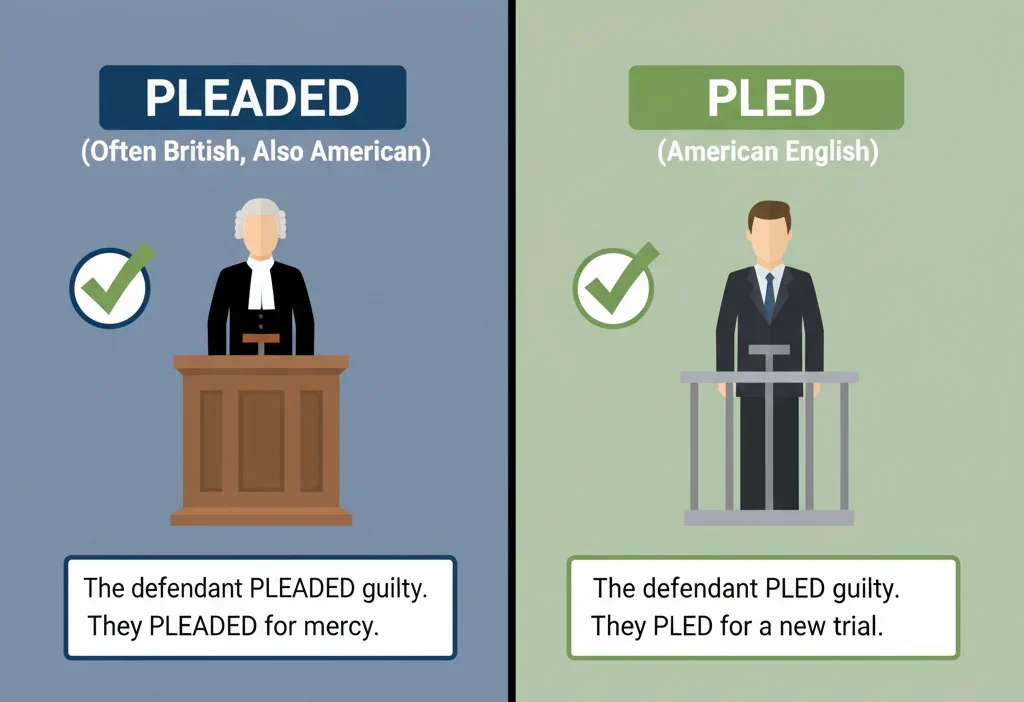
Have you ever wondered whether you should say “pleaded guilty” or “pled guilty”?
You’re not alone! These two forms — pleaded and pled — confuse even native English speakers. Both look right, both sound natural, and both appear in newspapers, TV shows, and court cases. So, which one is correct?
In this easy-to-understand grammar guide, you’ll learn:
- What pleaded and pled mean
- The difference between them
- When to use each correctly
- Common mistakes and how to avoid them
By the end, you’ll never mix up pleaded and pled again — even if you’re just starting to learn English.
📖 What Does Each Word Mean?
Both pleaded and pled come from the same base verb — “plead.”
Let’s understand them one by one.
✅ Pleaded — Meaning and Examples
Pleaded is the past tense and past participle of “plead.”
It means to make a request, appeal, or argument — often in a serious or emotional way.
Simple Meaning:
When someone pleaded, they asked or begged for something.
Part of Speech:
Verb (past tense of plead)
Examples:
- She pleaded with her parents to let her go to the party.
- The lawyer pleaded for mercy in court.
- I pleaded my case, but no one listened.
🟢 Tip: If you’re not sure which to use, “pleaded” is always correct in both American and British English.
✅ Pled — Meaning and Examples
Pled is also a past tense form of “plead.”
It means the same thing as pleaded, but it’s less formal and more common in American legal language.
Simple Meaning:
Pled means said something officially in court, such as “pled guilty” or “pled not guilty.”
Part of Speech:
Verb (past tense of plead)
Examples:
- The man pled guilty to the crime.
- She pled not guilty before the judge.
- They pled for leniency during the hearing.
🟢 Quick Note:
“Pled” sounds more modern or legal, while “pleaded” sounds more traditional and correct in writing.
⚖️ The Key Difference Between Pleaded and Pled
Here’s a clear side-by-side comparison to help you remember the difference easily:
| Feature | Pleaded | Pled |
|---|---|---|
| Part of Speech | Past tense of plead | Past tense of plead |
| Usage | Common in all forms of English | Mostly in American legal English |
| Formality | More formal and grammatically preferred | Less formal, often seen in legal speech |
| Example | “He pleaded for forgiveness.” | “He pled guilty to the charges.” |
| Correctness | ✅ Always correct | ⚠️ Accepted but less formal |
🧠 Quick Memory Tip:
If you’re writing for school, essays, or professional work, use pleaded.
If you’re talking about court or law in the U.S., pled may sound more natural.
❌ Common Mistakes and How to Avoid Them
Let’s look at some real-life mix-ups.
| ❌ Wrong | ✅ Correct | 💡 Why |
|---|---|---|
| He pled with his mom for ice cream. | He pleaded with his mom for ice cream. | “Pled” is rarely used outside of legal settings. |
| She pleaded guilty in court. | ✅ She pleaded guilty in court. | Perfect — “pleaded” is always safe. |
| They pled for help when the car broke down. | They pleaded for help when the car broke down. | “Pled” sounds too legal for casual talk. |
Remember:
👉 Use pleaded for emotional or everyday situations.
👉 Use pled only when talking about legal or court cases.
📚 When to Use Pleaded
Use pleaded when:
- You’re talking about begging, asking, or appealing for something.
- The sentence is not about a legal situation.
Examples:
- The child pleaded for one more bedtime story.
- I pleaded with my teacher to accept my homework late.
- They pleaded for peace during the protest.
- She pleaded with her friend to forgive her.
- We pleaded for help during the storm.
🧩 Easy Trick:
If the sentence involves feelings or emotion, choose pleaded.
⚖️ When to Use Pled
Use pled when:
- You are referring to courtrooms, law, or formal legal statements.
- The word follows “guilty” or “not guilty.”
Examples:
- The suspect pled guilty after the trial began.
- She pled not guilty to all charges.
- The company pled for a reduced penalty.
- He pled no contest to avoid a long trial.
- The lawyer said his client pled under pressure.
💡 Memory Hack:
Think of pled as “plead + law” → used mainly in legal contexts.
🔁 Quick Recap: Pleaded vs Pled
Here’s a fast summary you can screenshot or remember easily:
- Pleaded = always correct, emotional or general situations
- Pled = legal term, used mainly in American courts
- Pleaded works in formal writing and grammar tests
- Pled is fine in quotes, newspapers, and U.S. legal English
- When unsure, always use pleaded
📜 Advanced Tips (For Curious Learners)
- Origin: “Plead” comes from Old French plaider, meaning “to argue or present a case.”
- History: “Pled” appeared in the 16th century in Scottish and American English.
- Modern English: Most grammar guides (like APA, MLA, and Oxford) recommend pleaded as the correct form.
- In Legal Writing: American lawyers still commonly use “pled guilty.”
- In Texting: You’ll often see “pled” online because it’s shorter and easier to type.
So, both are acceptable — but pleaded remains the safest and most standard form in all kinds of English.
🧩 Mini Quiz: Test Your Understanding!
Fill in the blanks with the correct word — pleaded or pled.
- The lawyer _______ guilty to all charges.
- She _______ with her teacher for another chance.
- They _______ not guilty during the hearing.
- He _______ for mercy after making a mistake.
- The witness _______ for protection in court.
(Answers: 1. pled, 2. pleaded, 3. pled, 4. pleaded, 5. pleaded)
❓ FAQs About “Pleaded” vs “Pled”
1. Is “pled” wrong in grammar?
No, it’s not wrong — just less common and mainly used in legal English.
2. Which is preferred in formal writing?
Always use pleaded in essays, school work, or reports.
3. Can I say “pled guilty” in British English?
You can, but most British speakers say “pleaded guilty.”
4. Is “plead” irregular?
It’s a regular verb in modern English, so its past tense is pleaded.
5. Why do Americans say “pled”?
It’s a regional preference that evolved in U.S. courts and everyday speech.
🌟 Conclusion
Now you know exactly when to use pleaded and pled!
Both are correct, but they fit in different situations:
- Pleaded = safe for all contexts
- Pled = mostly for legal or American courtroom use
Keep practicing these words in sentences. Soon, choosing the right one will feel natural.
Remember, every time you learn the difference between confusing words, your English becomes clearer and stronger!

Henry Vale is a tech-savvy content creator at WordContrast.com, known for his in-depth guides and how-to articles. With a background in digital media and a passion for innovation, Henry focuses on simplifying technology for everyday users. His mission is to empower readers with clear, actionable knowledge they can use to improve their digital lives.