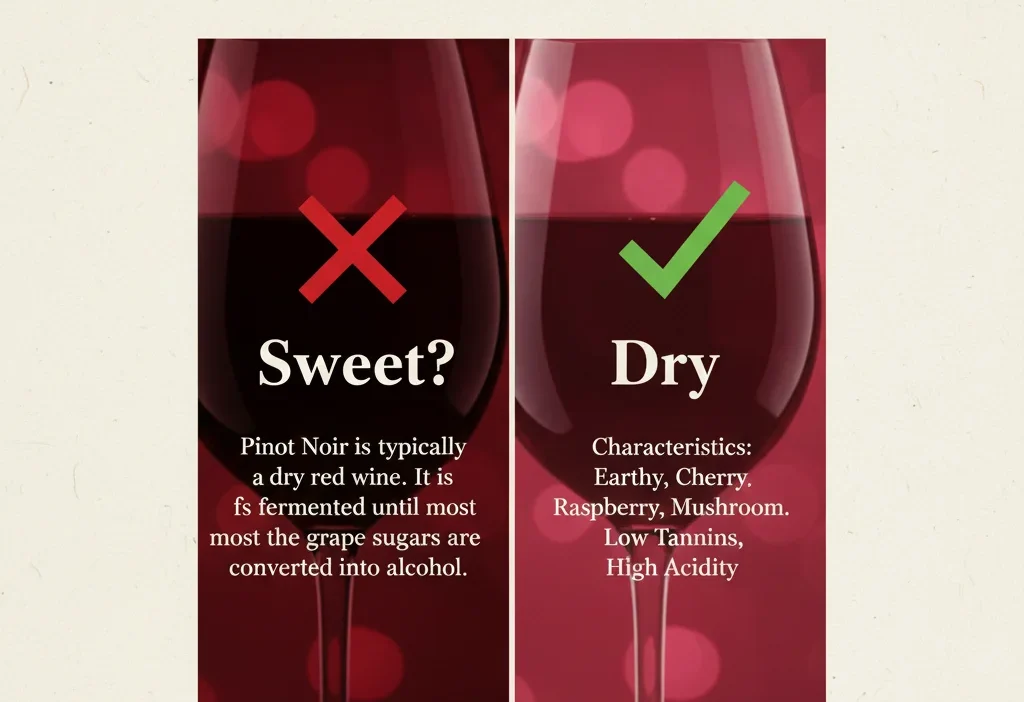
Pinot Noir is almost always a dry wine.
It has low sugar, light tannins, and bright fruity flavors like cherry or strawberry.
Some bottles may taste slightly sweet because of ripe fruit, but they are still dry wines.
Many people ask a common question when choosing wine: “Is Pinot Noir sweet or dry?” This confusion happens because Pinot Noir tastes fruity, soft, and smooth. Beginners often mistake “fruity flavor” for “sweetness.” In reality, almost all traditional Pinot Noir wines are dry, meaning they have very little sugar left after fermentationeasy wine guide
What Does “Sweet” Mean in Wine? (Simple Definition)
Sweet wine means a wine with noticeable sugar left after fermentation.
If the wine tastes like grape juice, honey, or syrup, it’s sweet.
Examples of Sweet Wines:
- Moscato
- Port
- Dessert wines
Three Easy Example Descriptions:
- “This wine tastes sugary like fruit syrup.”
- “I can feel sweetness on my tongue.”
- “It tastes like sweet berries with honey.”
What Does “Dry” Mean in Wine? (Simple Definition)
A dry wine has very little sugar.
The flavors come from fruit, spices, earth, tannins, and acidity, not sugar.
Examples of Dry Wines:
- Pinot Noir
- Merlot
- Cabernet Sauvignon
Three Easy Example Descriptions:
- “This wine tastes fruity but not sugary.”
- “The finish is smooth and clean.”
- “It tastes like cherries without sweetness.”
The Key Difference: Sweet vs Dry Pinot Noir
Comparison Table
| Feature | Sweet Wine | Dry Pinot Noir |
|---|---|---|
| Sugar Level | High | Very Low |
| Taste | Sugary, syrup-like | Fruity but not sweet |
| Mouthfeel | Thick & heavy | Light & smooth |
| Common Notes | Honey, candy, very ripe fruit | Cherry, strawberry, raspberry |
| Typical Pinot Noir? | No | Yes |
Quick Tip to Remember:
👉 If it tastes fruity but not sugary — it’s dry. Pinot Noir = dry.
Why People Mistake Pinot Noir as “Sweet”
People get confused because Pinot Noir smells and tastes like:
- fresh cherries
- strawberries
- raspberries
- spices
Fruitiness is not sweetness.
Sweetness = sugar.
Fruitiness = flavor.
Common Mistakes and How to Avoid Them
Mistake 1: “Pinot Noir tastes sweet because it’s fruity.”
❌ Incorrect
✔ Correction: Pinot Noir is dry; it only has fruity aromas.
Mistake 2: “Dry wine means it will dry my mouth.”
❌ Incorrect
✔ Correction: “Dry” means low sugar, not a dry mouth.
Mistake 3: “All red wines are sweet.”
❌ Incorrect
✔ Correct: Most red wines, including Pinot Noir, are dry wines.
When to Use the Term “Sweet Pinot Noir”
Although rare, some wines labeled “Pinot Noir Rosé,” “Off-Dry Pinot Noir,” or “Slightly Sweet Pinot Noir” may have a touch of sugar.
Use “Sweet Pinot Noir” when:
- The label says semi-sweet
- It comes from a region that makes sweeter versions (some German or Canadian brands)
- The taste clearly has noticeable sugar
Example Sentences:
- “This Pinot Noir is slightly sweet because it has extra residual sugar.”
- “The rosé-style Pinot Noir tastes sweeter than the red one.”
- “Some wineries make sweet versions for dessert pairing.”
When to Use the Term “Dry Pinot Noir”
This is the most common and correct usage.
Use “Dry Pinot Noir” when:
- You refer to traditional red Pinot Noir
- You describe low-sugar wine
- You want to explain typical Pinot Noir flavor
Example Sentences:
- “Pinot Noir is a light and dry red wine.”
- “This dry Pinot Noir tastes like cherries.”
- “Most Pinot Noir wines are dry by style.”
- “Restaurants usually serve dry Pinot Noir with meals.”
- “Dry Pinot Noir pairs well with chicken and salmon.”
Memory Hack:
👉 Pinot Noir = Dry. Think ‘P’ for Pinot, ‘P’ for Plain (no sugar).
Quick Recap: Sweet vs Dry Pinot Noir
- Pinot Noir is almost always dry.
- It tastes fruity but has low sugar.
- Sweet Pinot Noir is rare and usually marked on the label.
- Fruit flavor ≠ sweetness.
- Dry wines = clean, smooth finish.
Advanced Tips (Optional But Helpful)
- Origin: Pinot Noir comes from Burgundy, France, where it has always been a dry wine.
- Writing & Menus: In restaurants, “Pinot Noir” automatically means dry unless stated otherwise.
- Misuse in texting: Saying “Pinot Noir sweet” can confuse readers—always use “dry” unless the bottle is truly sweet.
Mini Quiz (Test Yourself!)
Fill in the blanks:
- Pinot Noir is usually a ______ wine.
- Sweet wines have more ______.
- Fruity taste does not mean ______.
- Dry wine means the wine has ______ sugar.
- Pinot Noir flavors include cherry and ______.
- A rare sweet Pinot Noir will be labeled ______.
- Most restaurants serve ______ Pinot Noir.
(Answers: dry, sugar, sweetness, low, raspberry, semi-sweet, dry)
5 FAQs
1. Is Pinot Noir sweet or dry?
Pinot Noir is almost always dry, with low sugar.
2. Why does Pinot Noir taste fruity?
Because of natural grape flavors, not sugar.
3. Can Pinot Noir ever be sweet?
Yes, but rarely. Only special rosé or semi-sweet versions.
4. Which Pinot Noir is best for beginners?
A smooth, dry Pinot Noir with soft tannins.
5. How do I know if my Pinot Noir is sweet?
Check the label for “semi-sweet,” “off-dry,” or higher residual sugar.
Conclusion
Now you know the clear difference between sweet and dry Pinot Noir. Pinot Noir is almost always dry, with fruity flavors but very little sugar. Sweet versions do exist, but they are unusual and normally labeled clearly. When you choose Pinot Noir, expect a smooth, light, and elegant dry wine that pairs well with many foods.
Keep practicing these simple terms, and soon you’ll feel confident ordering, describing, and enjoying wine without confusion. Understanding the meaning of sweet vs. dry helps you make better choices and enjoy your wine experience even more.

Henry Vale is a tech-savvy content creator at WordContrast.com, known for his in-depth guides and how-to articles. With a background in digital media and a passion for innovation, Henry focuses on simplifying technology for everyday users. His mission is to empower readers with clear, actionable knowledge they can use to improve their digital lives.