
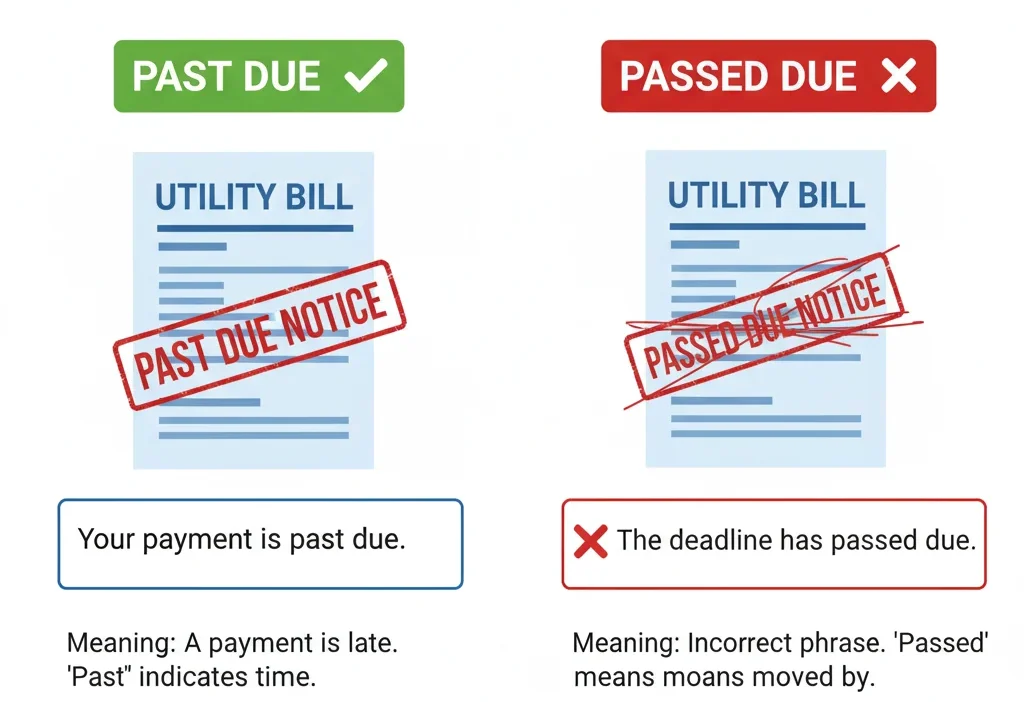
Have you ever seen the phrases “past due” and “passed due” and wondered which one is right? You’re not alone! These two look almost the same and sound similar, so it’s easy to mix them up.
In this simple guide, we’ll explain the difference between “past due” and “passed due”, their meanings, correct usage, and lots of easy examples. By the end, you’ll never get confused again — even if you’re just starting to learn English.
Let’s break it down step-by-step so even a 4th-grader can understand!
What Does Each Phrase Mean?
1. “Past Due” – Meaning and Usage
Part of Speech: Adjective Phrase
Definition:
“Past due” means something has not been done or paid by the expected time. It is used to describe things like bills, payments, deadlines, or assignments that are late.
In short:
👉 Past due = overdue = late.
Examples:
- My phone bill is past due, so I need to pay it today.
- The library book is past due by three days.
- Your rent payment became past due on the 10th of the month.
Mini-story:
Imagine you borrowed a book that was due on Monday. If you return it on Wednesday, it’s past due.
2. “Passed Due” – Meaning and Usage
Part of Speech: Verb Phrase (past tense of “pass”)
Definition:
“Passed due” is rarely correct in modern English. However, it can appear in very specific contexts where the verb “pass” is used before “due” in a sentence — meaning something has gone past its due point.
But most of the time, people use “passed due” incorrectly instead of “past due.”
Examples (correct but rare):
- The train passed the due station without stopping.
- The time for payment has passed — it is now late.
Examples (incorrect):
✖️ The bill is passed due.
✅ The bill is past due.
So, unless you are using “passed” as a verb, the correct phrase is “past due.”
The Key Difference Between Past Due and Passed Due
Here’s a simple table to help you remember:
| Aspect | Past Due | Passed Due |
|---|---|---|
| Part of Speech | Adjective Phrase | Verb Phrase |
| Meaning | Something is late or overdue | Something has gone past its due time |
| Usage | Used to describe overdue items like bills, books, rent | Used only with the verb “pass” in rare cases |
| Correct Example | “Your payment is past due.” | “The deadline has passed due to bad weather.” |
| Common Use | ✅ Correct and widely used | ❌ Rare and often incorrect |
Quick Tip to Remember:
✅ “Past due” = “Overdue.”
❌ “Passed due” = Almost never right.
If you’re talking about bills, dates, or deadlines — always use past due.
Common Mistakes and How to Avoid Them
Here are a few mistakes people make and how to fix them:
| Incorrect | Correct | Why |
|---|---|---|
| The fee is passed due. | The fee is past due. | “Past due” means late. “Passed due” isn’t used here. |
| My homework is passed due. | My homework is past due. | You’re describing something late, not using a verb. |
| The time has past due. | The time has passed. | Here you need a verb — “passed” works alone, not with “due.” |
Grammar Tip:
Use “past” as an adjective when describing lateness.
Use “passed” as a verb when showing an action.
When to Use “Past Due”
Use past due when you’re describing something that is late or not done on time.
You’ll mostly find it in bills, deadlines, payments, or reminders.
Examples:
- The rent is past due again this month.
- Your report is past due, please submit it today.
- I got an email saying my account payment is past due.
- The teacher marked the assignment as past due.
- My subscription renewal is past due, so it stopped working.
Memory Trick:
👉 If it’s about something late — it’s “past due.”
Think:
“Past due = Passed the due date.”
When to Use “Passed Due”
Use passed due only when the verb “passed” naturally fits the sentence — which is very rare.
It means something has gone beyond or already passed a certain point in time.
Examples:
- The storm passed due east of the island.
- The train passed the station that was due next.
- Time has passed; the project is overdue.
Memory Hack:
If you can replace the word “passed” with “went by”, it’s probably correct.
Example:
✅ “Time has passed.” → “Time has gone by.” (Correct)
❌ “My bill is passed due.” → “My bill has gone by due.” (Makes no sense!)
Quick Recap: Past Due vs Passed Due
✅ Past Due
- Means something is late or overdue.
- Used as an adjective.
- Common in payments, bills, and deadlines.
- Example: “Your rent is past due.”
❌ Passed Due
- Rarely correct; used only when “passed” is a verb.
- Example: “The train passed due east.”
In short:
If it’s about being late, use past due.
If it’s about movement or action, use passed (not “passed due”).
Advanced Tips
- The phrase “past due” is common in banking, billing, and education.
- You might see it on notices like “Past Due Invoice” or “Past Due Payment.”
- “Passed” is simply the past tense of “pass.”
- Example: “He passed the test.”
- Never write: “He past the test.”
- In formal writing or exams, using “passed due” instead of “past due” is marked wrong.
- On websites or apps, “Past Due” may appear in red text to signal a missed deadline.
Fun Fact:
The confusion exists because “past” and “passed” sound almost the same — but they work differently in grammar!
Mini Quiz: Test Yourself!
Fill in the blanks with past due or passed due.
- My library book is ________ by two days.
- The time for payment has ________.
- The rent is ________ — please pay immediately.
- The train ________ the station without stopping.
- Your assignment is marked as ________.
Answers:
- past due
- passed
- past due
- passed
- past due
Frequently Asked Questions (FAQs)
1. Which is correct: past due or passed due?
✅ “Past due” is correct in most situations. “Passed due” is almost always incorrect.
2. What does past due mean?
It means something is late or overdue, like a bill or assignment.
3. Can I say “my payment is passed due”?
No. The correct phrase is “my payment is past due.”
4. What’s the difference between past and passed?
“Past” can be a noun, adjective, or preposition, while “passed” is only a verb (the past tense of “pass”).
5. How can I remember the difference?
If it’s about lateness, say past due.
If it’s about movement or action, use passed.
Conclusion
Now you know the clear difference between past due and passed due!
Remember — “past due” means late or overdue, and it’s the phrase you’ll see on bills, reports, and reminders. “Passed due” is almost never correct, except in rare sentences where “passed” is used as a verb.
Keep practicing, notice these phrases in daily life, and soon you’ll use them naturally and correctly.
Every small step improves your English — keep learning and have fun with words!

Oliver Thorne is a passionate digital storyteller and content strategist at WordContrast.com. With years of experience in SEO writing and online marketing, he specializes in transforming complex ideas into clear, engaging articles. Oliver loves exploring the latest trends in technology, productivity, and digital culture—helping readers stay informed and inspired in today’s fast-moving world.