Do you ever get confused between parents’ and parent’s? You’re not alone! These two words look almost the same, but the tiny apostrophe makes a big difference in meaning.
In everyday writing — emails, school essays, or social media posts — many people mix them up. The good news? Once you learn the rule, it’s super easy to remember.
In this guide, we’ll clearly explain what each word means, when to use it, and how to tell them apart using simple examples. By the end, you’ll never confuse parents’ and parent’s again — even a 4th grader could get it right!
What Does Each Word Mean?
Let’s start by understanding the meanings of both words in plain English.
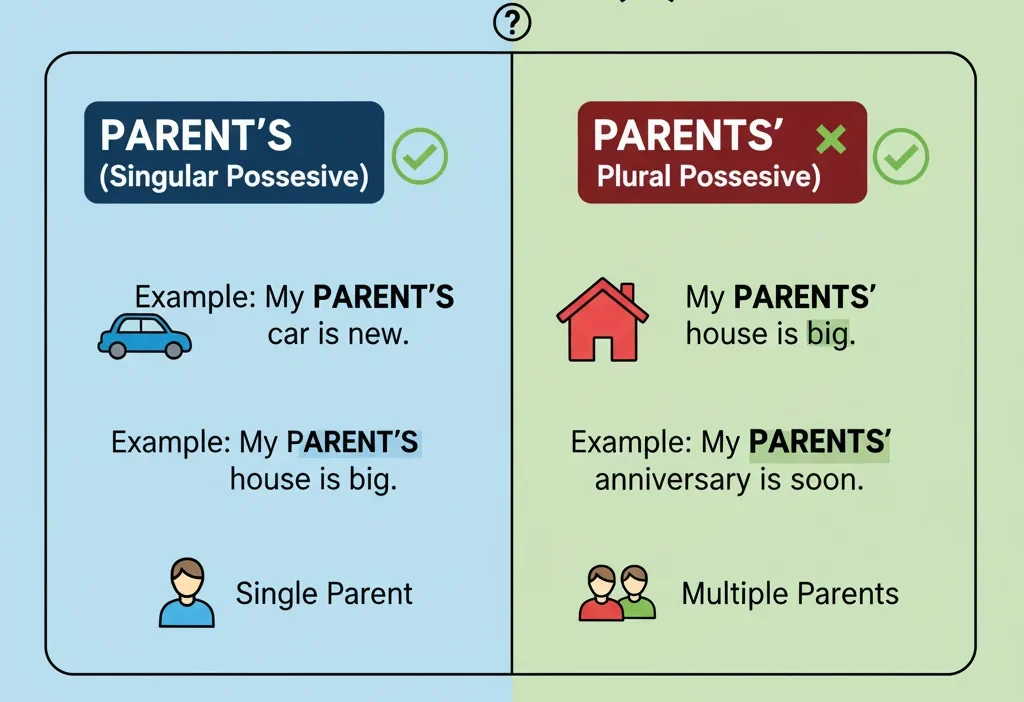
1. Parent’s (Singular Possessive)
The word parent’s means something that belongs to one parent — either your mother or your father.
The apostrophe comes before the “s” to show singular possession.
✅ Simple Definition:
Used when talking about one parent’s belonging.
✅ Examples:
- My parent’s car is parked outside. (One parent owns the car.)
- I took my parent’s advice seriously. (Advice from one parent.)
- The teacher spoke to my parent’s friend. (Friend of one parent.)
🧠 Tip:
If you can replace it with “my mom’s” or “my dad’s,” then parent’s is correct.
2. Parents’ (Plural Possessive)
The word parents’ means something that belongs to both parents — your mother and your father.
Here, the apostrophe comes after the “s” to show plural possession.
✅ Simple Definition:
Used when talking about things owned or shared by both parents.
✅ Examples:
- My parents’ house is near the park. (House belongs to both.)
- We followed our parents’ rules. (Rules made by both parents.)
- Our parents’ anniversary is next week. (Celebration for both.)
🧠 Tip:
If you can replace it with “my mom and dad’s,” then parents’ is correct.
The Key Difference Between Parents’ and Parent’s
Here’s a simple way to see the difference:
| Feature | Parent’s | Parents’ |
|---|---|---|
| Number | One parent (singular) | Two parents (plural) |
| Apostrophe Position | Before s | After s |
| Meaning | Belonging to one parent | Belonging to both parents |
| Example Sentence | My parent’s opinion matters. | My parents’ opinion matters. |
🔑 Quick Tip to Remember:
- If it’s about one, use parent’s.
- If it’s about two or more, use parents’.
Common Mistakes and How to Avoid Them
Here are a few common mix-ups people make:
❌ Incorrect: My parents car is new.
✅ Correct: My parents’ car is new.
(“Parents” are plural and own the car.)
❌ Incorrect: My parent’s are teachers.
✅ Correct: My parents are teachers.
(Here we’re not showing possession — no apostrophe needed!)
❌ Incorrect: I love my parents’s house.
✅ Correct: I love my parents’ house.
(The extra “s” after the apostrophe is wrong.)
💡 Fix it:
Always check what you mean — if you’re talking about ownership and how many people own it.
When to Use Parent’s
Use parent’s when referring to one parent and showing possession.
✅ Examples:
- I borrowed my parent’s phone.
- My parent’s signature is on the form.
- The teacher met my parent’s boss.
- I followed my parent’s advice.
- My parent’s friend visited yesterday.
🎯 Memory Hack:
If you’re thinking about one person (mom or dad), use parent’s — just one apostrophe before “s.”
When to Use Parents’
Use parents’ when referring to both parents and showing that they share ownership.
✅ Examples:
- My parents’ car is red.
- We’re going to our parents’ anniversary dinner.
- Our parents’ room is upstairs.
- I value my parents’ opinion.
- The teacher spoke with our parents’ friends.
🎯 Memory Hack:
If it belongs to both — like a shared home, rules, or plans — use parents’ with the apostrophe after the “s.”
Quick Recap: Parent’s vs Parents’
Let’s summarize everything in simple points:
- 👩 Parent’s = One parent’s thing (apostrophe before “s”)
👉 Example: My parent’s phone = phone of one parent. - 👨👩👧 Parents’ = Both parents’ thing (apostrophe after “s”)
👉 Example: My parents’ house = house of both parents. - 🚫 Parents (no apostrophe) = Just the plural form, no ownership
👉 Example: My parents are kind.
🧠 Remember:
One before, two after!
(If one person owns it → ‘s,
If two own it → s’)
Advanced Tips: Formal Writing and Exams
- In formal writing, always place apostrophes correctly — examiners often test this!
- In emails or essays, check if you’re talking about one or both parents before adding the apostrophe.
- On social media, people often drop the apostrophe — but in school or business writing, it matters!
- Historically, possessive apostrophes were added to show ownership in Old English — that’s why parent’s means “of the parent.”
Mini Quiz: Test Yourself!
Fill in the blanks with parent’s, parents’, or parents:
- My __________ house is in the city.
- The teacher met my __________ yesterday.
- I borrowed my __________ car.
- Our __________ friends came to dinner.
- My __________ are traveling to London.
- The form needs my __________ signature.
- We followed our __________ advice.
(Answers: 1. parents’, 2. parents, 3. parent’s, 4. parents’, 5. parents, 6. parent’s, 7. parents’)
FAQs About Parents’ vs Parent’s
1. What’s the difference between parents’ and parent’s?
Parent’s refers to one parent’s belonging, while parents’ means something belongs to both parents.
2. Is parents’ plural or singular?
Parents’ is plural possessive — it shows something owned by more than one parent.
3. When do you not use an apostrophe?
When you just mean “mom and dad” as people, not ownership — e.g., “My parents are at home.”
4. How can I remember the rule easily?
If one owns it → parent’s.
If both own it → parents’.
5. Can I say parents’s?
No! That’s grammatically incorrect. For plural nouns ending in s, you just add an apostrophe at the end.
Conclusion
Now you know exactly when to use parent’s and parents’ — and you’ll never mix them up again!
Remember:
- Parent’s = one parent’s thing.
- Parents’ = both parents’ thing.
Keep practicing with short sentences, and soon it’ll feel natural.
Good grammar isn’t hard — it’s just about paying attention to small details like apostrophes. Keep learning, keep improving, and you’ll write with confidence every day!