Have you ever seen both “on site” and “onsite” used online and wondered which one is correct? You’re not alone! Many English learners — and even native speakers — get mixed up between these two because they look so similar and sound exactly the same.
In this easy guide, you’ll learn the meaning, difference, and correct usage of on site vs onsite, with simple examples, grammar tips, and even a quick quiz to test your understanding.
By the end, you’ll know exactly when to use “on site” (two words) and when “onsite” (one word) fits better — all explained in simple English anyone can understand.
What Does Each Word Mean?
Let’s start by understanding each version separately.
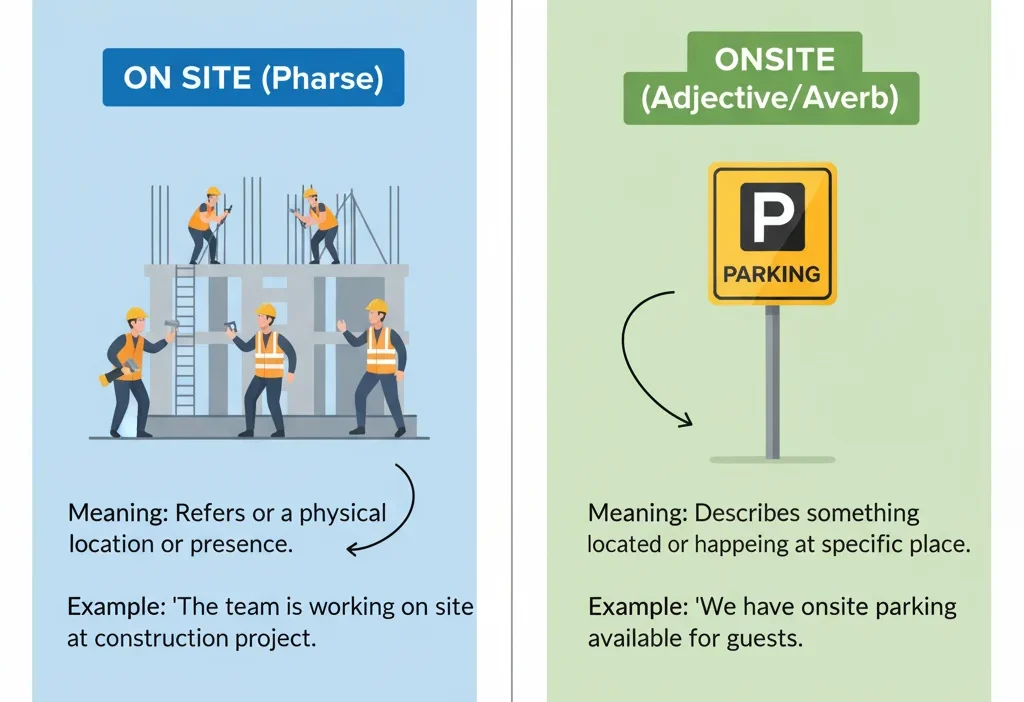
1. “On Site” (Two Words)
✅ Part of Speech: Phrase (preposition “on” + noun “site”)
✅ Meaning: It means “at a particular place” or “at a specific location.”
It describes being physically present at a location — such as a school, office, construction area, or store.
Examples:
- The engineers are working on site today.
- We met the manager on site to inspect the building.
- Food is available on site for all employees.
Think of “on site” as similar to “at the place.”
2. “Onsite” (One Word)
✅ Part of Speech: Adjective or adverb
✅ Meaning: It describes something that happens at the same place — often used before a noun.
It’s used to describe something related to a location or done within the same area.
Examples:
- The company has onsite parking for visitors.
- We offer onsite medical care for workers.
- The hotel provides onsite laundry services.
You can replace onsite with “at the place” and it will still make sense!
The Key Difference Between “On Site” and “Onsite”
| Feature | On Site | Onsite |
|---|---|---|
| Part of Speech | Phrase (preposition + noun) | Adjective or adverb |
| Meaning | At a specific location | Located or happening at that location |
| Usage | Used after verbs | Used before nouns |
| Example | The workers are on site today. | The company provides onsite housing. |
| Quick Tip | Use when saying “at the place.” | Use when describing something about that place. |
🧠 Quick Memory Trick:
👉 If the word comes before a noun, use “onsite.”
👉 If it comes after a verb, use “on site.”
Example:
- Correct: Workers are on site.
- Correct: Onsite workers are busy today.
Common Mistakes and How to Avoid Them
Let’s fix some common errors:
❌ Incorrect: The manager is onsite to check the progress.
✅ Correct: The manager is on site to check the progress.
👉 Why? It comes after the verb “is.”
❌ Incorrect: We provide on site parking.
✅ Correct: We provide onsite parking.
👉 Why? It comes before the noun “parking.”
Tip: Check where the word appears in your sentence — that’s your clue to the correct form!
When to Use “On Site”
Use “on site” when you mean “at the place” or when the phrase comes after a verb.
Examples:
- The doctors are on site 24 hours a day.
- You can pay on site at the registration desk.
- Security guards stay on site overnight.
- Students are allowed to eat lunch on site.
- The team will meet on site before starting work.
Easy Trick:
If you can replace it with “at the location,” then “on site” is correct.
When to Use “Onsite”
Use “onsite” when you are describing something or someone related to the location — especially before a noun.
Examples:
- We have onsite classrooms for training.
- The office includes onsite childcare services.
- There’s an onsite restaurant inside the factory.
- Onsite maintenance staff fix any issues quickly.
- The event will have onsite photographers.
Memory Hack:
If the word comes right before a noun, stick with “onsite.”
Example: onsite staff, onsite service, onsite event.
Quick Recap: On Site vs Onsite
✅ “On Site”
- Means “at a location.”
- Used after verbs.
- Example: The workers are on site today.
✅ “Onsite”
- Describes something at that location.
- Used before nouns.
- Example: The company offers onsite facilities.
🧩 Simple Rule to Remember:
After the verb? → “On site.”
Before a noun? → “Onsite.”
Advanced Tips and Fun Facts
🕰 Word Origin:
“On site” comes from the phrase “on the site,” meaning “at the place.” Over time, people started merging it into “onsite,” especially when using it as an adjective.
📚 In Formal Writing:
Both “on site” and “onsite” are correct — it depends on usage. Business and academic writing prefer onsite as an adjective (e.g., onsite inspection), but on site as a prepositional phrase (e.g., on site today).
💬 In Emails or Texts:
You might see people use them interchangeably. But if you want to sound professional, follow the grammar rule above.
Mini Quiz: Test Yourself!
Fill in the blanks with “on site” or “onsite.”
- The new building has _______ parking for employees.
- The technicians are working _______ today.
- We offer _______ training to improve safety.
- There’s a cafeteria _______ for all workers.
- The doctor is available _______ during emergencies.
- Our company provides _______ accommodation.
- The meeting will be held _______ tomorrow.
(Answers: 1. onsite, 2. on site, 3. onsite, 4. on site, 5. on site, 6. onsite, 7. on site)
FAQs
1. Which is grammatically correct: on site or onsite?
Both are correct — “on site” is a phrase, while “onsite” is an adjective or adverb.
2. Is onsite one word or two?
It depends on usage. Use “onsite” before nouns and “on site” after verbs.
3. Can I use onsite in formal writing?
Yes. “Onsite” is acceptable in formal or business English when describing services or locations.
4. Is onsite hyphenated?
No. “Onsite” is written as one word (not “on-site”) in modern English.
5. What’s the easiest way to remember the difference?
If it’s describing something → “onsite.”
If it’s telling where someone/something is → “on site.”
Conclusion
Now you know the difference between “on site” and “onsite” — and when to use each.
Use “onsite” when describing something (like “onsite staff” or “onsite service”) and “on site” when talking about being at a place (“The workers are on site”).
Practice using them in your writing and daily conversation — soon, you’ll never mix them up again!
✨ Keep learning, keep improving — every word makes your English stronger!

Celeste Rowan is a creative writer and editor at WordContrast.com, crafting compelling stories across topics like motivation, education, and personal development. She combines a warm narrative voice with data-driven insight to make her writing both relatable and reliable. Celeste believes words can spark change—and she writes to make that change happen.