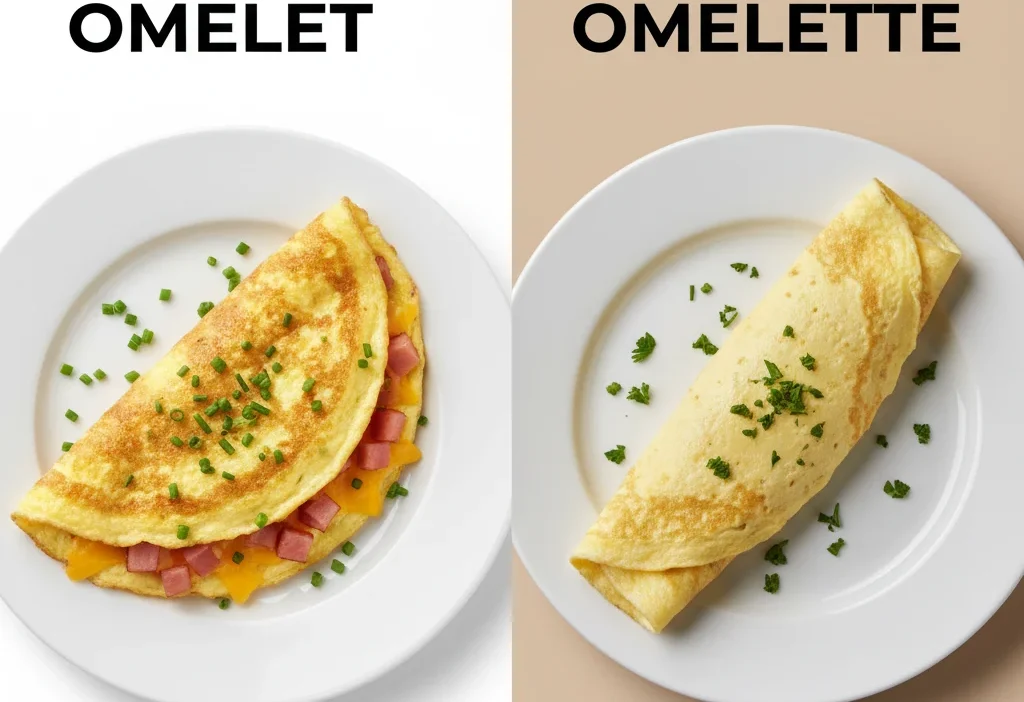
Have you ever seen both “omelet” and “omelette” written on menus or in recipes and wondered which one is right? Don’t worry — you’re not alone! These two spellings look almost the same, sound the same, and mean the same thing. But they come from different versions of English.
In this guide, you’ll learn:
- What each spelling means
- The difference between “omelet” and “omelette”
- When to use each one correctly
- Simple examples, tips, and memory tricks
By the end, you’ll never mix them up again — and you can order breakfast anywhere in the world with confidence!
🍳 What Does Each Word Mean?
🥚 What Does “Omelet” Mean?
Omelet is a noun.
It means a dish made from beaten eggs, cooked in a pan, and often folded around fillings like cheese, vegetables, or ham.
👉 In short: It’s your fluffy, delicious breakfast favorite!
Examples:
- I made a cheese omelet for breakfast.
- My brother loves mushroom omelets on Sundays.
- The café serves a big omelet with toast and coffee.
➡️ “Omelet” is the American English spelling. It’s common in the U.S. and sometimes in Canada.
🍽️ What Does “Omelette” Mean?
Omelette is also a noun, and it means the exact same thing — a dish made from beaten eggs cooked in a pan.
Examples:
- Mum made a vegetable omelette for lunch.
- I ordered a cheese omelette at the hotel.
- The recipe says to fold the omelette in half before serving.
➡️ “Omelette” is the British English spelling. It’s used in the U.K., Australia, India, and other Commonwealth countries.
🔍 The Key Difference Between “Omelet” and “Omelette”
Even though both words describe the same food, the difference lies in spelling and regional usage, not meaning.
| Feature | Omelet | Omelette |
|---|---|---|
| Meaning | A dish made from beaten eggs cooked in a pan | Same meaning |
| Language Style | American English | British English |
| Used In | U.S., Canada | U.K., Australia, India |
| Example Sentence | I ordered an omelet with cheese. | I ordered an omelette with cheese. |
| Pronunciation | /ˈɑː.mə.lɪt/ | /ˈɒm.lət/ |
💡 Quick Tip to Remember:
If you spell “color” (not “colour”) — use omelet.
If you spell “colour” — use omelette.
❌ Common Mistakes and How to Avoid Them
Mistake 1: Thinking They Mean Different Foods
❌ “An omelet is American, but an omelette has milk and cheese.”
✅ Both are the same dish — only the spelling changes.
Mistake 2: Mixing Spellings in the Same Text
❌ I made an omelet for breakfast and an omelette for lunch.
✅ Stick to one version depending on your audience (American or British).
Mistake 3: Overcomplicating Grammar
❌ Is omelette a plural or verb?
✅ It’s only a noun — and the plural is omelets or omelettes.
🍳 When to Use “Omelet”
Use “omelet” if:
- You’re writing for an American audience
- You’re following U.S. recipes or cookbooks
- You’re in the U.S. or Canada
Example Sentences:
- My favorite breakfast is a spinach omelet.
- Can you make a tomato omelet for me?
- The diner serves fluffy omelets every morning.
- He learned to flip an omelet without breaking it.
- I saw a recipe for a three-egg omelet online.
🧠 Memory Hack:
Think of “Omelet” = “USA short and simple.”
Americans often prefer shorter spellings (like “color” instead of “colour”).
🍽️ When to Use “Omelette”
Use “omelette” if:
- You’re writing for a British or international audience
- You’re reading U.K. recipes or magazines
- You’re in England, India, Australia, or Europe
Example Sentences:
- She ordered a ham omelette at the café.
- The chef served a delicious cheese omelette.
- He cracked three eggs to make an omelette.
- My grandmother’s omelette recipe is famous.
- I added herbs to the omelette for extra flavor.
🧠 Memory Trick:
The word “omelette” looks a bit fancier — just like British English often does!
76+Ready or Not vs Valley of the Dolls: Character Study 2025
🧾 Quick Recap: Omelet vs Omelette
- 🍳 Meaning: Both mean a cooked egg dish.
- 🇺🇸 Omelet = American English.
- 🇬🇧 Omelette = British English.
- 📚 Part of Speech: Noun.
- 🔤 Plural Forms: Omelets / Omelettes.
- ✍️ Usage Tip: Stay consistent — use one form in the same piece of writing.
🥇 Advanced Tips & Fun Facts
- The word comes from French “omelette,” first used in the 16th century.
- The American version (omelet) dropped the extra “-te” later to simplify spelling.
- In formal writing (like essays or cookbooks), choose one spelling and stick with it.
- In social media or texting, either is fine — just be consistent.
🧩 Mini Quiz: Test Your Understanding
Fill in the blanks with the correct word — omelet or omelette:
- I ordered a cheese ______ for breakfast.
- Americans usually write it as ______.
- The British spelling is ______.
- My mom taught me how to make an ______.
- Can you flip the ______ without breaking it?
- In U.K. recipes, you’ll often see the word ______.
- He added mushrooms to his ______.
(✅ Answers: 1. omelet/omelette, 2. omelet, 3. omelette, 4. omelet/omelette, 5. omelet, 6. omelette, 7. omelet)
❓FAQs About “Omelet” and “Omelette”
1. Is there any difference between an omelet and an omelette?
No, both mean the same dish. The only difference is spelling — “omelet” is American, “omelette” is British.
2. Which one should I use in writing?
Use “omelet” for American readers and “omelette” for British or international readers.
3. Are both spellings correct in English?
Yes, both are correct depending on where you are or who you’re writing for.
4. Is “omelet” countable or uncountable?
Countable. You can say “an omelet” or “two omelets.”
5. Can I use both spellings in one document?
It’s best to stay consistent. Pick one style (American or British) and use it throughout.
🏁 Conclusion
Now you know the truth about “omelet” vs “omelette.”
They’re the same delicious dish — just spelled differently in American and British English. Whether you prefer the short “omelet” or the fancy “omelette,” you’ll always be right as long as you’re consistent.
Keep learning little word differences like this every day — it’s the best way to become confident in English! 🥚✨

Henry Vale is a tech-savvy content creator at WordContrast.com, known for his in-depth guides and how-to articles. With a background in digital media and a passion for innovation, Henry focuses on simplifying technology for everyday users. His mission is to empower readers with clear, actionable knowledge they can use to improve their digital lives.