Noisy or noisey — which one is correct, and are you making this common mistake? Many writers, students, and content creators struggle with spelling and proper usage, often leaving sentences awkward or unprofessional. Choosing the wrong form can make your writing seem careless or confuse your readers.
This guide will give you clear, easy-to-follow rules for spelling and usage, explain the subtle differences (if any), and show you how to avoid embarrassing mistakes every time. By the end, you’ll know exactly which word to use in any context, so your writing is polished, professional, and confident.
What Does Each Word Mean?
Let’s break it down step by step.
1. Noisy – The Correct Word ✅
Part of Speech: Adjective
Meaning: “Noisy” means making or full of noise. It describes a place, person, or thing that is loud or not quiet.
Simple Examples:
- The classroom was very noisy during break time.
- My neighbors play noisy music every night.
- The noisy crowd cheered for the team.
🧠 Memory Tip: “Noisy” is just “noise” + “y.” Think of it like happy → happily. You don’t need an “e” before “y.”
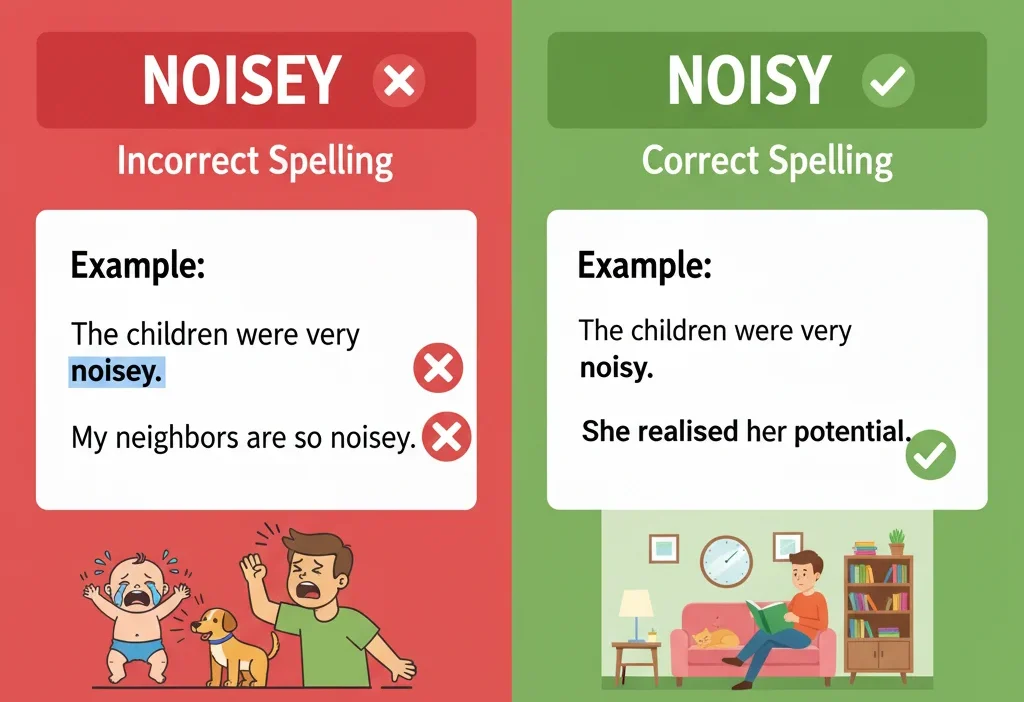
2. Noisey – The Incorrect Word ❌
Part of Speech: (Not a real English word)
Meaning: “Noisey” is a common misspelling of “noisy.” It doesn’t exist in standard English dictionaries.
You might see “noisey” online or in social media posts, but it’s still wrong. Always use “noisy.”
Incorrect Examples:
- ✗ The street was noisey last night.
- ✗ I can’t sleep because of the noisey dogs.
Corrected Versions:
- ✓ The street was noisy last night.
- ✓ I can’t sleep because of the noisy dogs.
The Key Difference Between “Noisey” and “Noisy”
Here’s a quick comparison to make it crystal clear:
| Feature | Noisy | Noisey |
|---|---|---|
| Correct Spelling | ✅ Yes | ❌ No |
| Meaning | Full of noise; loud | Not a real word |
| Part of Speech | Adjective | — |
| Example Sentence | The kids were very noisy. | ✗ The kids were very noisey. |
| Dictionary Status | Appears in all English dictionaries | Not found in any dictionary |
💡 Quick Tip to Remember:
If you remove “y” from the word, you should get a real word — noise. Since noisey gives you nois, it’s wrong!
Common Mistakes and How to Avoid Them
Many learners mistakenly think “noisey” follows the same pattern as words like money → moneyed or honey → honeyed. But that rule doesn’t apply here.
❌ Wrong:
- “The party was very noisey.”
- “It’s hard to study in a noisey place.”
✅ Correct:
- “The party was very noisy.”
- “It’s hard to study in a noisy place.”
Why the mistake happens:
People often add “-ey” to words ending in “e,” but “noise” drops the “e” before adding “y.”
How to fix it:
Remember: If a word ends with “e,” drop the “e” and add “y.”
→ noise → noisy
→ shine → shiny
→ smoke → smoky
When to Use “Noisy”
You should use “noisy” whenever you describe something or someone that makes a lot of sound.
Examples in Real Life:
- The noisy fan kept me awake all night.
- Our school bus is always noisy in the morning.
- We moved away from the noisy traffic.
- The parrot is small but very noisy.
- After the storm, the city was noisy with alarms and sirens.
💡 Memory Hack:
Think: If it’s loud, it’s noisy! — short, simple, and easy to recall.
When to Avoid “Noisey”
You should never use “noisey” — not in homework, essays, or messages. Even spell checkers will underline it in red because it’s not in the English dictionary.
If you’re writing something and it feels wrong, always double-check using a grammar app or dictionary. “Noisy” will always come up as the correct form.
Quick Recap: Noisey vs Noisy
✅ Noisy
- Correct spelling
- Means full of noise
- Adjective (describes something loud)
- Example: “The market was very noisy.”
❌ Noisey
- Incorrect spelling
- Not in English dictionaries
- Should always be replaced with “noisy”
🔑 Rule to Remember:
If a word ends with “e,” drop the “e” and add “y.” (noise → noisy)
Advanced Tips: Word Origin & Grammar Insight
The word “noisy” comes from the Middle English word noise, meaning sound or disturbance, and the suffix -y, which turns it into an adjective (something having that quality).
In formal writing, like essays or reports, “noisy” can describe both literal and figurative loudness:
- The noisy debate continued for hours.
- The city’s noisy energy never fades.
Avoid using “noisey” in emails, academic papers, or job applications, as it may seem unprofessional.
Even in texting or social media, correct spelling shows confidence and attention to detail.
Mini Quiz: Test Yourself!
Fill in the blanks with noisy or noisey (hint: only one is correct 😄).
- The _______ classroom made it hard to hear the teacher.
- Our neighbors are very _______ every weekend.
- Don’t be _______ in the library.
- The _______ engine woke everyone up.
- I like peaceful places, not _______ ones.
Answer Key: noisy, noisy, noisy, noisy, noisy ✅
FAQs About “Noisey” vs “Noisy”
1. Which is correct: noisey or noisy?
✅ “Noisy” is the correct spelling. “Noisey” is a common mistake.
2. Why is “noisey” wrong?
Because when adding “y” to a word ending in “e,” we drop the “e.” So noise → noisy.
3. What does “noisy” mean in English?
It means loud or full of noise. Example: “The kids were noisy during lunch.”
4. How can I remember the correct spelling?
Think: “Noise + y = Noisy.” Never add an extra “e.”
5. Can “noisey” be used in casual writing or slang?
No. Even in informal writing, “noisy” is always the right form.
Conclusion
So now you know — “noisy” is the only correct spelling! The word describes anything that’s loud or full of sound, while “noisey” is just a common misspelling.
Keep practicing and use the rule: If it ends with “e,” drop it before adding “y.”
The more you write and read, the more natural these spellings will feel. Keep learning — every small step improves your English skills! 🌟

Celeste Rowan is a creative writer and editor at WordContrast.com, crafting compelling stories across topics like motivation, education, and personal development. She combines a warm narrative voice with data-driven insight to make her writing both relatable and reliable. Celeste believes words can spark change—and she writes to make that change happen.