
People often mix up the words mouse and rat, especially when describing small animals in English. Both animals look somewhat alike, and both show up in stories, science classes, and even real life. Because of this, many learners get confused and ask: “Should I say mouse or rat?”
In this simple guide, you will learn the meaning, differences, correct usage, and examples of mouse vs rat. Everything is explained in easy English so even a 4th-grade student can understand it.
By the end of this article, you will know when to use “mouse” and when to use “rat,” how to avoid common mistakes, and how to remember the difference forever.
What “Mouse” Means
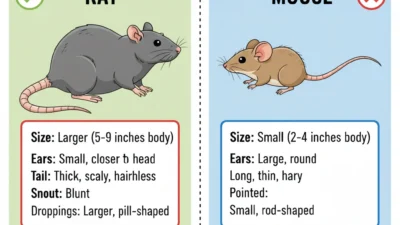
A mouse is a small animal with a tiny body, short fur, and a long thin tail.
It is much smaller than a rat.
Part of speech: noun
Simple Examples
- A mouse ran across the kitchen floor.
- We saw a little mouse in the garden.
- The cat caught a mouse.
A mouse is usually tiny, cute-looking, and not very scary.
What “Rat” Means
A rat is a bigger rodent with a thicker body, long tail, and stronger teeth.
Rats look sharper, tougher, and more dangerous than mice.
Part of speech: noun
Simple Examples
- A large rat was hiding near the trash bin.
- The farmer found a rat in the barn.
- A rat can bite harder than a mouse.
A rat is bigger, stronger, and usually considered harmful.
The Key Difference Between Mouse and Rat
Below is a very easy comparison table to remember their differences:
Mouse vs Rat Comparison Table
| Feature | Mouse | Rat |
|---|---|---|
| Size | Small | Much bigger |
| Tail | Thin and shorter | Long and thick |
| Looks | Cute, tiny face | Sharp face, bigger body |
| Behavior | Less harmful | More harmful |
| Common Sentence | “I saw a mouse.” | “I saw a rat.” |
Quick Tip to Remember
👉 If it’s small and cute → mouse.
👉 If it’s big and scary → rat.
Common Mistakes and How to Avoid Them
❌ Mistake 1:
“I saw a rat in my room!” (But it was actually tiny.)
✔ Correct: “I saw a mouse in my room.”
Why?
People say “rat” because they are scared, but most indoor sightings are mice.
❌ Mistake 2:
“There is a mouse near the street trash.”
✔ Correct: “There is a rat near the street trash.”
Why?
Trash areas attract bigger animals, usually rats—not mice.
❌ Mistake 3:
“The cartoon shows a rat helping the cook.”
✔ Correct: “The cartoon shows a mouse helping the cook.”
Cartoon mice (like Mickey Mouse) are small and cute, not rats.
When to Use “Mouse”
Use mouse when you are talking about:
- A small rodent
- A tiny animal inside homes or fields
- Cute animals shown in cartoons
- Something not dangerous
Easy Examples
- A mouse ate the cheese.
- I saw a mouse hiding under the bed.
- The baby mouse was very tiny.
- The mouse in the story helped the lion.
- She drew a picture of a mouse for her class.
Memory Hack
👉 Think of Mickey Mouse → small, cute, friendly.
When to Use “Rat”
Use rat when you are talking about:
- A bigger rodent
- An animal found near trash or big buildings
- Something harmful or dirty
- Wild, tough animals
Easy Examples
- A rat was running near the garbage.
- The old house had rats in the basement.
- A rat chewed the wires.
- They saw a huge rat at night.
- The farmer set traps for rats.
Memory Hack
👉 Think of a big scary animal = rat.
Quick Recap: Mouse vs Rat
- Mouse = small, cute, tiny body.
- Rat = big, strong, long tail.
- Use mouse for small indoor rodents.
- Use rat for large outdoor rodents.
- If it looks harmless → mouse.
- If it looks dangerous → rat.
Advanced Tips (Optional)
1. Origin & History
Both words come from Old English and Old German. “Mouse” comes from the older word mus, while “rat” comes from rattus. Their names have existed for hundreds of years.
2. Use in Essays or Exams
- Use mouse when describing a small scientific sample (biology experiments).
- Use rat for scientific studies involving larger animals.
- In formal writing, choose the correct word based on size and behavior.
3. Online Writing & Texting
People exaggerate and say “rat” even when they mean “mouse.”
But correct usage improves clarity and avoids confusion.
Mini Quiz (Test Yourself!)
Fill in the blanks with mouse or rat:
- The cat chased a small ________.
- A big ________ was near the trash bin.
- My sister screamed when she saw a tiny ________ in the cupboard.
- The farmer caught two large ________ last night.
- The cartoon hero is a friendly ________.
- A ________ chewed a hole in the grain bag.
- We found a baby ________ in the garden.
(Answers: mouse, rat, mouse, rats, mouse, rat, mouse)
FAQs
1. What is the main difference between a mouse and a rat?
A mouse is small and cute; a rat is bigger and stronger.
2. How do I know if I should say mouse or rat?
Check the size. Small = mouse. Big = rat.
3. Are “mouse” and “rat” used in grammar like “then or than”?
No, these are not grammar words. They are nouns for different animals.
4. Can a mouse be called a rat?
No. They are different animals with different sizes and features.
5. Which word is more commonly used in homes?
“Mouse” because small rodents enter homes more often.
Conclusion
Now you clearly understand the difference between mouse vs rat, how they look, when to use each word, and how to avoid common mistakes. With the examples, quick tips, and memory tricks, you can easily choose the correct word every time.
Keep practicing, stay curious, and improve your English step by step. You will get better every single day!

Oliver Thorne is a passionate digital storyteller and content strategist at WordContrast.com. With years of experience in SEO writing and online marketing, he specializes in transforming complex ideas into clear, engaging articles. Oliver loves exploring the latest trends in technology, productivity, and digital culture—helping readers stay informed and inspired in today’s fast-moving world.