Have you ever stopped while writing and wondered — should I say “man” or “men”?
You’re not alone! Many English learners mix these two words because they look and sound very similar. But using the wrong one can completely change your sentence’s meaning.
In this simple guide, you’ll learn the meaning, difference, and correct usage of “man” and “men” — with plenty of examples, grammar tips, and even a mini quiz at the end!
By the time you finish reading, you’ll know exactly when to use each word — even if you’re a beginner.
What Does Each Word Mean?
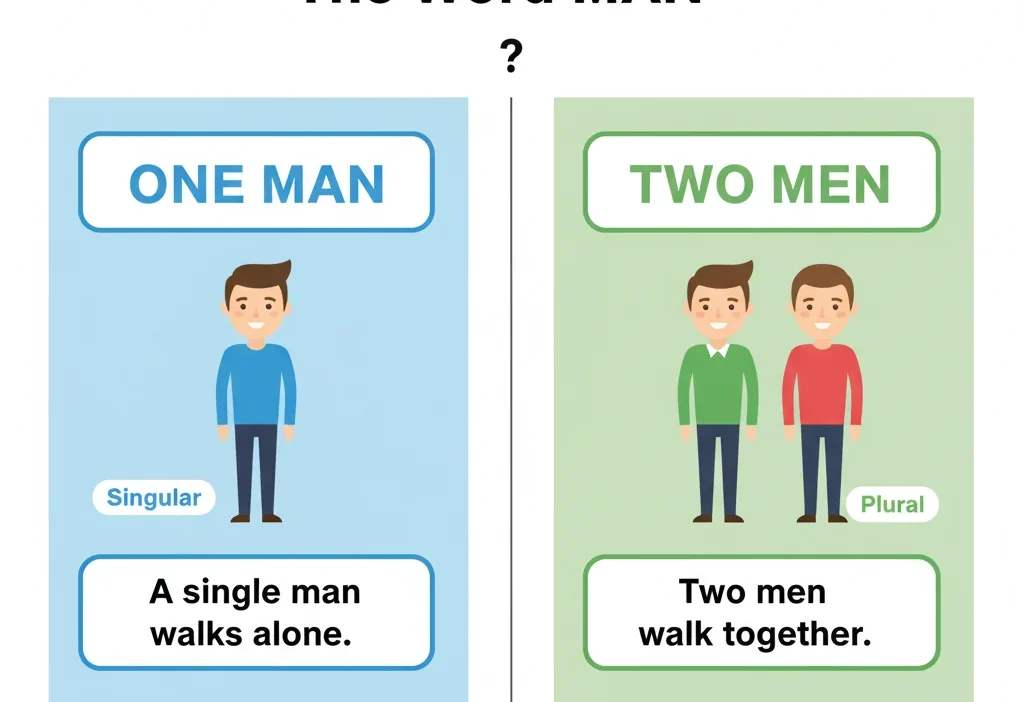
Let’s start with the basics: both “man” and “men” are nouns, and both refer to an adult male human.
But they differ in number — one means singular, and the other means plural.
What Does “Man” Mean?
“Man” means one adult male person.
It’s the singular form.
Examples:
- The man is reading a newspaper.
- A man walked into the shop.
- That man helped me cross the road.
💡 Tip: If you’re talking about one person, use “man.”
What Does “Men” Mean?
“Men” means more than one adult male.
It’s the plural form of “man.”
Examples:
- The men are playing football.
- Three men built the new bridge.
- All the men in the team wore blue shirts.
💡 Tip: If you’re talking about two or more people, use “men.”
The Key Difference Between Man and Men
| Feature | Man | Men |
|---|---|---|
| Meaning | One adult male person | Two or more adult male persons |
| Part of Speech | Noun (singular) | Noun (plural) |
| Example Sentence | The man is cooking dinner. | The men are cooking dinner. |
| When to Use | Talking about one person | Talking about more than one person |
| Pronunciation | /mæn/ (short “a” sound) | /men/ (short “e” sound) |
Quick Tip to Remember:
👉 “A” in “man” stands for A = one.
👉 “E” in “men” stands for E = everyone (more than one).
Common Mistakes and How to Avoid Them
❌ Mistake 1:
“I saw two man walking down the street.”
✅ Correct: “I saw two men walking down the street.”
Why?
Because “two” means plural, you must use “men.”
❌ Mistake 2:
“That men is my teacher.”
✅ Correct: “That man is my teacher.”
Why?
Because you are talking about one person, use man.
❌ Mistake 3:
“All the man are working.”
✅ Correct: “All the men are working.”
Why?
“All” refers to more than one, so the plural form “men” is correct.
When to Use “Man”
Use “man” when referring to one adult male.
It can also be used in general terms for human(though now people often use “humans” or “people” instead to be more inclusive).
Examples:
- A man is standing by the door.
- That man drives a taxi.
- This is the man who won the race.
- Every man has his own dreams.
- The man at the counter was very kind.
Everyday Use Tip:
If you could replace the word with “he” or “him,” you probably need “man.”
When to Use “Men”
Use “men” when referring to more than one adult male — usually in groups or plural situations.
Examples:
- The men are working on the road.
- Two men helped me move my boxes.
- All men must wear helmets in the factory.
- The men in the class are very polite.
- These men are firefighters.
Memory Hack:
Think of the word “many” — both “men” and “many” start with “M” and have an “e.”
👉 Many → Men → More than one!
🌞 When to Take CoQ10: Morning or Night for Best Results? 2025
Quick Recap: Man vs Men
- “Man” = One person.
✅ Example: The man is tall. - “Men” = More than one person.
✅ Example: The men are tall. - Singular → man
- Plural → men
- Think “A man” (one) vs “Many men” (more than one).
Always check your numbers:
If your sentence has words like “one,” “a,” “that,” or “this,” → use man.
If it has “two,” “many,” “those,” or “all,” → use men.
Advanced Tips (For Curious Learners)
- Origin:
The word “man” comes from Old English mann, which originally meant person or human being.
Over time, it began to refer specifically to adult males. - Formal Writing:
In essays or formal contexts, “man” can sometimes represent human(e.g., “Man has always sought knowledge”).
But today, it’s more common to say “humans” or “people” for gender neutrality. - In Expressions:
- “Every man for himself.” (each person acts for their own benefit)
- “Men at work.” (group of male workers)
- “Man of the match.” (best male player)
- In Everyday English:
You’ll hear both in movies, signs, or daily talk.
Always notice numbers — they’ll tell you which one to use!
Mini Quiz: Test Yourself!
Fill in the blanks with the correct word — man or men.
- That _____ is my uncle.
- Five _____ are waiting outside.
- A brave _____ saved the child.
- The two _____ are police officers.
- This _____ is very kind to animals.
- All the _____ were tired after the game.
- The _____ at the shop gave me a discount.
✅ Answers: 1. man, 2. men, 3. man, 4. men, 5. man, 6. men, 7. man.
Conclusion
Now you know the difference between “man” and “men” — and when to use each correctly!
Remember:
👉 Man = One person
👉 Men = More than one person
Keep practicing with examples in your daily conversations or writing. The more you use, the more natural they’ll feel.
FAQs
1. What is the plural of man?
The plural of “man” is “men.”
2. Can “man” mean all humans?
Yes, in older or formal English, “man” can mean humankind, but “people” or “humans” is now more common.
3. Why does “man” change to “men” and not “mans”?
Because it’s an irregular plural noun — its vowel changes from “a” to “e.”
4. How do you pronounce “men”?
It’s pronounced /men/, like “pen.”
5. Is “men’s” the plural possessive form?
Yes! “Men’s” shows something belongs to multiple men — e.g., “Men’s jackets.”

Marianne Solace is a lifestyle and personal-growth writer for WordContrast.com. Her work blends inspiration with practicality, offering thoughtful insights on wellness, creativity, and mindful living. When she’s not writing, Marianne enjoys journaling with a cup of coffee, exploring art museums, and helping others find balance through the written word.