
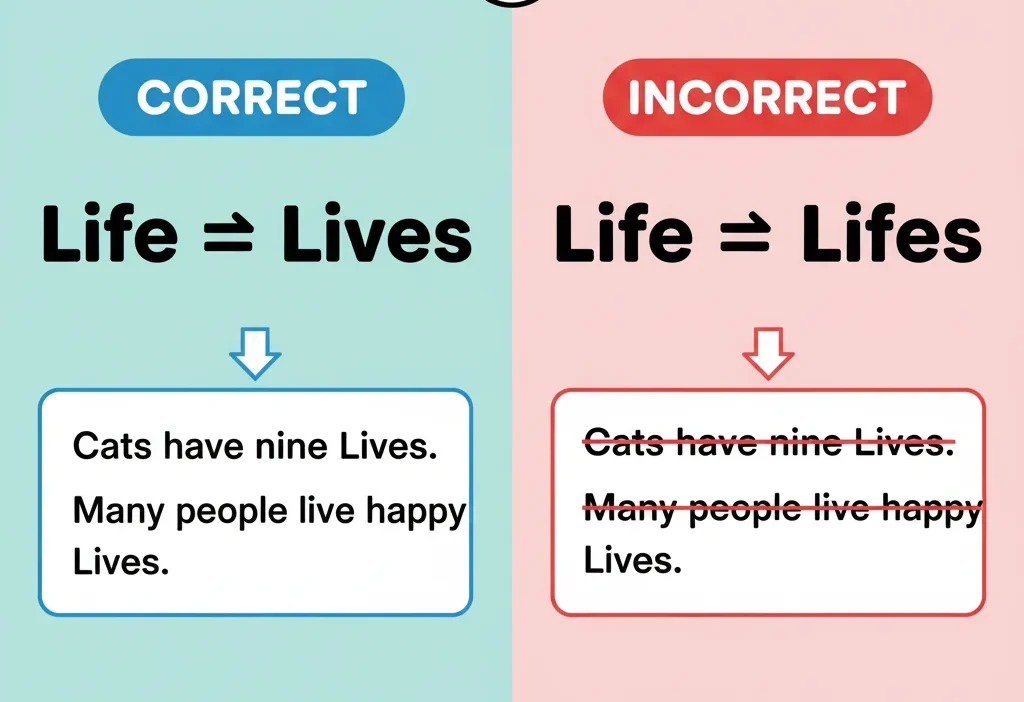
But here’s the truth: only one of them is correct in standard English.
Have you ever written “lifes” instead of “lives” and wondered if it’s right? You’re not alone! Many English learners get confused between these two because they look similar — and both seem like they could mean “more than one life.”
In this simple guide, you’ll learn the meaning, difference, and correct usage of lifes and lives — with examples so easy that even a 4th grader can understand.
By the end, you’ll know exactly when and how to use lives correctly — and never make the mistake of using lifes again!
What Does Each Word Mean?
Let’s break it down simply.
1. “Life” — The Singular Form
Part of speech: Noun
Meaning: The existence of a person, animal, or any living thing.
Examples:
- Life is beautiful when you smile.
- She saved a cat’s life.
- Life on Earth depends on water.
“Life” is singular — it talks about one being or existence.
2. “Lives” — The Correct Plural Form
Part of speech: Noun (plural of life) / Verb (form of live)
As a noun:
“Lives” means more than one life.
Example: “The firefighters saved many lives.”
As a verb:
“Lives” also comes from the verb live, meaning “to exist” or “to stay somewhere.”
Example: “She lives in London.”
Examples:
- The doctor saved many lives. (noun)
- He lives near the park. (verb)
- Animals in the jungle live freely. (verb)
So, “lives” can be both a plural noun and a verb form. That’s why it’s often confusing — but we’ll make it easy.
3. “Lifes” — A Common Mistake
“Lifes” ❌ is not a real English word. It’s a spelling mistake that happens when people try to make life plural by just adding -s.
However, life is an irregular noun — it changes f → v before adding -es.
✅ Correct: Life → Lives
❌ Incorrect: Life → Lifes
Think of other similar words:
- Knife → Knives
- Wife → Wives
- Leaf → Leaves
So, lifes never appears in correct English writing.
The Key Difference Between “Lifes” and “Lives”
Here’s a simple comparison table to make it clear:
| Word | Part of Speech | Meaning | Correct Usage | Example Sentence |
|---|---|---|---|---|
| Life | Noun (singular) | One existence | Use for one person/being | “A dog’s life is short.” |
| Lives | Noun (plural) / Verb | More than one life OR present tense of live | Use as plural or as a verb | “They saved many lives.” / “She lives in Paris.” |
| Lifes | ❌ Not a word | ❌ Incorrect spelling | ❌ Never use | — |
Quick Tip to Remember:
If the word ends with “f” (like life), change f → v and add -es to make it plural.
Example: Life → Lives, Knife → Knives.
Common Mistakes and How to Avoid Them
Let’s look at a few common errors and how to fix them.
| ❌ Wrong | ✅ Correct | Why |
|---|---|---|
| I love reading about different lifes. | I love reading about different lives. | “Life” is irregular — it becomes lives. |
| My cat lifes in the garden. | My cat lives in the garden. | “Lives” is the correct verb form. |
| He saved three lifes in the accident. | He saved three lives in the accident. | The plural of life is lives. |
Tip: Always remember — “lifes” doesn’t exist. If you’re talking about more than one life or using the verb live, always choose lives.
When to Use “Lives”
Use lives when:
- You’re talking about more than one life (noun).
- Example: Doctors save many lives every day.
- You’re describing someone’s residence or existence (verb).
- Example: She lives near the ocean.
- You’re explaining how something continues to exist.
- Example: The memory of his kindness lives on.
More Examples:
- The villagers risked their lives to help others.
- My grandmother lives a peaceful life.
- Hope lives in every heart.
Memory Hack:
➡️ “Lives” has “v” for vital, meaning alive! That’s how you remember it’s the right one.
When to Use “Lifes”
Never. ✅
“Lifes” is not a real word in English grammar.
If you ever feel tempted to write it, stop and remember:
“Life becomes lives — not lifes.”
Quick Recap: “Lifes” vs “Lives”
- Life = one existence.
- Lives = more than one life OR the action of living.
- Lifes = ❌ incorrect spelling.
✅ Easy Rule:
If it ends with f, change f → v and add -es.
Examples:
Life → Lives
Knife → Knives
Wife → Wives
Advanced Tips: Grammar and History
- The word “life” comes from Old English līf, meaning “existence.”
- Its plural “lives” followed an old English rule where some words ending in f change to v for plural forms.
- This rule still applies to a few modern words like leaf → leaves and wolf → wolves.
In formal writing (like essays or exams):
- Use “lives” correctly — examiners often notice this common mistake.
- Never write “lifes,” even casually.
In texting or online writing, people sometimes use “lifes” by accident. Avoid it to keep your English sharp and professional.
Mini Quiz: Test Your Understanding
Fill in the blanks with life or lives.
- Doctors work hard to save many _______.
- My sister _______ in New York.
- The story of his bravery still _______ on.
- A good _______ is full of kindness.
- They risked their _______ to rescue the puppy.
Answers:
- lives
- lives
- lives
- life
- lives
FAQs
1. Which is correct — lifes or lives?
✅ Lives is correct. Lifes is not a real word.
2. What is the plural of life?
The plural of life is lives.
3. Can “lives” be used as a verb?
Yes. Example: “She lives in Canada.”
4. Why do we say lives instead of lifes?
Because words ending in f often change f → v before adding -es.
5. How do you pronounce “lives”?
/lɪvz/ — rhymes with “gives.”
Conclusion
Now you know the truth — “lifes” doesn’t exist, and “lives” is always the correct form.
Remember:
- “Life” is singular.
- “Lives” is plural or a verb form of live.
Keep practicing with short sentences and real-life examples. The more you use it, the more natural it feels!
Learning small grammar rules like this makes your English clearer and more confident every day. 🌟

Celeste Rowan is a creative writer and editor at WordContrast.com, crafting compelling stories across topics like motivation, education, and personal development. She combines a warm narrative voice with data-driven insight to make her writing both relatable and reliable. Celeste believes words can spark change—and she writes to make that change happen.


