
Have you ever heard someone ask, “Should I call your landline or cell?” and wondered what exactly that means? You’re not alone! These two words—landline and cell—are often used when talking about phones, but they describe very different things.
In this article, we’ll explain the difference between landline and cell, their meanings, and how to use each word correctly in daily conversation. We’ll go step by step, with simple examples and a comparison table to make it easy to understand.
By the end, you’ll know exactly when to say landline and when to say cell, so you can sound confident in English conversations.
What Does Each Word Mean?
Let’s start by understanding what landline and cell actually mean.
Landline – Definition and Meaning
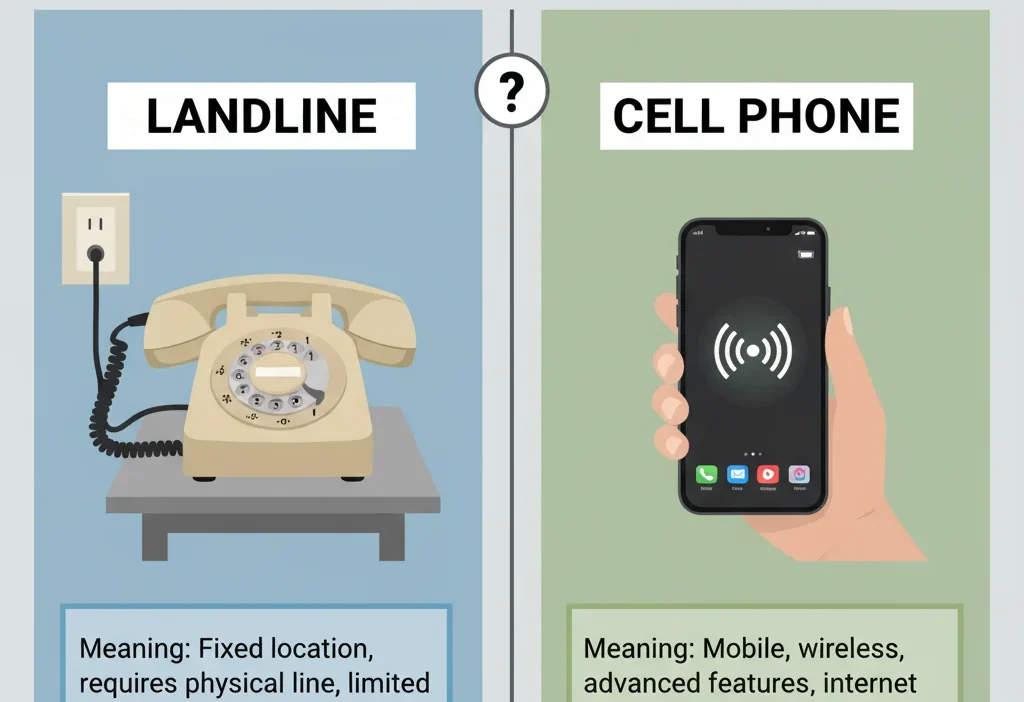
A landline is a telephone connected by wires to a network. It stays in one place, usually at home or in an office. The signal travels through cables, not through the air.
Part of speech: Noun
Simple definition: A phone that uses wires to make calls.
Examples:
- “You can call me on my landline after 6 p.m.”
- “Our landline stopped working during the storm.”
- “Every office used to have a landline before mobile phones became common.”
You can think of a landline as a “home phone.” It’s fixed and cannot move around.
Cell – Definition and Meaning
Cell (short for cell phone or cellular phone) means a mobile phone—a device you can carry anywhere. It works using radio signals and towers, not wires.
Part of speech: Noun
Simple definition: A phone that works without wires and can move with you.
Examples:
- “I’ll text you from my cell when I get there.”
- “He forgot his cell at home.”
- “Most people use their cell more than their home phone.”
A cell phone is portable and wireless—perfect for travel, school, or work on the go.
The Key Difference Between Landline and Cell
Here’s a clear comparison table to help you see the difference:
| Feature | Landline | Cell (Cell Phone) |
|---|---|---|
| Connection Type | Uses wires and cables | Uses wireless signals and towers |
| Mobility | Fixed in one location | Portable, can be used anywhere |
| Power Source | Works without charging (plugged in) | Needs regular charging |
| Sound Quality | Often clearer and more stable | Depends on signal strength |
| Example Sentence | “Call me on the landline at work.” | “I’ll call you from my cell later.” |
Quick Tip to Remember:
👉 Landline = land (it stays on the ground).
👉 Cell = cellular network (it moves with you everywhere).
Common Mistakes and How to Avoid Them
Let’s look at a few mistakes people often make when using these words.
| ❌ Incorrect | ✅ Correct | Explanation |
|---|---|---|
| “I lost my landline at school.” | “I lost my cell at school.” | You can’t lose a landline—it’s not portable. |
| “My cell is connected to the wall.” | “My landline is connected to the wall.” | Landlines connect through wires, not cells. |
| “I called her landline while driving.” | “I called her cell while driving.” | You wouldn’t use a landline on the go. |
How to fix it:
Remember — landline stays, cell moves.
When to Use “Landline”
You use landline when talking about:
- Phones at home or the office
- Devices that use cables or wires
- Conversations that happen in one place
Examples:
- “My grandparents only have a landline.”
- “Can you write down the landline number?”
- “Our office landline is available 9 to 5.”
- “The power outage didn’t affect our landline.”
- “He called from the landline because his mobile battery died.”
Memory Tip:
Think “land” = fixed on the ground → landline = fixed phone.
When to Use “Cell”
Use cell when referring to:
- Mobile or portable phones
- Wireless communication
- Everyday talking, texting, or calling anywhere
Examples:
- “Don’t forget to charge your cell.”
- “I’ll call you from my cell when I’m on the way.”
- “Students mostly use their cells for online learning.”
- “Keep your cell on silent in class.”
- “She left her cell in the car.”
Memory Hack:
“Cell” sounds like “sell” — you can sell or carry it anywhere. It moves with you!
Quick Recap: Landline vs Cell
- Landline → Fixed, wired phone at home or work.
- Cell → Wireless, mobile phone you can carry.
- Main difference → Wires vs. wireless, fixed vs. mobile.
- Easy trick → Landline stays; cell moves.
✅ Always use landline for home or office phones.
✅ Use cell for portable, wireless phones.
Advanced Tips and Background
- The word landline became common in the 20th century, when wired phones were standard in homes.
- Cell comes from cellular network, which refers to the way phone signals travel through different network “cells” (areas covered by towers).
- In formal writing, use landline phone or cell phone for clarity.
- In texting, people often just say “phone,” but in job forms or surveys, you might see both:
- “Enter your landline number.”
- “Enter your cell number.”
- Misusing them can confuse people—for example, saying “I’ll call your landline” when you mean their cell might make them wait by the wrong phone!
Mini Quiz: Test Your Understanding
Fill in the blanks with landline or cell.
- Grandma still uses a ___________ to talk to her friends.
- I always keep my ___________ charged.
- The office ___________ number is busy right now.
- She forgot her ___________ at home.
- During the storm, our ___________ worked when mobiles didn’t.
- He called from his ___________ while traveling.
- Please leave your ___________ number for emergency contact.
(Answers: 1. landline, 2. cell, 3. landline, 4. cell, 5. landline, 6. cell, 7. cell)
FAQs
1. What is the main difference between landline and cell?
A landline uses wires and stays in one place, while a cell (cell phone) is wireless and portable.
2. Is a smartphone the same as a cell phone?
Yes, a smartphone is a type of cell phone with extra features like apps and internet access.
3. Can I use “phone” instead of saying landline or cell?
Yes, “phone” is fine in general conversation, but “landline” or “cell” gives more detail.
4. Which one works without electricity?
Most landlines can work during power cuts, while cells need battery power.
5. Why is it called a “cell phone”?
Because it connects through a network of cellular towers, each covering a small “cell” area.
Conclusion
Now you know the difference between landline and cell!
A landline is the traditional wired phone that stays put, while a cell (or cell phone) is your portable, wireless companion.
Remember: Landline stays. Cell moves.
Practice using these words correctly when talking about phone numbers or devices. The more you use them, the more natural it will feel.
Keep learning and improving your English one word at a time—you’re doing great!

Oliver Thorne is a passionate digital storyteller and content strategist at WordContrast.com. With years of experience in SEO writing and online marketing, he specializes in transforming complex ideas into clear, engaging articles. Oliver loves exploring the latest trends in technology, productivity, and digital culture—helping readers stay informed and inspired in today’s fast-moving world.