Many people get confused between job aid or job aide. At first glance, these two phrases look almost identical, but they have different meanings and uses. Mixing them up can make your writing unclear, especially in professional or educational settings.
In this guide, you will learn what each term means, how to use them correctly, and the common mistakes people make. By the end, even if you are a beginner, you will confidently know when to write job aid and when job aide fits best.
This article includes clear definitions, easy examples, memory tips, and a handy comparison table. No confusing grammar rules — just simple explanations anyone can understand.
What Does Each Word Mean?
Job Aid
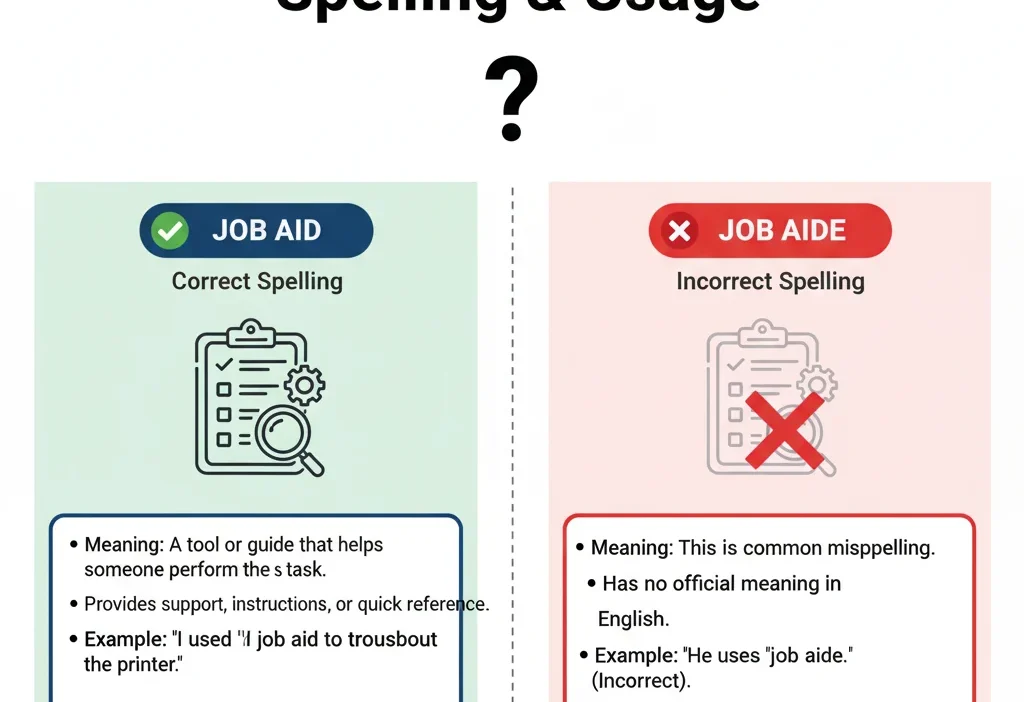
A job aid is a tool or resource that helps someone perform a task more easily. It is not a person; it’s usually a chart, checklist, guide, or step-by-step instruction.
- Part of Speech: Noun
- Meaning: A helpful tool or guide to complete a task
Examples:
- The company gave all employees a job aid to fill out the new software form.
- I keep a small job aid on my desk to remember the monthly reporting steps.
- The teacher handed out a job aid to help students solve math problems.
Think of a job aid as a “cheat sheet” or “quick guide” that helps you do your work faster and correctly.
Job Aide
A job aide, on the other hand, refers to a person — someone who assists another person in their work. This is less common than job aid but still correct in some contexts.
- Part of Speech: Noun
- Meaning: A helper or assistant for someone at work
Examples:
- The senator’s job aide scheduled all of her meetings for the day.
- During the event, my job aide helped set up the decorations.
- The manager relies on a job aide to organize all team documents.
Think of a job aide as a “helper” who supports someone in their job duties.
The Key Difference Between Job Aid and Job Aide
Here’s a simple comparison table for quick understanding:
| Feature | Job Aid | Job Aide |
|---|---|---|
| Meaning | A tool or guide to help complete a task | A person who helps someone with their work |
| Part of Speech | Noun | Noun |
| Example Sentence | The company provided a job aid for the new software. | The CEO’s job aide prepared the daily schedule. |
| Quick Tip | If it’s an object or document, use aid | If it’s a person, use aide |
Quick Tip: Remember — aid = tool, aide = assistant.
Common Mistakes and How to Avoid Them
Mistake 1: Using “job aide” for a tool
Incorrect: I printed a job aide for the training session.
Correct: I printed a job aid for the training session.
Why: The printed guide is not a person; it’s a tool.
Mistake 2: Using “job aid” for a person
Incorrect: My manager assigned me a job aid to help organize meetings.
Correct: My manager assigned me a job aide to help organize meetings.
Why: A person is assisting, not a tool.
Mistake 3: Confusing spelling in professional writing
Incorrect: The HR department asked for a job aide checklist.
Correct: The HR department asked for a job aid checklist.
Why: Remember, documents or checklists are always aid, never aide.
When to Use Job Aid
Use job aid whenever you are referring to a document, chart, guide, checklist, or tool that helps perform a task.
Examples:
- The job aid explains how to operate the new printer.
- I use a job aid to remember the steps for filing tax forms.
- Students were given a job aid to solve geometry problems.
- Our team created a job aid for customer service scripts.
- You can create a simple job aid to track your daily tasks.
Real-life tip: Think “job aid = quick reference sheet.”
When to Use Job Aide
Use job aide when referring to a person who helps or supports another worker.
Examples:
- The senator’s job aide handled all phone calls and appointments.
- During the conference, my job aide assisted with setting up materials.
- The CEO relies on a job aide to prepare briefing notes.
- The teacher’s job aide helped organize classroom activities.
- Military officers often have a job aide to assist with planning.
Memory Hack: Think “aide = assistant.” If it’s a person, spell it aide.
Quick Recap: Job Aid vs Job Aide
- Job Aid
- Tool, guide, or checklist
- Helps complete a task
- Example: “Use the job aid to learn the software.”
- Job Aide
- Person who assists someone
- Helps in daily work or tasks
- Example: “The manager’s job aide arranged all meetings.”
Remember: Aid = tool, Aide = assistant.
Advanced Tips
- Origin: “Aid” comes from Latin adiutare (to help), while “aide” comes from French, meaning assistant.
- Formal writing: In reports, HR documents, and manuals, job aid is much more common than job aide.
- Texting / online writing: Using “job aide” instead of “job aid” can confuse readers who expect a document, not a person.
Mini Quiz
Fill in the blanks with job aid or job aide:
- The teacher gave a __________ to help students with spelling.
- The senator’s __________ scheduled all the meetings.
- I always keep a __________ on my desk for software instructions.
- My manager’s __________ helped prepare the presentation.
- The company created a __________ for customer service training.
- The CEO relies on a __________ to organize office events.
- During training, a __________ guided us through the process.
FAQs
1. Can “job aide” be used for a document?
No, job aide refers to a person. Use job aid for documents or tools.
2. Are “aid” and “aide” interchangeable?
No. “Aid” = help/tool. “Aide” = person/assistant.
3. Which is more common in workplaces?
Job aid is more common because most references are to tools or guides.
4. Can I use “job aide” in informal writing?
Yes, but only when clearly referring to a person assisting another.
5. How can I remember the difference?
Think: aid = tool, aide = assistant. Easy visual: a document = aid, a person = aide.
Conclusion
Now you know the difference between job aid or job aide. One is a tool or guide, and the other is a person helping someone. With these tips, examples, and memory hacks, you can use both words confidently in writing and speaking.
Practice creating sentences using job aid for documents and job aide for assistants. Each time you write correctly, your English improves a little more. Remember, learning English is a journey — and every step counts!

Henry Vale is a tech-savvy content creator at WordContrast.com, known for his in-depth guides and how-to articles. With a background in digital media and a passion for innovation, Henry focuses on simplifying technology for everyday users. His mission is to empower readers with clear, actionable knowledge they can use to improve their digital lives.