
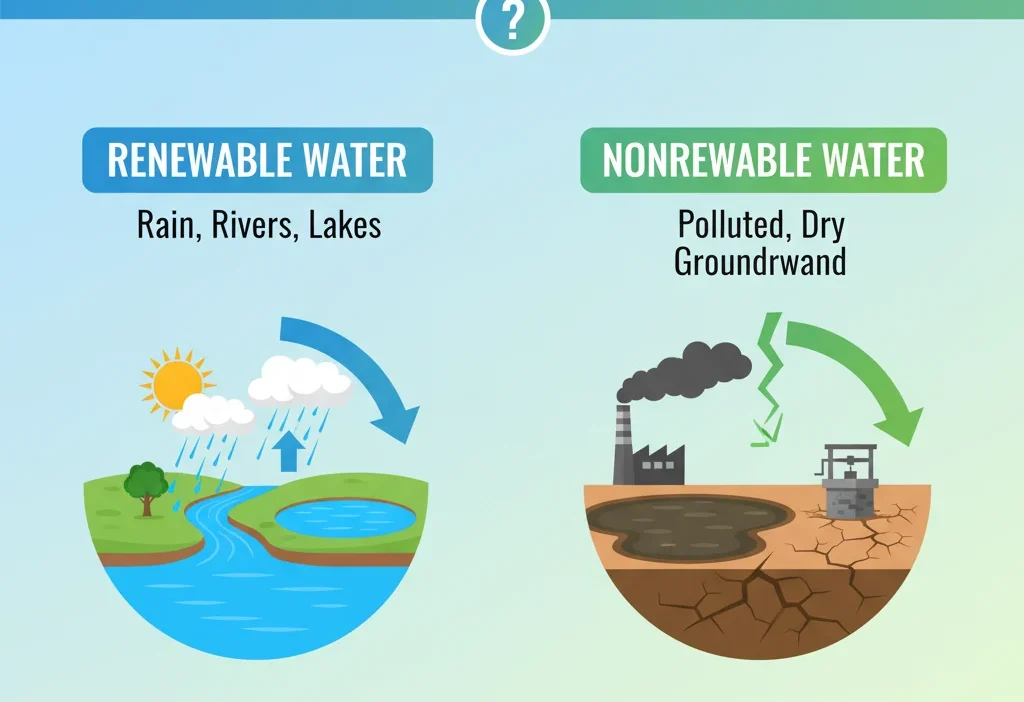
Have you ever wondered — is water renewable or nonrenewable? This question often confuses people, especially students learning about natural resources and the environment. Some say water is renewable because it comes back as rain, while others think it’s nonrenewable because it can run out.
In this simple guide, we’ll explain what “renewable” and “nonrenewable” mean, how water fits into both categories, and when it can become limited. You’ll also see real-life examples, easy explanations, and a quick quiz at the end to test your understanding.
By the time you finish reading, you’ll clearly understand whether water is renewable, nonrenewable, or both — in the simplest way possible!
💧 What Does “Renewable” and “Nonrenewable” Mean?
Before we decide if water is renewable or nonrenewable, we need to understand what these two terms mean.
✅ Renewable Resources
A renewable resource is something that nature can replace quickly after we use it.
Examples: sunlight, wind, and trees.
Easy examples:
- The sun shines every day — we never “run out” of sunlight.
- Wind keeps blowing — we can always use it to make electricity.
- Trees grow again after being cut down (if we plant more).
So, renewable means it can be naturally replaced in a short time.
❌ Nonrenewable Resources
A nonrenewable resource cannot be replaced easily. Once we use it up, it takes millions of years to form again.
Examples: oil, coal, and natural gas.
Easy examples:
- If we burn all the coal, we can’t make new coal quickly.
- Oil used in cars doesn’t come back easily — it takes millions of years to form.
- Natural gas runs out once we use it.
So, nonrenewable means it cannot be replaced quickly.
🌍 Is Water Renewable or Nonrenewable?
Now let’s apply what we learned.
At first, it seems clear: water is renewable.
It moves through the water cycle — it evaporates from oceans, forms clouds, and falls back as rain. This keeps repeating forever.
But wait — if water is renewable, why do some places face droughts and water shortages?
That’s where the difference comes in. Water is renewable in theory, but it can become nonrenewable in practice when misused, polluted, or overdrawn.
Let’s explore this clearly.
🔎 The Key Difference Between Renewable and Nonrenewable Water
| Aspect | Renewable Water | Nonrenewable Water |
|---|---|---|
| Definition | Water that naturally replenishes through the water cycle (rain, rivers, groundwater). | Water that cannot be replenished fast enough once used or polluted. |
| Examples | Rainwater, river water, lakes that refill every season. | Groundwater from deep aquifers that refill very slowly. |
| Time to Replace | Quickly replaced (days to months). | Takes hundreds or thousands of years. |
| Human Impact | Remains renewable when used wisely. | Becomes nonrenewable if overused or polluted. |
| Simple Tip | Renewable = can come back. | Nonrenewable = gone for a long time. |
🧠 Quick Tip to Remember:
“If water can come back soon, it’s renewable.
If it takes too long or is gone forever, it’s nonrenewable.”
⚠️ Common Mistakes and How to Avoid Them
❌ Mistake 1: “All water is renewable.”
Correction: Not always!
Deep groundwater or fossil water takes thousands of years to refill, so it’s nonrenewable.
❌ Mistake 2: “Water never runs out.”
Correction: Water doesn’t disappear, but clean water can become scarce due to pollution and overuse.
❌ Mistake 3: “Polluted water is still renewable.”
Correction: Once water is too polluted, it becomes nonrenewable until nature (or technology) can clean it — and that can take years.
💦 When Is Water Renewable?
Water is renewable when it can return to use through the natural water cycle or human conservation efforts.
✅ Examples:
- Rain refills rivers and lakes each season.
- Melted snow flows into reservoirs.
- Recycled water used in gardens or industries.
- Desalinated seawater reused for drinking.
- Clean rivers and lakes maintained through conservation.
When we protect and recycle water, we make it renewable for future generations.
🚱 When Is Water Nonrenewable?
Water becomes nonrenewable when we use it faster than it refills or pollute it beyond repair.
❌ Examples:
- Pumping underground water faster than it rains.
- Polluting rivers with chemicals or waste.
- Cutting down forests, which stops rain from refilling lakes.
- Wasting clean water in dry areas.
- Overusing irrigation water in farming without recycling.
💡 Memory Trick:
“If you can’t get it back soon, it’s nonrenewable water.”
🔁 Quick Recap: Renewable vs Nonrenewable Water
- Renewable water: Comes back through the water cycle (rain, rivers, lakes).
- Nonrenewable water: Lost or unavailable for long periods.
- Key idea: The way humans use and protect water decides whether it stays renewable.
- Rule: Use wisely → renewable; waste carelessly → nonrenewable.
🧭 Advanced Tips and Facts
- Origin of the Idea: The terms “renewable” and “nonrenewable” come from environmental science, where “renewable” means “can be replaced naturally.”
- Water Cycle Role: Evaporation → condensation → precipitation → collection — this keeps water renewable.
- Fossil Water: Some groundwater (like in deserts) is called fossil water — millions of years old and nonrenewable.
- In Writing or Exams: When asked, say: “Water is a renewable resource, but it can become nonrenewable if used faster than it is replaced.”
🧠 Mini Quiz: Test Your Understanding
Fill in the blanks to check what you learned!
- A ______ resource can be replaced quickly by nature.
- A ______ resource takes millions of years to form.
- Water becomes nonrenewable when it is ______ or ______.
- The water cycle makes water ______.
- ______ water takes thousands of years to refill.
(Answers: 1. renewable, 2. nonrenewable, 3. overused, polluted, 4. renewable, 5. Groundwater)
💬 5 Common FAQs
1. Is water a renewable or nonrenewable resource?
Water is mostly renewable, but it can become nonrenewable if overused or polluted.
2. Why do some scientists call water nonrenewable?
Because in many dry regions, underground water doesn’t refill quickly — it’s lost for centuries.
3. Can humans make water?
No. We can purify and recycle it, but we can’t create new water naturally.
4. Is ocean water renewable?
Yes, ocean water is part of the water cycle, but we must use desalination to make it drinkable.
5. How can we keep water renewable?
By saving water, reducing pollution, planting trees, and recycling it responsibly.
🌱 Conclusion
So, is water renewable or nonrenewable?
The truth is — water is both. It’s renewable when we protect, clean, and recycle it, but nonrenewable when we waste or pollute it.
Every drop counts! By using water wisely, we make sure this precious resource stays renewable for everyone — today and in the future.
Written by an environmental and English enthusiast passionate about making complex topics simple for everyone.


