Many students and even adults often ask the same question: Is sand homogeneous or heterogeneous? At first, it feels confusing because sand looks like one thing from far away, but when you look closely, you see tiny grains of different colors and sizes. This makes people unsure how to classify it.
In this guide, you will learn the simple meanings, the difference between homogeneous and heterogeneous, and how sand fits into these categories. Every idea is explained in easy, everyday English, so even a 4th-grade student can understand clearly. By the end, you’ll know exactly how to tell the difference, how to use these words correctly, and you’ll never get confused again
What Does “Homogeneous” Mean?
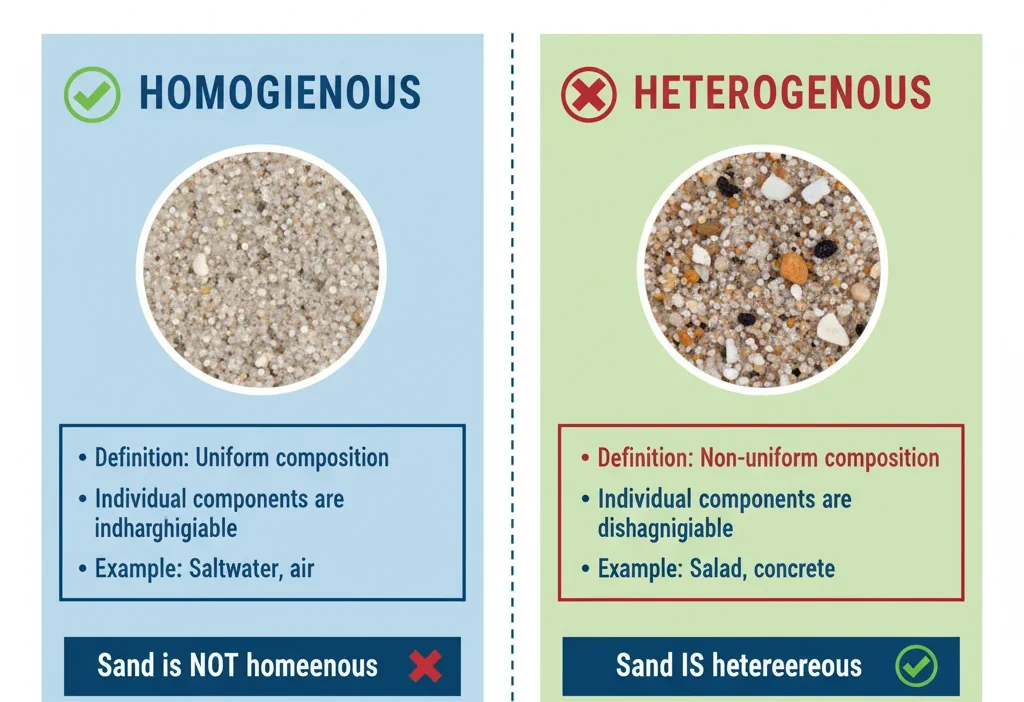
A homogeneous mixture is a mixture that looks the same everywhere. You cannot see the different parts because they are mixed so well that they appear like one single thing.
Simple Meaning:
Everything looks uniform and even.
Part of Speech: Adjective
Examples:
- Sugar dissolved in water is homogeneous because you can’t see the sugar crystals.
- Air is homogeneous because the gases mix evenly.
- Lemonade (without pulp) is homogeneous because every sip tastes the same.
Imagine mixing blue food coloring in water. Once it blends fully, the entire cup is the same color. That’s homogeneous.
What Does “Heterogeneous” Mean?
A heterogeneous mixture is a mixture where you can see the different parts. The components do not blend evenly, and each part is separate.
Simple Meaning:
Different parts are visible.
Part of Speech: Adjective
Examples:
- A bowl of cereal with milk is heterogeneous—you can see cereal pieces and milk separately.
- A fruit salad is heterogeneous—you can see apples, bananas, grapes, and more.
- Soil is heterogeneous because you can spot stones, leaves, and different particles.
Think of a jar of candy with many colors—nothing looks the same. That’s heterogeneous.
The Key Difference Between Homogeneous and Heterogeneous
Here is a simple comparison table to make it clearer:
| Feature | Homogeneous Mixture | Heterogeneous Mixture |
|---|---|---|
| Appearance | Looks the same everywhere | Looks different in different parts |
| Parts visible? | No | Yes |
| Example | Saltwater | Fruit salad |
| Texture | Even and smooth | Mixed and uneven |
| Easy Definition | Uniform mixture | Non-uniform mixture |
Quick Tip to Remember
If you can see the different pieces → Heterogeneous
If everything looks even and the same → Homogeneous
Environmental Factors Can Influence Natural Selection Because They Can Increase or Decrease
So… Is Sand Homogeneous or Heterogeneous?
The correct answer is:
Most sand is heterogeneous.
Why?
Because sand is made up of different particles like small rocks, shells, minerals, and tiny pieces of coral. These particles are different in:
- shape
- size
- color
- material
If you look at sand closely (even with your eyes), you can see these differences. That makes sand a heterogeneous mixture.
But sometimes sand can be homogeneous.
If sand comes from only one type of material (like pure white quartz sand), and all grains look the same, then it may appear homogeneous.
But in everyday life, beach sand, river sand, desert sand, and construction sand are usually heterogeneous.
Common Mistakes and How to Avoid Them
❌ Mistake 1: Calling sand homogeneous just because it looks uniform from far away.
Correction:
When you look closer, the grains are different. This makes it heterogeneous.
❌ Mistake 2: Saying “homogeneous means things look similar, so sand must be homogeneous.”
Correction:
Homogeneous mixtures don’t just “look similar”—their parts actually blend completely, like sugar water. Sand grains never blend.
❌ Mistake 3: Thinking all mixtures must be either one or the other.
Correction:
Some mixtures, like sand, can appear homogeneous from far away but are actually heterogeneous.
When to Call Sand “Homogeneous”?
Sand can be classified as homogeneous if:
- All grains are the same material
- They have similar color
- They have similar size
- They look uniform everywhere
Examples:
- Pure quartz sand (all grains white and similar).
- Lab-processed sand used for experiments.
- Highly filtered industrial sand used in manufacturing.
Though this is less common, it is still possible.
When to Call Sand “Heterogeneous”?
In most real-life cases, sand is heterogeneous. You should call sand heterogeneous when:
- The grains are different colors
- The grains are different sizes
- You can spot other materials like shells or pebbles
- It comes from natural sources like beaches or rivers
Examples:
- Beach sand with tiny shells
- River sand with stones and minerals
- Desert sand with mixed particles
- Construction sand with gravel and dust
Memory Hack
If the sand looks “speckled,” it’s heterogeneous.
Different little specks = different materials.
Quick Recap: Homogeneous vs Heterogeneous
- Homogeneous:
- Looks the same everywhere
- Parts are not visible
- Example: saltwater
- Heterogeneous:
- Looks different in different parts
- You can see the pieces
- Example: fruit salad
- Sand is usually heterogeneous because grains differ in color, shape, and material.
- Rarely, sand can be homogeneous if all particles are identical.
Advanced Tips (Optional Section)
- The word homogeneous comes from Greek “homo” (same) + “genos” (kind).
- The word heterogeneous comes from “hetero” (different) + “genos” (kind).
- In science exams, sand is almost always classified as heterogeneous unless specified as “pure sand” or “uniform sand.”
- Online, many people misuse the words because they judge mixtures from a distance, not from close observation.
- In formal reports, teachers expect you to explain why sand is heterogeneous, not just choose the word.
Mini Quiz: Test Yourself
Fill in the blanks:
- A mixture that looks the same everywhere is called __________.
- A mixture where you can see different parts is __________.
- Most natural sand is __________.
- Salt mixed in water is a __________ mixture.
- A fruit salad is an example of a __________ mixture.
- Sand appears uniform from far away but is __________ up close.
- Pure white quartz sand may look __________.
(Answers: homogeneous, heterogeneous, heterogeneous, homogeneous, heterogeneous, heterogeneous, homogeneous)
5 Helpful FAQs
1. Is sand homogeneous or heterogeneous?
Most sand is heterogeneous because its grains differ in color, size, and material.
2. Can sand ever be homogeneous?
Yes, pure sand made from one material (like quartz) can be homogeneous.
3. What type of mixture is beach sand?
Beach sand is heterogeneous due to shells, minerals, and varied grains.
4. Why do people think sand looks homogeneous?
From far away, sand looks uniform, but up close it contains different particles.
5. How can I tell what type of mixture something is?
If you can see the different parts, it’s heterogeneous. If not, it’s homogeneous.
Conclusion
Understanding whether sand is homogeneous or heterogeneous becomes easy once you know the meanings of both words. A homogeneous mixture looks the same everywhere, while a heterogeneous mixture has visible differences. Sand is usually heterogeneous, but in some rare cases, it can be homogeneous if all grains are identical.
Now you confidently know how to explain the difference between homogeneous and heterogeneous, use the words correctly, and identify which category sand belongs to in everyday situations. Keep exploring simple science ideas like this—you’ll get better every day!

Marianne Solace is a lifestyle and personal-growth writer for WordContrast.com. Her work blends inspiration with practicality, offering thoughtful insights on wellness, creativity, and mindful living. When she’s not writing, Marianne enjoys journaling with a cup of coffee, exploring art museums, and helping others find balance through the written word.