
Have you ever wondered why things smell the way they do — like the sweet scent of a flower or the strong odor of vinegar?
When you learn science, you’ll often hear teachers ask: “Is odor a physical or chemical property?”
It’s a tricky question because odor can appear in both cases — sometimes it’s a physical change, and other times it’s a chemical change. Many students get confused about this.
In this guide, you’ll easily learn:
- What “odor” really means in science
- The difference between physical and chemical properties
- How to tell when odor is physical and when it’s chemical
- Simple examples you can use in school or daily life
By the end, you’ll never be confused again — even if you’re just starting to learn about matter and its properties!
🔍 What Does “Odor” Mean?
Odor means the smell that something gives off. It can be pleasant (like perfume) or unpleasant (like rotten eggs).
In science, an odor happens when tiny particles (molecules) move into the air and reach your nose.
- Part of speech: Noun
- Simple definition: The smell something has
- Scientific meaning: The molecules that enter the air and can be detected by your nose
🧴 Examples of Odor:
- The sweet odor of vanilla ice cream.
- The strong odor of vinegar.
- The burnt odor after wood catches fire.
Odor helps scientists understand what is happening to a substance — whether it’s just changing form or actually forming something new.
⚖️ What Are Physical and Chemical Properties?
Before deciding if odor is physical or chemical, let’s understand the two types of properties of matter.
1️⃣ Physical Property (Simple Definition)
A physical property can be observed without changing what the substance is made of.
✅ Examples:
- Color
- Shape
- Texture
- Odor (sometimes!)
- Melting or boiling point
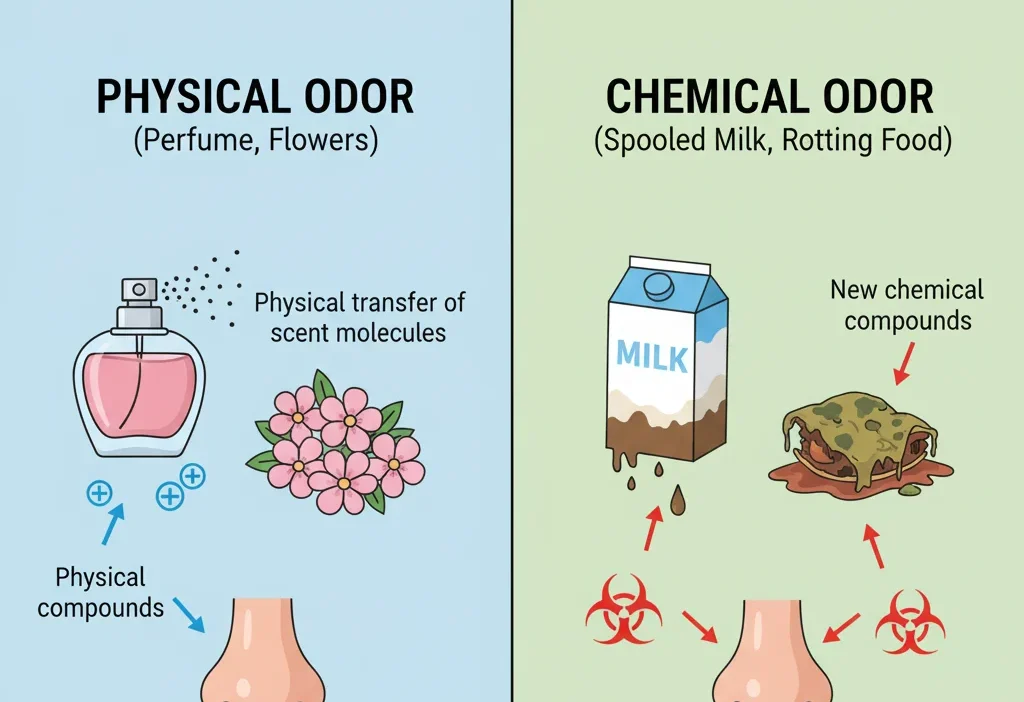
➡️ When you smell perfume, you don’t change what perfume is — you just sense it. That’s a physical property.
2️⃣ Chemical Property (Simple Definition)
A chemical property is when a substance’s composition changes — it forms a new substance.
✅ Examples:
- Rusting of iron
- Burning of paper
- Rotting of food
- Odor change after reaction
➡️ When milk spoils and smells sour, it’s a chemical property — because bacteria have changed the milk into new substances.
⚗️ The Key Difference Between Physical and Chemical Properties of Odor
Here’s a simple comparison table to help you remember 👇
| Feature | Physical Property | Chemical Property |
|---|---|---|
| Definition | Observed without changing the substance | Observed when the substance changes |
| Odor Example | Smelling perfume or coffee | Smelling rotten eggs or spoiled milk |
| Change Type | No new substance formed | New substance formed |
| Reversible? | Usually yes | Usually no |
| Quick Tip | The smell comes from evaporation | The smell comes from a reaction |
💡 Quick Tip:
If the odor comes from something evaporating, it’s physical.
If the odor comes from something rotting, burning, or reacting, it’s chemical.
🚫 Common Mistakes and How to Avoid Them
❌ Mistake 1:
“All odors are chemical properties.”
Correction:
Not true! The smell of perfume or a flower is a physical property because nothing new is made — the particles just move into the air.
❌ Mistake 2:
“Odor means a chemical change happened.”
Correction:
Sometimes, yes — like when food spoils. But not always. Odor by itself doesn’t prove a chemical change. You must check other signs like color change, gas production, or temperature change.
❌ Mistake 3:
“You can’t smell a physical change.”
Correction:
You can! Evaporation (like water turning to vapor or perfume evaporating) often releases odor without chemical change.
👃 When Is Odor a Physical Property?
Odor is a physical property when:
- The substance stays the same.
- Molecules escape into the air but don’t change.
- You can reverse it by cooling or covering it.
🧠 Easy Examples:
- Smelling coffee or tea — the liquid stays the same.
- The odor of a candle before it’s lit.
- The fresh scent of flowers in a garden.
- Perfume or deodorant — smell spreads but nothing new forms.
- The odor of gasoline — it evaporates but doesn’t change chemically.
🧩 Memory Hack:
If it evaporates, it’s physical. Just like perfume spreading in air — still the same perfume!
🔥 When Is Odor a Chemical Property?
Odor is a chemical property when:
- The smell appears because something new has formed.
- It’s caused by burning, rotting, or reacting.
- The change cannot be undone easily.
🔬 Examples:
- Rotten eggs — hydrogen sulfide gas forms (new substance).
- Burnt toast — burning changes the bread’s chemistry.
- Spoiled milk — bacteria create new sour-smelling compounds.
- Rusting metal — produces a metallic or musty odor.
- Cooking food — chemical reactions create new smells.
🧠 Memory Hack:
If it stinks because something new formed, it’s chemical.
🧭 Quick Recap: Odor as Physical vs Chemical Property
- Odor (Physical): Smell comes from particles evaporating, no new substance made.
- Odor (Chemical): Smell appears when a new substance forms (rotting, burning, reacting).
- Simple Test: Ask — Did something new form?
- If no, it’s physical.
- If yes, it’s chemical.
🧠 Advanced Tips and Fun Facts
- The word “odor” comes from Latin odorare, meaning “to smell.”
- In chemistry labs, odor helps scientists detect reactions (for example, sulfur gives off a rotten-egg smell).
- In exams, remember: odor can be both — your explanation must match the type of change.
- In daily life, knowing this helps you tell if food is spoiled (chemical) or just has a strong scent (physical).
- Online writing tip: Don’t just say “odor = chemical.” Explain why — teachers love clear reasoning!
📝 Mini Quiz: Test Your Understanding!
Fill in the blanks with physical or chemical 👇
- The smell of freshly baked bread is a _______ property.
- The odor of rotten eggs is a _______ property.
- Perfume spreading in the air shows a _______ property.
- The bad smell of spoiled milk is a _______ property.
- The scent of roses in a garden is a _______ property.
- Burning plastic gives off a strong _______ odor.
- The smell of gasoline before burning is a _______ property.
(Answers: 1-Chemical, 2-Chemical, 3-Physical, 4-Chemical, 5-Physical, 6-Chemical, 7-Physical)
📘 FAQs
1. Is odor a physical property?
Yes, when the smell comes from something evaporating (like perfume or coffee), it’s a physical property.
2. Is odor a chemical property?
Yes, if the odor forms due to a reaction, like rotting or burning, it’s a chemical property.
3. How can I tell the difference?
Ask: Did a new substance form? If yes, it’s chemical. If no, it’s physical.
4. What causes odor in general?
Odor happens when molecules from a substance reach your nose through the air.
5. Can something have both physical and chemical odors?
Yes! For example, cooking food first releases physical odors (steam) and then chemical odors (browning or burning).
🏁 Conclusion
Now you know the full answer to “Is odor a physical or chemical property?”
Odor can be both, depending on the situation.
If it comes from evaporation, it’s physical.
If it comes from a new substance forming, it’s chemical.
Keep observing the smells around you — they tell fascinating stories about how matter changes every day.
Learning science doesn’t have to be hard — it’s as simple as using your nose!

Celeste Rowan is a creative writer and editor at WordContrast.com, crafting compelling stories across topics like motivation, education, and personal development. She combines a warm narrative voice with data-driven insight to make her writing both relatable and reliable. Celeste believes words can spark change—and she writes to make that change happen.