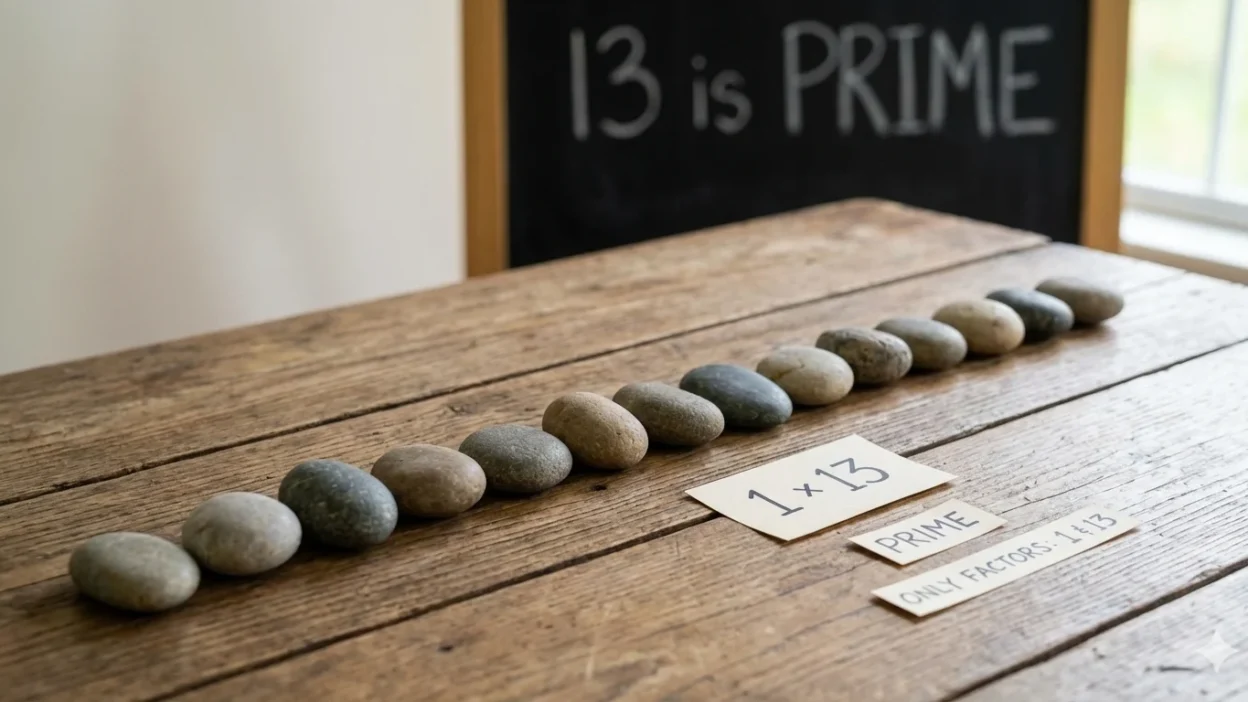
👉 13 is a prime number, not a composite number.
It has only two factors: 1 and 13
Many students and beginners often ask: is 13 prime or composite?
This confusion is very common, especially when learning basic math.
Prime and composite numbers look similar at first. Both are whole numbers. Both are used in math every day. But the difference between prime and composite numbers is very important.
In this simple guide, you will learn:
- The meaning of prime and composite
- The key difference between prime and composite
- Why 13 is prime, not composite
- Easy examples, mistakes, and memory tricks
This article is written in plain English, with short sentences and real-life examples.
Even a class 4 student can understand it easily. 😊
What Does Each Word Mean?
Before answering is 13 prime or composite, let’s understand both words clearly.
What Is a Prime Number?
A prime number is a number that:
- Has only two factors
- Can be divided by 1 and itself only
Think of it like this:
A prime number is picky. It does not like sharing. 😄
Examples of Prime Numbers
- 2 → factors: 1, 2
- 5 → factors: 1, 5
- 13 → factors: 1, 13
✅ Because 13 has only two factors, it is prime.
What Is a Composite Number?
A composite number is a number that:
- Has more than two factors
- Can be divided by numbers other than 1 and itself
Think of it like this:
A composite number likes to share with many numbers.
Examples of Composite Numbers
- 4 → factors: 1, 2, 4
- 6 → factors: 1, 2, 3, 6
- 12 → factors: 1, 2, 3, 4, 6, 12
❌ These numbers are not prime.
The Key Difference Between Prime and Composite Numbers
Here is a simple comparison table to understand the difference between prime and composite:
| Feature | Prime Number | Composite Number |
|---|---|---|
| Number of factors | Exactly 2 | More than 2 |
| Divisible by | 1 and itself only | 1, itself, and others |
| Example | 13, 7, 11 | 4, 6, 9 |
| Easy idea | “Picky number” | “Sharing number” |
✅ Quick Tip to Remember
If a number has only 2 factors → Prime
If a number has more than 2 factors → Composite
Is 13 Prime or Composite? (Step-by-Step)
Let’s answer the main question clearly:
Step 1: List the factors of 13
- 1 × 13 = 13
So the factors are:
- 1
- 13
Step 2: Count the factors
- Total factors = 2
✅ Final Answer
13 is a prime number, not a composite number.
Common Mistakes and How to Avoid Them
Many learners make mistakes when deciding if 13 is prime or composite.
❌ Mistake 1: Thinking all odd numbers are composite
- Wrong idea: “13 is odd, so it must be composite.”
- ✔️ Truth: Some odd numbers are prime (like 13, 17, 19).
❌ Mistake 2: Forgetting to count factors
- Wrong: Guessing without checking.
- ✔️ Fix: Always list the factors.
❌ Mistake 3: Confusing with number 1
- Some think 1 is prime.
- ✔️ Truth: 1 is neither prime nor composite.
When to Use “Prime” (Prime Numbers Explained)
Use prime when a number:
- Has only two factors
- Cannot be divided evenly by other numbers
Real-Life Examples
- 13 students standing alone in pairs → only 1 and 13
- 13 candies cannot be shared equally except with everyone or one person
Example Sentences
- 13 is a prime number.
- Prime numbers have only two factors.
- 13 cannot be divided by 2, 3, or 4.
- That is why 13 is prime.
When to Use “Composite” (Composite Numbers Explained)
Use composite when a number:
- Has more than two factors
- Can be divided in many ways
Memory Hack 🧠
Composite = Company
Many numbers come together.
Example Sentences
- 12 is a composite number.
- Composite numbers have many factors.
- 13 is not composite.
- Numbers like 6 and 9 are composite.
Quick Recap: Is 13 Prime or Composite?
- ✔️ 13 is prime
- ❌ 13 is not composite
- Factors of 13 = 1 and 13 only
- Prime = 2 factors
- Composite = more than 2 factors
Advanced Tips (Optional but Helpful)
Origin of Prime Numbers
The word prime comes from a word meaning “first” or “important.”
In Exams & School
- Always show factors
- Do not guess
- Write clearly: 13 is a prime number because it has only two factors.
Online & Texting
Writing “13 is composite” is a math error and changes the meaning completely.
Mini Quiz: Test Your Understanding 📝
Fill in the blanks:
- 13 has ___ factors.
- A number with only two factors is called ___ .
- 12 is a ___ number.
- 13 can be divided by ___ and ___ only.
- Prime numbers are not ___ numbers.
Answers:
- two
- prime
- composite
- 1, 13
- composite
FAQs
❓ Is 13 a prime number?
Yes, 13 is a prime number because it has only two factors.
❓ Why is 13 not composite?
Composite numbers have more than two factors. 13 does not.
❓ How many factors does 13 have?
13 has exactly two factors: 1 and 13.
❓ Is every odd number prime?
No. Some odd numbers are composite, like 9 or 15.
❓ Is 1 prime or composite?
No. 1 is neither prime nor composite.
Conclusion
Now you clearly know the answer to is 13 prime or composite.
The answer is simple and clear: 13 is a prime number.
It has only two factors. That is the main rule.
By learning how to count factors, you can classify any number easily.
Keep practicing with other numbers.
Math becomes fun when rules are simple.
You’re improving every day — keep going! 🌟

Henry Vale is a tech-savvy content creator at WordContrast.com, known for his in-depth guides and how-to articles. With a background in digital media and a passion for innovation, Henry focuses on simplifying technology for everyday users. His mission is to empower readers with clear, actionable knowledge they can use to improve their digital lives.