Have you ever written “in tact” and wondered if it looked a little off? You’re not alone!
Many English learners — even native speakers — get confused between “in tact” and “intact.” At first glance, they sound the same. But only one of them is correct in standard English.
In this simple guide, we’ll explain the meaning, difference, and correct usage of in tact vs intact. You’ll also learn helpful grammar tips, examples, and memory tricks to remember the right one every time. By the end, you’ll easily spot and use the correct form — just like a language pro!
What Does Each Word Mean?
Let’s start by understanding what each term means — and whether both are actually words.
1. “Intact” (✅ Correct Word)
Part of Speech: Adjective
Meaning: Something that is whole, complete, or undamaged.
If something stays intact, it hasn’t been broken, harmed, or changed.
Examples of “Intact”:
- After the earthquake, the old bridge remained intact.
- My phone fell, but the screen is still intact.
- The teacher checked if the project files were intact after the computer crashed.
Think of “intact” as meaning perfectly fine or not ruined.
2. “In Tact” (❌ Incorrect Phrase)
Part of Speech: None — because “in tact” is not a correct English phrase.
Some people mistakenly write “in tact” because they hear “intact” as two separate words.
But “tact” alone is a real word, meaning sensitivity or politeness when dealing with others.
Examples of “tact”:
- She handled the bad news with great tact.
- It takes tact to tell someone their mistake kindly.
- Teachers need tact when correcting students.
So while “tact” is a valid word, “in tact” (as two words) doesn’t make sense in grammar.
When you want to say “not damaged” or “still whole,” the correct form is “intact.”
The Key Difference Between “In Tact” and “Intact”
| Feature | Intact | In Tact |
|---|---|---|
| Correctness | ✅ Correct | ❌ Incorrect |
| Part of Speech | Adjective | Not a real phrase |
| Meaning | Whole, undamaged, unbroken | No valid meaning |
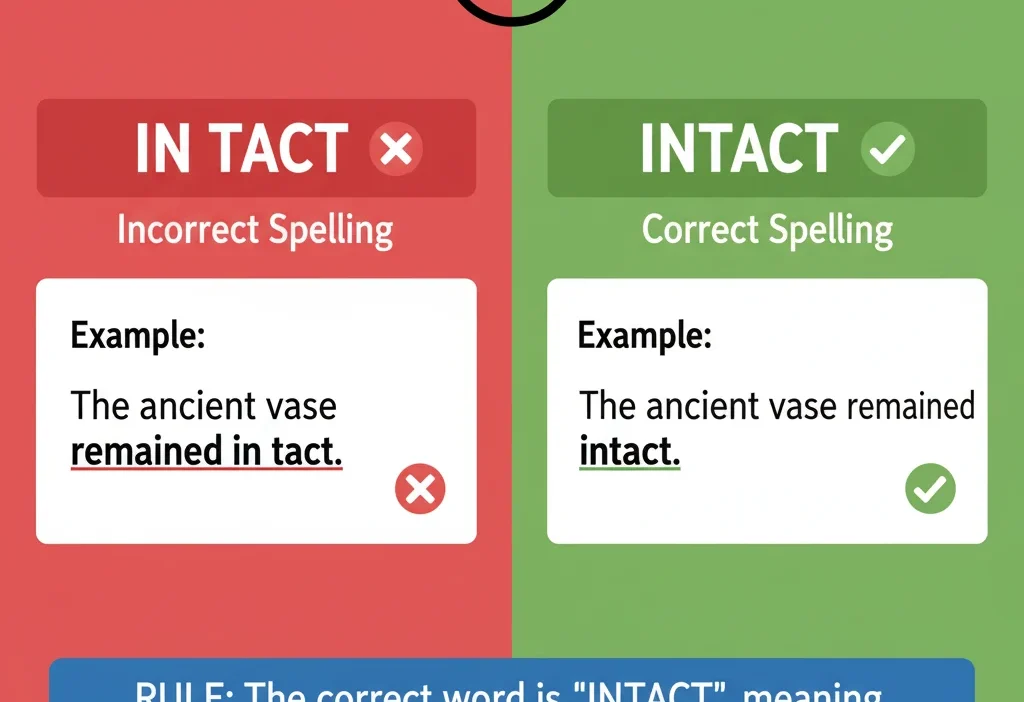
| Example | “The vase is still intact.” | ❌ “The vase is still in tact.” |
| Usage | Used to describe something unharmed | Often a spelling or hearing mistake |
Quick Tip to Remember
👉 If you mean something is not broken — use “intact.”
Think of it like this: “In one piece = intact.”
Common Mistakes and How to Avoid Them
Even fluent English speakers sometimes type “in tact” by accident. Here are common examples and how to fix them:
| ❌ Wrong Sentence | ✅ Correct Sentence |
|---|---|
| The package arrived in tact. | The package arrived intact. |
| I want to keep the book in tact. | I want to keep the book intact. |
| The photo stayed in tact. | The photo stayed intact. |
Why This Mistake Happens
- The word “intact” sounds like two words when spoken quickly.
- People know “tact” is a real word, so they assume “in tact” could be correct.
- Autocorrect tools sometimes don’t catch it!
How to Fix It:
When you want to describe something still whole or unbroken, remember it’s one word: intact.
When to Use “Intact”
You should use “intact” when you’re describing something that:
- is complete, unharmed, or unchanged
- has survived damage or time
- still looks or functions as it originally did
Examples of “Intact” in Sentences
- Despite the storm, the house remained intact.
- His reputation stayed intact after the investigation.
- The ancient temple is surprisingly intact after centuries.
- Please keep the packaging intact for a full refund.
- Her confidence stayed intact despite the criticism.
Memory Trick
💡 Remember:
Intact = In one piece
Both have the word “in” and mean not broken apart.
When to Use “In Tact”
The phrase “in tact” should not be used when you mean undamaged.
However, you can use the word “tact” alone correctly!
Here’s how:
Examples Using “Tact” (Correctly)
- You need tact when giving honest feedback.
- He spoke with tact and kindness.
- A manager must have tact to solve conflicts.
So if your sentence makes sense with “politeness” or “sensitivity,” use tact — not “in tact.”
Quick Recap: “In Tact” vs “Intact”
✅ Intact
- Means whole, unbroken, complete
- Example: “The statue is still intact.”
❌ In Tact
- Not a valid phrase
- Common spelling mistake for “intact”
✅ Tact
- Means sensitivity or politeness
- Example: “She spoke with tact.”
Advanced Tips
Origin and History
The word “intact” comes from Latin intactus, meaning untouched.
It combines “in” (not) + “tangere” (to touch).
So literally, intact means “not touched.”
That’s why we use it for things that stay whole and unharmed.
Formal Writing Usage
In essays, reports, or academic writing:
- “intact” is a formal and precise word.
- Avoid “in tact” — it’s a red flag for editors and teachers.
Examples in formal writing:
- “The experiment’s results remained intact.”
- “The original structure of the text is kept intact for analysis.”
Texting or Online Mistakes
In casual texting, people often write “in tact” by mistake because autocorrect doesn’t flag it.
Always double-check spelling in emails or essays — “intact” is the only correct form!
Mini Quiz: Test Yourself!
Fill in the blanks with intact or tact:
- The letter was found perfectly __________.
- She handled the complaint with great __________.
- His pride stayed __________ even after the loss.
- Please keep the seal __________ until opening.
- It takes __________ to give honest advice kindly.
- The castle walls are still __________ after centuries.
(Answers: 1. intact, 2. tact, 3. intact, 4. intact, 5. tact, 6. intact)
FAQs About “In Tact” vs “Intact”
1. Is “in tact” ever correct?
No. “In tact” is incorrect. The correct word is “intact.”
2. What does “intact” mean in English?
“Intact” means whole, complete, or undamaged.
3. Can I use “tact” instead of “intact”?
No. “Tact” means sensitivity or politeness, not wholeness.
4. Why do people confuse “in tact” and “intact”?
Because they sound the same when spoken — a common spelling error.
5. What’s an easy way to remember “intact”?
Think of “in one piece” — both start with “in.” So “intact” means “still in one piece.”
Conclusion
Now you know the truth: “in tact” isn’t a real phrase — the correct word is “intact.”
It means something that’s whole, unbroken, or undamaged.
Meanwhile, “tact” is a separate word that means politeness or sensitivity.
So next time you write, check your spelling:
If you mean not broken, say intact — and your English will stay perfectly intact too!

Henry Vale is a tech-savvy content creator at WordContrast.com, known for his in-depth guides and how-to articles. With a background in digital media and a passion for innovation, Henry focuses on simplifying technology for everyday users. His mission is to empower readers with clear, actionable knowledge they can use to improve their digital lives.