Have you ever seen hippy and hippie and wondered which one is right? You’re not alone! These two words look almost the same, sound the same, and are often used in similar ways. But there’s a small difference in meaning and usage that can completely change what you’re trying to say.
In this guide, you’ll learn:
✅ The meaning of hippy and hippie
✅ The key difference between them
✅ How to use each correctly with examples
✅ Common mistakes and how to avoid them
By the end, you’ll easily remember when to write hippy and when to write hippie —
What Does Each Word Mean?
Let’s start with the basics — what do hippy and hippie actually mean?
Hippie – The Free-Spirited Person
Part of Speech: Noun
Meaning:
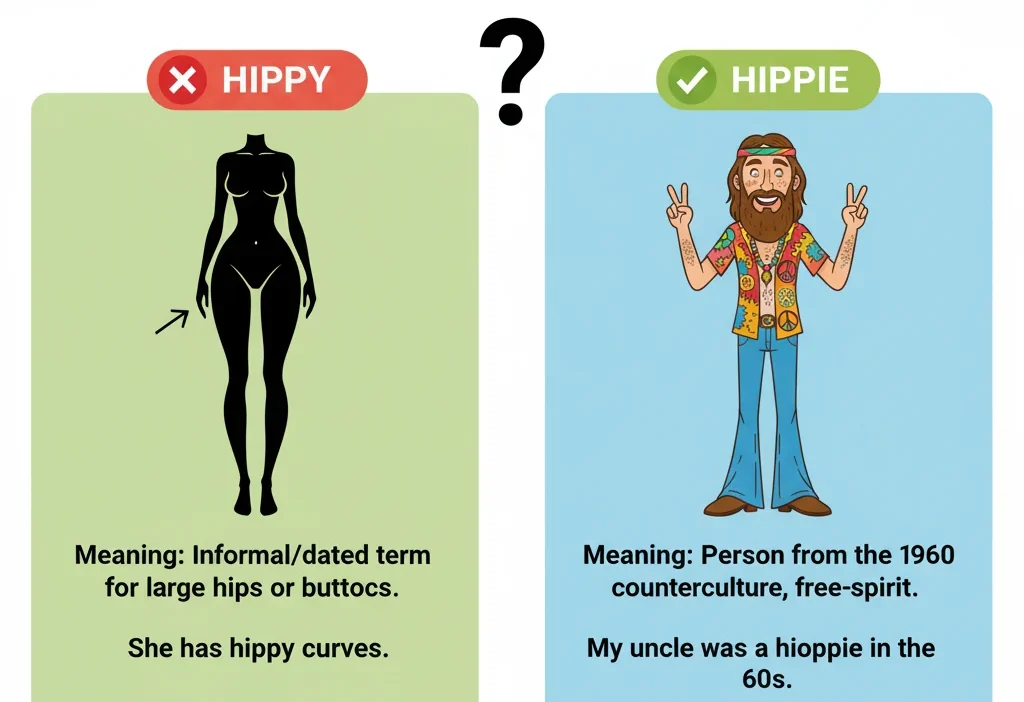
A hippie is a person who follows a lifestyle that values peace, love, nature, and freedom. Hippies were especially famous in the 1960s for their colorful clothes, long hair, and anti-war beliefs.
Simple Definition:
A hippie is someone who believes in peace and love and often lives in a simple, natural way.
Examples:
- My aunt was a hippie in the 1970s who loved music festivals.
- The hippies at the park were playing guitars and dancing freely.
- He lives a hippie lifestyle — relaxed, peaceful, and close to nature.
Hippy – Someone Who Has Big Hips
Part of Speech: Adjective
Meaning:
Hippy is used to describe someone who has large or rounded hips. It comes from the word “hip,” which is the part of the body at the top of your legs.
Simple Definition:
A hippy person has wide or full hips.
Examples:
- The dress was designed for hippy women.
- She’s a bit hippy, so those jeans fit perfectly.
- The artist drew a hippy character with a curvy figure.
The Key Difference Between Hippy and Hippie
Even though they look similar, hippy and hippie mean very different things.
Here’s a quick comparison to make it super clear:
| Feature | Hippy | Hippie |
|---|---|---|
| Part of Speech | Adjective | Noun |
| Meaning | Someone with large or wide hips | A person from the peace-loving, nature-focused subculture |
| Used For | Describing body shape | Describing a type of person or lifestyle |
| Example | “She’s a bit hippy.” | “My uncle was a hippie in college.” |
| Origin | From the word hip (body part) | From 1960s slang “hipster” |
Quick Tip to Remember:
👉 Hippy has one “p” in the middle — think of a hip (body part).
👉 Hippie ends with “ie” — think of a free, friendly person who says “Hi!”
Common Mistakes and How to Avoid Them
People often mix these two words because they sound the same. Here are a few common mistakes:
| ❌ Wrong Sentence | ✅ Correct Sentence | 💡 Explanation |
|---|---|---|
| She dresses like a hippy from the 1960s. | She dresses like a hippie from the 1960s. | The word for the 1960s peace movement is hippie, not hippy. |
| My aunt is a hippie woman with wide hips. | My aunt is a hippy woman with wide hips. | Hippy describes a person’s body shape. |
| The hippy festival was amazing! | The hippie festival was amazing! | A festival related to the culture is hippie. |
How to Avoid the Confusion:
✅ If you’re talking about people or culture, use hippie.
✅ If you’re describing body shape, use hippy.
When to Use “Hippy”
Use hippy when you want to describe someone’s physical appearance, especially their hips.
Examples:
- The new jeans are perfect for hippy women.
- The artist painted a hippy figure with wide hips.
- She has a hippy silhouette that looks great in skirts.
- The mannequin looked too hippy for that dress.
- My grandmother used to say being hippy was a sign of beauty.
Memory Trick:
Think of the word hip — that’s your clue. If it’s about hips or curves, use hippy.
When to Use “Hippie”
Use hippie when you’re talking about people, culture, fashion, or lifestyle related to peace, love, and freedom.
Examples:
- The hippie movement started in the 1960s.
- My parents met at a hippie festival.
- She wears colorful clothes and flowers like a hippie.
- Many hippies believed in love and equality.
- His hippie spirit makes him very kind and calm.
Memory Hack:
Remember the “ie” in hippie stands for “individual expression.” Hippies were all about being unique and free-spirited!
Quick Recap: Hippy vs Hippie
Here’s a quick summary you can remember easily:
✅ Hippy
- Describes body shape
- Means someone with large hips
- Example: “She’s a bit hippy.”
✅ Hippie
- Refers to a person or lifestyle
- Means peace-loving, nature-focused person
- Example: “He’s a hippie who loves music festivals.”
Easy Rule:
If it’s about hips, write hippy.
If it’s about peace and freedom, write hippie.
Advanced Tips: Origins and Usage
- Origin of “Hippie”:
The term hippie came from hip (meaning “cool” or “in the know”) and was first used in the 1960s. It described young people who rejected materialism and followed alternative lifestyles focused on peace and love. - Origin of “Hippy”:
The adjective hippy comes from hip (body part) + -y, meaning “having hips.” It has no connection to the cultural movement. - In Writing:
- Use hippie in essays, blogs, or cultural discussions.
- Use hippy in fashion, design, or body-type descriptions.
- In Everyday English:
Most people will understand what you mean from context, but using the correct spelling shows strong grammar and attention to detail.
Mini Quiz: Test Your Understanding
Fill in the blanks with either hippy or hippie:
- My mom was a _______ in her college days.
- The artist drew a _______ woman with a curved figure.
- They went to a _______ festival full of music and colors.
- She’s a bit too _______ for those skinny jeans.
- The 1960s _______ culture focused on love and freedom.
- Her _______ style includes long skirts and peace signs.
- The sculpture shows a beautiful, _______ figure.
(Answers: 1. hippie, 2. hippy, 3. hippie, 4. hippy, 5. hippie, 6. hippie, 7. hippy)
FAQs
1. Is “hippie” or “hippy” the correct spelling?
Both are correct but mean different things — hippie means a peace-loving person, while hippy describes someone with wide hips.
2. Can I use “hippy” instead of “hippie”?
Not really. It changes the meaning. “Hippy” describes body shape, while “hippie” describes lifestyle or culture.
3. Is “hippie” still used today?
Yes! People still use hippie to describe free-spirited individuals who value peace, love, and simplicity.
4. What is the plural of hippie?
The plural form is hippies. Example: “Many hippies attended the concert.”
5. What is a modern version of a hippie?
Today, people who live naturally, love the environment, or practice minimalism are sometimes called modern hippies or bohemians.
Conclusion
Now you know the difference between hippy and hippie!
- Use hippie for people or culture.
- Use hippy for describing hips or body shape.
Next time you’re writing about the 1960s, peace, or fashion, you’ll know exactly which one fits. Keep practicing, notice how writers use these words, and soon it’ll come naturally.
✨ Remember: Every small grammar skill brings you closer to mastering English — one word at a time!

Henry Vale is a tech-savvy content creator at WordContrast.com, known for his in-depth guides and how-to articles. With a background in digital media and a passion for innovation, Henry focuses on simplifying technology for everyday users. His mission is to empower readers with clear, actionable knowledge they can use to improve their digital lives.