Have you ever wondered whether it’s high school or highschool? Many people mix these two terms, and it’s easy to see why. Both refer to the same stage of education, but their spelling and usage have subtle differences that can affect your writing. Using the wrong version in essays, emails, or social media posts can make your English look less polished.
In this guide, we’ll explain the meaning of each term, the key differences, and examples to show you exactly how to use them correctly. Even if you are a beginner, by the end of this article, you’ll feel confident using the right form every time. We’ll also give tips, common mistakes to avoid, and a simple memory trick to remember the difference.
What Does Each Word Mean?
High School
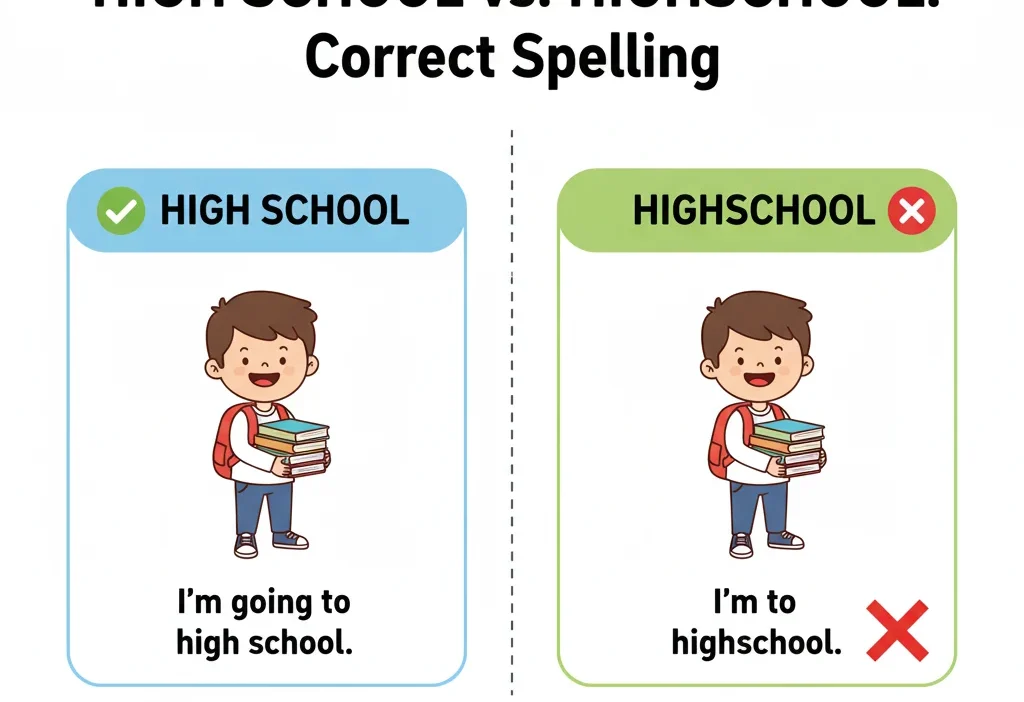
High school is the correct and standard form in English. It is a noun that refers to the stage of education after middle school, usually for students aged 14–18. High school includes grades 9–12 in most countries.
Examples:
- I will start high school next year.
- She met her best friend in high school.
- High school students often take exams in May.
Think of high school as two separate words: “high” (tall, advanced) and “school” (place of learning). Together, they describe the educational stage.
Highschool
Highschool is often seen in casual writing, but it is not standard English. Most dictionaries and style guides list it as incorrect. Using “highschool” as one word may confuse readers, especially in formal writing like essays, emails, or reports.
Examples (informal):
- I met her in highschool.
- Highschool life can be fun.
- He played basketball during highschool.
While many people write it this way online or in texting, it’s better to use the two-word version for correctness.
The Key Difference Between High School and Highschool
| Feature | High School | Highschool |
|---|---|---|
| Correct Usage | ✅ Standard English | ❌ Informal / incorrect |
| Part of Speech | Noun | Noun |
| Meaning | Secondary education for teens | Same meaning but informal |
| Examples | I am in high school. | I am in highschool. |
| Tip | Always write as two words in formal writing | Avoid in essays or official documents |
Quick Tip: If you are writing anything important — like homework, emails, or applications — always use high school (two words).
Common Mistakes and How to Avoid Them
Mistake 1: I met her in highschool.
Correction: I met her in high school.
Why: Using one word is informal and considered incorrect in standard English.
Mistake 2: He loves his highschool friends.
Correction: He loves his high school friends.
Why: Even when plural, “high school” stays two words.
Mistake 3: Highschool is difficult.
Correction: High school is difficult.
Why: Always separate the words to maintain proper grammar.
When to Use High School
You should use high school in formal and informal contexts. It works for writing, speaking, and daily conversation.
Examples:
- I have a science project due in high school tomorrow.
- My brother graduated from high school last year.
- High school students often participate in sports competitions.
- We are visiting the high school to meet the teachers.
- She enjoyed her high school years the most.
Memory Trick: Think of it as “high + school” — two important words coming together. Always write them separately.
When You See Highschool
The one-word form appears mostly in casual writing, online posts, or social media.
Examples (casual use only):
- I miss my highschool friends.
- Back in highschool, I joined the drama club.
- He was popular in highschool.
Visual Hack: If it’s formal writing, split the words. If it’s a casual chat, people might understand “highschool,” but it’s still not grammatically correct.
Quick Recap: High School vs Highschool
- High School
- ✅ Correct and standard
- Noun: secondary education
- Two words
- Use in essays, emails, exams
- Highschool
- ❌ Informal and nonstandard
- Noun: same meaning but not correct
- One word
- Avoid in formal writing
Tip: Remember “high + school” as separate words — it’s easier to recall and always correct.
Advanced Tips
- Origin: “High school” comes from Scottish and American education systems, meaning an advanced stage after elementary or middle school.
- Formal Writing: Use “high school” in essays, reports, and applications.
- Online Misuse: Writing “highschool” on social media is common, but it can affect readability and professionalism in posts or emails.
Mini Quiz: Test Yourself
Fill in the blanks with high school or highschool:
- I met my best friend in ________.
- She is going to ________ next year.
- Many students join clubs during ________.
- Back in ________, I loved playing basketball.
- We visited the ________ to attend the science fair.
Answer Key: 1. high school 2. high school 3. high school 4. highschool (informal) 5. high school
FAQs
1. Is “highschool” correct?
No. The correct form is high school.
2. Can I use “highschool” in casual writing?
Yes, but it is informal and not recommended in essays or official documents.
3. What is the part of speech of high school?
It is a noun.
4. How do I remember the difference?
Think of high + school as two separate words.
5. Are “high school students” and “highschool students” the same?
Meaning-wise, yes. But only high school students is correct in standard English.
Conclusion
Now you know the difference between high school and highschool. Remember, the correct and standard usage is always high school. Use it in essays, emails, and daily writing to improve your English skills. With practice, you’ll never confuse these words again. Keep learning, and your writing will shine!

Marianne Solace is a lifestyle and personal-growth writer for WordContrast.com. Her work blends inspiration with practicality, offering thoughtful insights on wellness, creativity, and mindful living. When she’s not writing, Marianne enjoys journaling with a cup of coffee, exploring art museums, and helping others find balance through the written word.