If you’ve ever seen the phrase “Group these nucleotides by name or category” in a biology or exam question, you might wonder what it really means.
Do we group them by their chemical type, by their names, or by their function?
Don’t worry — this guide will explain everything in simple English.
By the end, you’ll understand:
✅ What nucleotides are,
✅ What “grouping by name” and “grouping by category” means,
✅ The difference between the two, and
✅ How to answer such questions correctly with examples.
Let’s start with the basics!
🔍 What Does “Group These Nucleotides” Mean?
To group means to put similar things together.
In biology, when your teacher says “group these nucleotides,” they want you to sort or arrange nucleotides that share a common feature.
🧠 What Are Nucleotides?
Nucleotides are the building blocks of DNA and RNA — the molecules that store and pass genetic information in all living things.
Each nucleotide has three parts:
- A sugar (like deoxyribose or ribose)
- A phosphate group
- A nitrogen base (A, T, G, C, or U)
There are five main nucleotides:
- Adenine (A)
- Thymine (T)
- Guanine (G)
- Cytosine (C)
- Uracil (U)
📘 What Does “By Name” Mean?
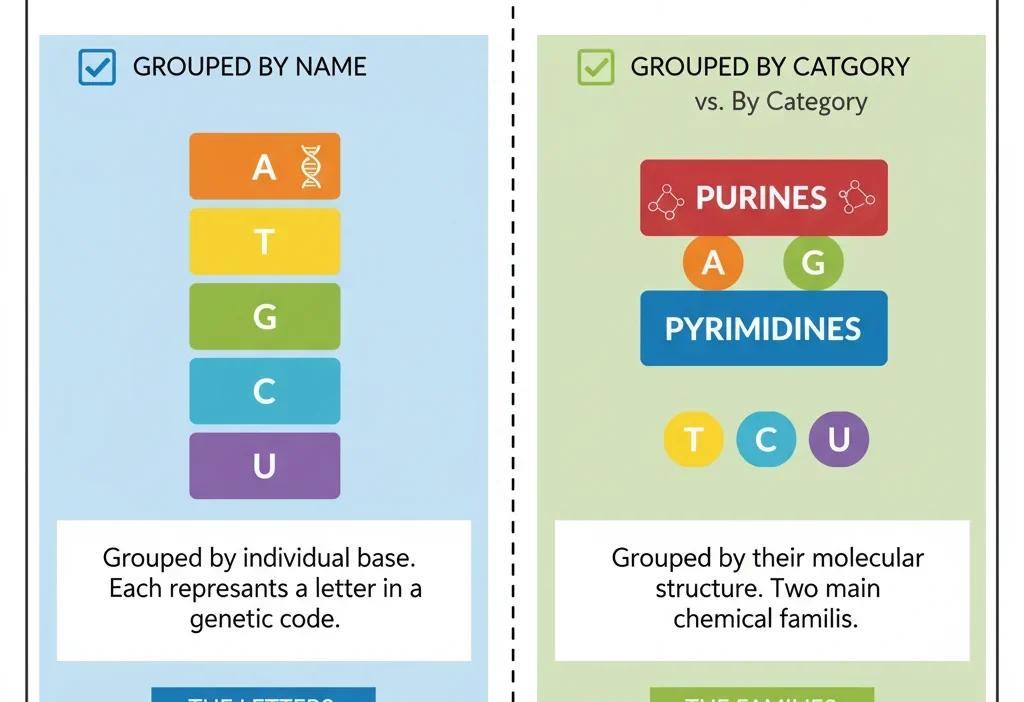
When a question says “Group these nucleotides by name,” it means you should organize them based on their actual names or chemical identity.
In this case, each nucleotide stands alone by its specific name: Adenine, Thymine, Guanine, Cytosine, or Uracil.
✅ Example:
| Group by Name | Members |
|---|---|
| Adenine | A |
| Thymine | T |
| Guanine | G |
| Cytosine | C |
| Uracil | U |
You’re simply listing or separating them according to their names — no need to think about structure or type.
📗 What Does “By Category” Mean?
When a question says “Group these nucleotides by category,” it means to sort them by type or class — based on their chemical structure or function.
Nucleotides can be grouped into two main categories:
| Category | Nucleotides | Meaning |
|---|---|---|
| Purines | Adenine (A), Guanine (G) | Large, double-ring structures |
| Pyrimidines | Thymine (T), Cytosine (C), Uracil (U) | Small, single-ring structures |
🧩 Quick Tip to Remember:
👉 “AG are purines” (Adenine & Guanine) — both big and “pure.”
👉 “TCU are pyrimidines” (Thymine, Cytosine, Uracil) — smaller, lighter, single rings.
⚖️ The Key Difference Between “By Name” and “By Category”
| Feature | Group by Name | Group by Category |
|---|---|---|
| Basis of Grouping | Actual name of each nucleotide | Type or structure |
| Example | A, T, G, C, U | Purines: A, G — Pyrimidines: T, C, U |
| Used When | Listing or identifying individual nucleotides | Explaining structure or function |
| Helps You Learn | Names and symbols | Chemical classes and pairing rules |
🧠 Quick Memory Trick:
If you’re just naming, group by name.
If you’re classifying, group by category.
🚫 Common Mistakes and How to Avoid Them
❌ Mistake 1: Mixing Names and Categories
Wrong:
Purine → Adenine, Cytosine
Correct:
Purine → Adenine, Guanine
🔍 Tip: Always remember — A & G are Purines. T, C, U are Pyrimidines.
❌ Mistake 2: Confusing DNA and RNA Bases
Wrong: DNA has Uracil (U).
Correct: RNA has Uracil (U); DNA has Thymine (T).
🧠 Memory Hack: “T is for Two strands (DNA); U is for Uni strand (RNA).”
🧩 When to Group by Name
You should group by name when the question asks for:
- Listing all the nucleotide names
- Writing their symbols (A, T, G, C, U)
- Showing differences in spelling or abbreviation
✅ Example Sentences:
- Group the nucleotides by name: A, T, G, C, U.
- Identify the names of DNA bases.
- “Adenine” and “Thymine” are grouped by name, not by type.
- Teachers may ask this when checking your memory of base names.
🧬 When to Group by Category
You should group by category when the question refers to:
- Structure (double or single ring)
- DNA or RNA base pairing
- Purine vs. Pyrimidine classification
✅ Example Sentences:
- Group the nucleotides by category into purines and pyrimidines.
- Adenine and Guanine belong to the purine category.
- Thymine, Cytosine, and Uracil belong to the pyrimidine category.
- Scientists often group by category to study structure and pairing rules.
📋 Quick Recap: Group by Name vs. Group by Category
- Group by Name = Sort by individual names (A, T, G, C, U)
- Group by Category = Sort by type or structure (Purine or Pyrimidine)
- Purines: A, G
- Pyrimidines: T, C, U
- DNA → A, T, G, C
- RNA → A, U, G, C
💡 Remember: Name = “what it’s called,” Category = “what kind it is.”
📖 Advanced Tips (for Curious Minds)
- Origin of Terms:
- “Purine” comes from Latin purus (pure) + uric acid — pure structure.
- “Pyrimidine” comes from pyridine (a type of nitrogen base).
- In Formal Writing:
Scientists use category grouping in papers to compare DNA and RNA structures. - In Exams or Worksheets:
“Group by name” questions usually check your recall, while “group by category” tests your understanding. - In Digital Learning or Online Quizzes:
Always double-check if the question asks for “name” or “category” — that one word changes the whole meaning!
🧠 Mini Quiz: Test Yourself!
Fill in the blanks:
- Adenine and Guanine are __________.
- Thymine and Cytosine are __________.
- Grouping by __________ means sorting by chemical type.
- Uracil replaces __________ in RNA.
- “A, T, G, C, U” grouped individually are grouped by __________.
(Answers: 1. Purines, 2. Pyrimidines, 3. Category, 4. Thymine, 5. Name)
💬 5 FAQs
1. What does “Group these nucleotides by name or category” mean?
It means to organize nucleotides either by their names (A, T, G, C, U) or by their types (purines and pyrimidines).
2. What are purines and pyrimidines?
Purines (A, G) are larger double-ring bases; Pyrimidines (T, C, U) are smaller single-ring bases.
3. Which nucleotides are in DNA?
DNA contains Adenine, Thymine, Guanine, and Cytosine.
4. Which nucleotide is only in RNA?
Uracil (U) replaces Thymine (T) in RNA.
5. How can I remember them easily?
Use the trick: “AG are Big (Purines), TCU are Small (Pyrimidines).”
🌟 Conclusion
Now you know exactly what “Group these nucleotides by name or category” means!
Grouping by name focuses on what each nucleotide is called, while grouping by category focuses on what kind of structure it has.
With this simple guide, you’ll never get confused again. Keep practicing, and soon you’ll explain it as easily as spelling your name!
✍️ Written by an English grammar and science enthusiast passionate about making learning simple for everyone.

Celeste Rowan is a creative writer and editor at WordContrast.com, crafting compelling stories across topics like motivation, education, and personal development. She combines a warm narrative voice with data-driven insight to make her writing both relatable and reliable. Celeste believes words can spark change—and she writes to make that change happen.