The greater than or equal sign is a symbol that often confuses beginners in math, programming, or Excel. Many people mix it up with the simple “greater than” or even “less than” signs. Understanding it correctly can make math problems, formulas, and logical comparisons much easier.
In this guide, you’ll learn what the greater than or equal sign really means, how to use it in sentences and formulas, and the common mistakes to avoid. Even if you are a complete beginner, this article will make the concept simple and easy to remember. By the end, you’ll feel confident using the greater than or equal sign in any situation—school, work, or daily life.
What Does the Greater Than or Equal Sign Mean?
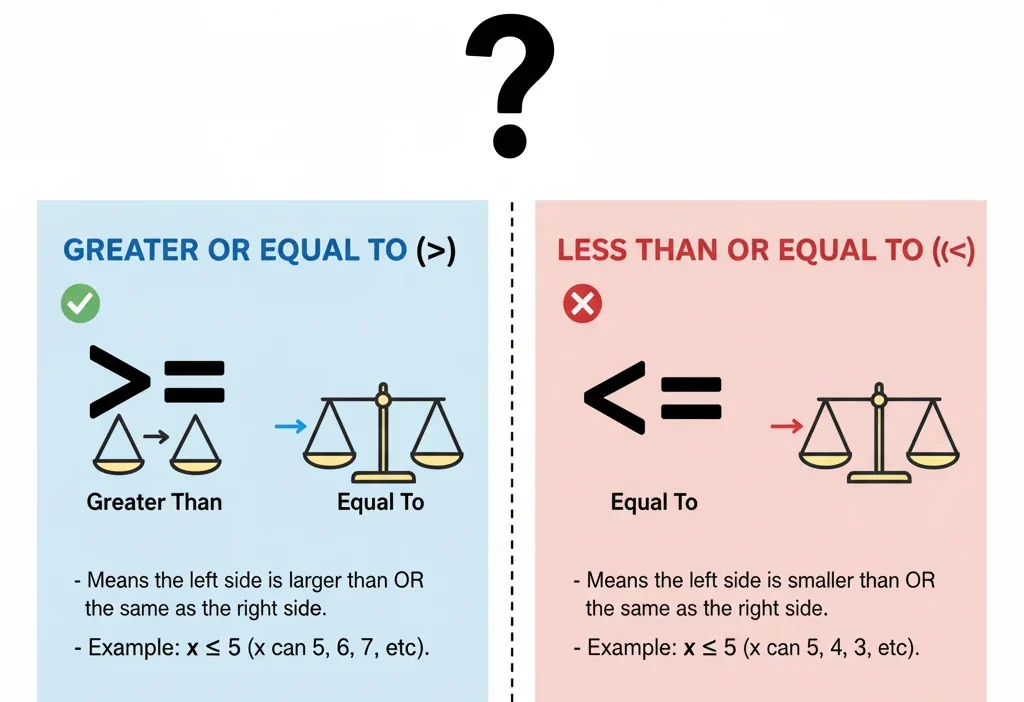
The greater than or equal sign (≥) is a combination of two concepts:
- Greater than (>): Something is bigger than another thing.
- Equal to (=): Two things are exactly the same.
When combined, the greater than or equal sign (≥) means “this number is either bigger than or exactly equal to another number.”
Part of Speech: Symbol (used in math, programming, and logic statements)
Examples in Simple English
- 5 ≥ 3 → 5 is greater than 3. ✅
- 7 ≥ 7 → 7 is equal to 7. ✅
- 10 ≥ 2 → 10 is greater than 2. ✅
Mini Story Example:
Imagine you are taller than your friend or exactly the same height. You can say, “I am ≥ my friend’s height.” This means either taller or exactly the same height.
The Key Difference Between Greater Than and Greater Than or Equal Sign
| Feature | Greater Than (>) | Greater Than or Equal (≥) |
|---|---|---|
| Meaning | One number is strictly bigger than another | One number is bigger than or exactly equal to another |
| Symbol | > | ≥ |
| Example 1 | 5 > 3 ✅ | 5 ≥ 3 ✅ |
| Example 2 | 7 > 7 ❌ | 7 ≥ 7 ✅ |
| Usage Tip | Use only when equality is NOT allowed | Use when equality is allowed |
Quick Tip:
If equality is okay, use ≥. If it must be strictly bigger, use >.
Could Not Find or Load Main Class: Secret Tip to Solve It 2025
Common Mistakes and How to Avoid Them
Mistake 1: Confusing > with ≥
Wrong: 7 > 7 ✅ (incorrect, because 7 is not greater than 7)
Correct: 7 ≥ 7 ✅
Mistake 2: Using ≥ in Excel Formulas Incorrectly
Wrong: =IF(A1>=,B1,"Yes") ❌ (syntax error)
Correct: =IF(A1>=B1,"Yes","No") ✅
Mistake 3: Misreading ≥ as “just bigger”
Wrong: “10 ≥ 10” means 10 is only bigger ❌
Correct: “10 ≥ 10” means 10 is bigger or equal ✅
Why These Happen:
People often skip the “equal to” part or misplace the symbol. Always read it as “greater than or equal to” for clarity.
When to Use the Greater Than or Equal Sign
You can use ≥ in situations where equality is allowed, such as:
- School: “You need ≥ 50 marks to pass.”
- Shopping: “Spend ≥ $20 to get a discount.”
- Daily Life: “You must be ≥ 18 years old to vote.”
- Programming/Excel:
=IF(Sales>=1000,"Bonus","No Bonus") - Measurements: “The box must weigh ≥ 2 kg.”
Memory Hack:
Think “≥” as a hungry alligator that eats the bigger number, but it’s polite enough to also eat equality.
Quick Recap: Greater Than vs Greater Than or Equal Sign
- > (Greater Than): Strictly bigger, equality not allowed
- ≥ (Greater Than or Equal): Bigger or equal
- Use ≥: When equality is acceptable
- Tip: Always read symbols out loud: “greater than or equal to”
Advanced Tips
- Origin: The ≥ symbol has been used in math since the 19th century to simplify comparisons.
- Formal Writing: Use ≥ in scientific papers, math essays, and data reports for clarity.
- Online Writing: Avoid using “>=” in plain text for general readers; it’s better to write “greater than or equal to.”
Mini Quiz
Fill in the blanks with > or ≥:
- 8 ___ 5
- 10 ___ 10
- 7 ___ 9
- 20 ___ 15
- 3 ___ 3
- 6 ___ 6
- 12 ___ 15
(Answers: 1: >, 2: ≥, 3: >, 4: >, 5: ≥, 6: ≥, 7: >)
FAQs
1. What is the greater than or equal sign used for?
It shows that one value is bigger than or equal to another.
2. How is it different from the greater than sign?
Greater than (>) only allows strictly bigger numbers, while ≥ includes equality.
3. Can I use ≥ in Excel?
Yes, for logical formulas like =IF(A1>=B1,"Yes","No").
4. Is ≥ a common symbol in daily life?
Yes, often used in rules, limits, and thresholds.
5. How can I remember ≥ easily?
Think of the “alligator” analogy: it eats the bigger number but politely includes equality.
Conclusion
The greater than or equal sign (≥) is simple once you understand it. It tells you when a value is bigger or exactly equal to another. Using it correctly avoids mistakes in math, Excel, programming, or daily life rules. Remember the quick tip: use > for strictly bigger and ≥ when equality is okay.
With practice, reading and using the greater than or equal sign will become second nature. Keep practicing with examples around you, and your confidence in numbers and formulas will grow every day!

Oliver Thorne is a passionate digital storyteller and content strategist at WordContrast.com. With years of experience in SEO writing and online marketing, he specializes in transforming complex ideas into clear, engaging articles. Oliver loves exploring the latest trends in technology, productivity, and digital culture—helping readers stay informed and inspired in today’s fast-moving world.