Have you ever heard someone say, “I can’t tell if he’s a friend or foe”?
This short phrase sounds dramatic — like something out of a movie — but it’s actually common in English!
People often mix up friend and foe because they sound poetic and old-fashioned. Yet, they have opposite meanings. Understanding them helps you use the phrase “friend or foe” correctly in conversations, writing, and stories.
In this guide, you’ll learn what each word means, the difference between friend and foe, how to use them in real-life examples, and simple tips to remember them forever.
By the end, you’ll easily know when someone is your friend — and when they might be your foe.
What Does Each Word Mean?
Let’s break it down simply.
Friend – Meaning and Usage
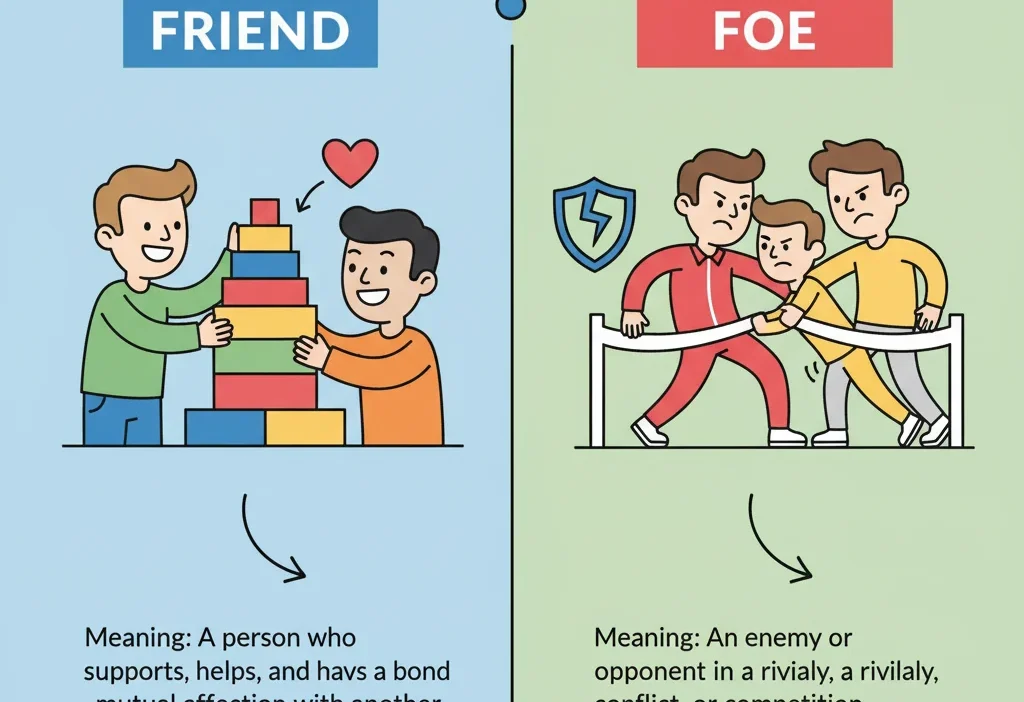
A friend is a person you like and trust. They care about you and want good things for you.
Part of speech: Noun
Simple Definition: Someone who helps, supports, and stands by you.
Examples:
- Ali is my best friend; we study together every day.
- A friend will tell you the truth, even when it’s hard.
- My dog is my loyal friend.
Easy Story Tip:
Think of a friend as someone who smiles when they see you and helps when you’re sad.
Foe – Meaning and Usage
A foe is the opposite of a friend. It means an enemy — someone who is against you or tries to harm you.
Part of speech: Noun
Simple Definition: A person or group that is your opponent or enemy.
Examples:
- In stories, heroes often face a powerful foe.
- Time can be both a friend and a foe.
- The two teams treated each other as foes during the final match.
Easy Story Tip:
Think of a foe as someone who frowns when they see you and makes life harder instead of easier.
The Key Difference Between Friend and Foe
Here’s a simple way to see the contrast between them:
| Feature | Friend | Foe |
|---|---|---|
| Meaning | A person who likes and supports you | A person who dislikes or opposes you |
| Emotion | Positive | Negative |
| Common Synonyms | Ally, companion, buddy | Enemy, opponent, rival |
| Example Sentence | “A friend helps you when you fall.” | “A foe laughs when you fall.” |
| Symbol | ❤️ | ⚔️ |
Quick Tip to Remember:
Both words start with “F,” but a friend brings “fun,” while a foe brings “fear.”
Common Mistakes and How to Avoid Them
Even though these words are opposites, people sometimes use them incorrectly, especially in dramatic writing or jokes.
❌ Mistake 1:
“He’s my friend and foe at the same time.”
✅ Correction:
“He’s like both a friend and a foe — sometimes helpful, sometimes not.”
Why: The original sentence confuses the phrase. “Friend or foe” means one or the other, not both at once.
❌ Mistake 2:
“She is a good foe who always supports me.”
✅ Correction:
“She is a good friend who always supports me.”
Why: A foe doesn’t support — a friend does.
When to Use “Friend”
Use friend when you’re talking about positive relationships, kindness, or support.
Examples:
- My friend helped me study for my exam.
- A friend in need is a friend indeed.
- She met many new friends at school.
- The teacher is a friend to all students.
- Be your own friend by thinking kindly of yourself.
Memory Trick:
A friend has the word “end”, but true friendship never ends!
When to Use “Foe”
Use foe when describing an enemy, opponent, or someone who challenges you.
Examples:
- The superhero faced his greatest foe.
- In chess, your foe is the player sitting across from you.
- Pollution is a foe of nature.
- Don’t underestimate your foe — learn from them.
- Sometimes, fear is our biggest foe.
Memory Hack:
The word foe sounds like “oh no!” — and that’s how you feel when facing an enemy.
Quick Recap: Friend vs Foe
Here’s everything you need to remember:
- Friend = Ally, helper, supporter
- Foe = Enemy, rival, opponent
- Both are nouns that describe people or forces.
- “Friend or foe” means good or bad, helper or enemy.
- Use “friend” for positive feelings and “foe” for negative ones.
✅ Simple Reminder:
If they stand with you → they’re a friend.
If they stand against you → they’re a foe.
Advanced Tips and Interesting Facts
- The word “foe” comes from Old English fāh, meaning “hostile.”
- “Friend” comes from Old English freond, related to freo, meaning “free” — showing how friendship is built on freedom and kindness.
- In modern writing, “friend or foe” often appears in movies, video games, and technology — like “friend-or-foe radar systems” used in aircraft.
- In essays or stories, using “friend or foe” adds dramatic effect to show clear opposites.
Mini Quiz: Test Your Understanding
Fill in the blanks with friend or foe.
- A true ______ never betrays your trust.
- In the movie, the hero couldn’t tell if the stranger was a ______.
- Honesty is a ______ of truth, not a ______ of lies.
- The team treated their rivals as ______ during the match.
- My pet cat has been my best ______ since childhood.
- Laziness can become your biggest ______ when you’re trying to succeed.
- A smile can turn a ______ into a ______!
(Answers: 1. friend 2. foe 3. friend, foe 4. foes 5. friend 6. foe 7. foe, friend)
Frequently Asked Questions (FAQs)
1. What does “friend or foe” mean?
It means asking whether someone is an ally (friend) or an enemy (foe).
2. Is “foe” still used today?
Yes! It’s common in stories, games, and formal writing to describe an opponent or enemy.
3. Can someone be both a friend and a foe?
Sometimes! We call such people “frenemies” — part friend, part enemy.
4. What’s another word for foe?
Enemy, rival, or opponent.
5. How do I remember the difference easily?
“Friend” brings fun and smiles. “Foe” brings fear and frowns.
Conclusion
Now you know exactly how to tell a friend from a foe!
A friend helps you rise, while a foe tries to make you fall.
Remember the quick tip — both start with “F,” but only one stands for fun and friendship.
Keep practicing these words in your conversations, stories, or school essays. The more you use them, the easier it gets to speak English with confidence and clarity

Oliver Thorne is a passionate digital storyteller and content strategist at WordContrast.com. With years of experience in SEO writing and online marketing, he specializes in transforming complex ideas into clear, engaging articles. Oliver loves exploring the latest trends in technology, productivity, and digital culture—helping readers stay informed and inspired in today’s fast-moving world.