Do you often wonder whether a red, itchy bump on your lip is eczema on lips or a cold sore? Many people confuse these two conditions because they both affect the lips and can cause discomfort. However, knowing the difference is important—not just for health, but also for talking about them correctly in English.
In this guide, you will learn what each term really means, how to spot the differences, and how to use these phrases correctly in conversation or writing. We will provide simple explanations, easy examples, and memory tricks so that even beginners can understand. By the end, you’ll confidently identify eczema on lips or cold sore, avoid common mistakes, and explain them clearly to others.
What Does Each Word Mean?
Eczema on Lips
Definition:
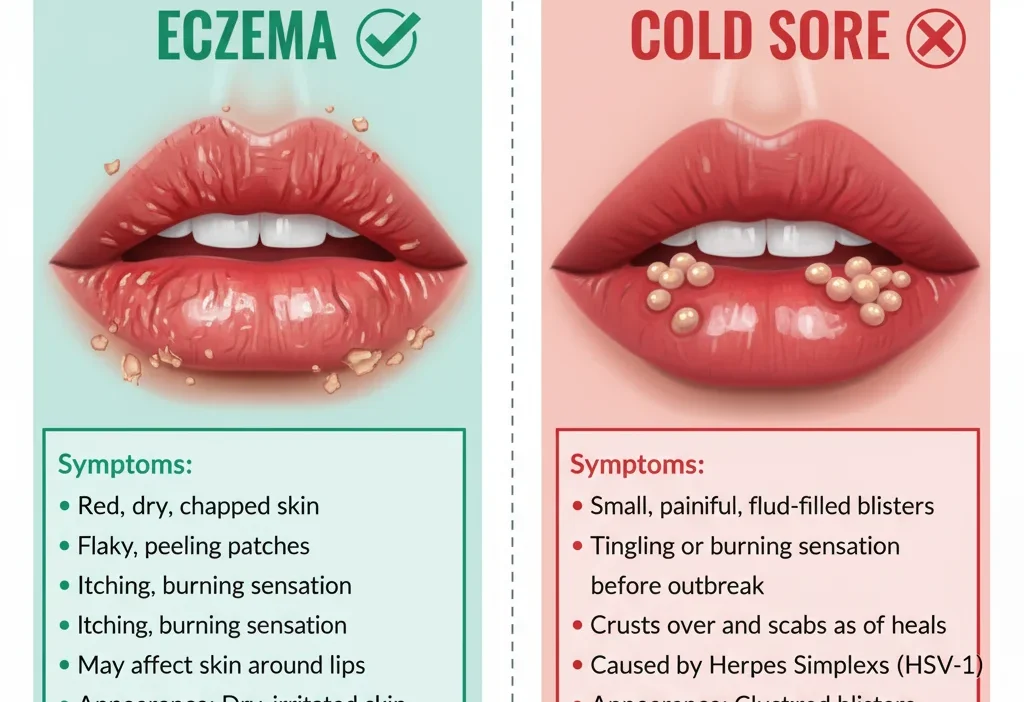
Eczema on lips is a skin condition that causes redness, dryness, itching, or small bumps. It is usually linked to irritation, allergies, or sensitive skin.
Part of Speech: Noun phrase
Examples:
- Sarah’s eczema on lips made it painful to eat ice cream.
- He applied cream to treat his eczema on lips.
- Doctors say that stress can worsen eczema on lips.
Memory Tip: Think of eczema as a “skin reaction” that comes from irritation or allergies.
Cold Sore
Definition:
A cold sore is a small, fluid-filled blister caused by the herpes simplex virus. It usually appears on or around the lips and can be painful or itchy.
Part of Speech: Noun phrase
Examples:
- After feeling tired, she noticed a cold sore on her lip.
- He avoided kissing because of the cold sore.
- Cold sores often heal in 7–10 days without treatment.
Memory Tip: Remember that cold sores are viral and contagious, unlike eczema.
The Key Difference Between Eczema on Lips and Cold Sore
| Feature | Eczema on Lips | Cold Sore |
|---|---|---|
| Cause | Irritation, allergies, dry skin | Herpes simplex virus |
| Appearance | Red, dry, sometimes flaky | Small fluid-filled blisters |
| Pain | Itchy or mildly uncomfortable | Painful or tingling |
| Contagious | No | Yes |
| Treatment | Moisturizers, creams | Antiviral creams or medications |
| Duration | Can last days to weeks | Usually 7–10 days |
Quick Tip: If it’s itchy and dry, it’s likely eczema on lips. If it’s blistered and contagious, it’s probably a cold sore.
Common Mistakes and How to Avoid Them
Incorrect: I have a cold sore because my lips are dry and red.
Correct: I have eczema on lips because my lips are dry and red.
Incorrect: Don’t worry, your eczema on lips will spread to others.
Correct: Don’t worry, your cold sore can spread to others.
Why These Mistakes Happen:
People mix them up because both appear on lips and can be uncomfortable. Always remember: eczema = irritation, cold sore = virus.
When to Use Eczema on Lips
Situations to Use:
- Describing dry, itchy, or irritated lips
- Talking about allergies or skincare
- Explaining treatment with moisturizers or creams
Examples:
- I put cream on my eczema on lips before bed.
- Eczema on lips can get worse in winter.
- Avoid spicy food if you have eczema on lips.
- Doctors recommend gentle lip care for eczema on lips.
Memory Hack: Think “eczema = itch + irritation.”
When to Use Cold Sore
Situations to Use:
- Talking about contagious lip blisters
- Explaining viral infections
- Warning others to avoid close contact
Examples:
- Cover your cold sore so it doesn’t spread.
- Stress can trigger a cold sore outbreak.
- Cold sores are common in adults and children.
- He avoided swimming because of his cold sore.
Visual Trick: Imagine a tiny bubble on the lip—this is your cold sore.
Quick Recap: Eczema on Lips vs Cold Sore
- Eczema on lips = itchy, red, irritated skin (not contagious)
- Cold sore = small, fluid-filled blister caused by a virus (contagious)
- Tip: Dry + itchy → eczema; Blister + contagious → cold sore
Advanced Tips
- Origins: “Eczema” comes from Greek, meaning “to boil over.” “Cold sore” is named because it appears during cold or stress.
- Formal writing: Use “eczema on lips” in medical or skincare articles, and “cold sore” in health or viral infection contexts.
- Online communication: Don’t call a viral cold sore “eczema”—this can confuse friends or readers.
Mini Quiz
Fill in the blanks:
- Red, itchy lips are usually ________.
- A small, contagious blister on the lip is called a ________.
- You should use cream for ________ on lips.
- ________ can spread through kissing.
- Winter dryness can worsen ________ on lips.
- Feeling tired sometimes triggers a ________.
- Avoid spicy food if you have ________ on lips.
FAQs
1. Can eczema on lips and cold sores appear at the same time?
Yes, but they are separate conditions. Eczema is irritation, and cold sores are viral.
2. Is eczema on lips contagious?
No, it cannot spread to others.
3. How long does a cold sore last?
Usually 7–10 days.
4. What triggers eczema on lips?
Allergies, dry skin, irritants, or stress.
5. Can lip balm help both conditions?
It can help eczema by moisturizing but will not cure a cold sore.
Conclusion
Understanding whether it’s eczema on lips or a cold sore is easier than it seems. Eczema causes dry, itchy, irritated skin, while cold sores are small, viral, contagious blisters. By learning the differences, spotting symptoms, and using these words correctly, you can avoid confusion in conversation, writing, or social situations.
Practice using eczema on lips or cold sore in sentences daily. Remember the quick tips and visual tricks: dry + itchy = eczema; blister + contagious = cold sore. With a little practice, you’ll confidently explain these terms to anyone. Keep reading, practicing, and improving your English—it gets easier every day!

Marianne Solace is a lifestyle and personal-growth writer for WordContrast.com. Her work blends inspiration with practicality, offering thoughtful insights on wellness, creativity, and mindful living. When she’s not writing, Marianne enjoys journaling with a cup of coffee, exploring art museums, and helping others find balance through the written word.