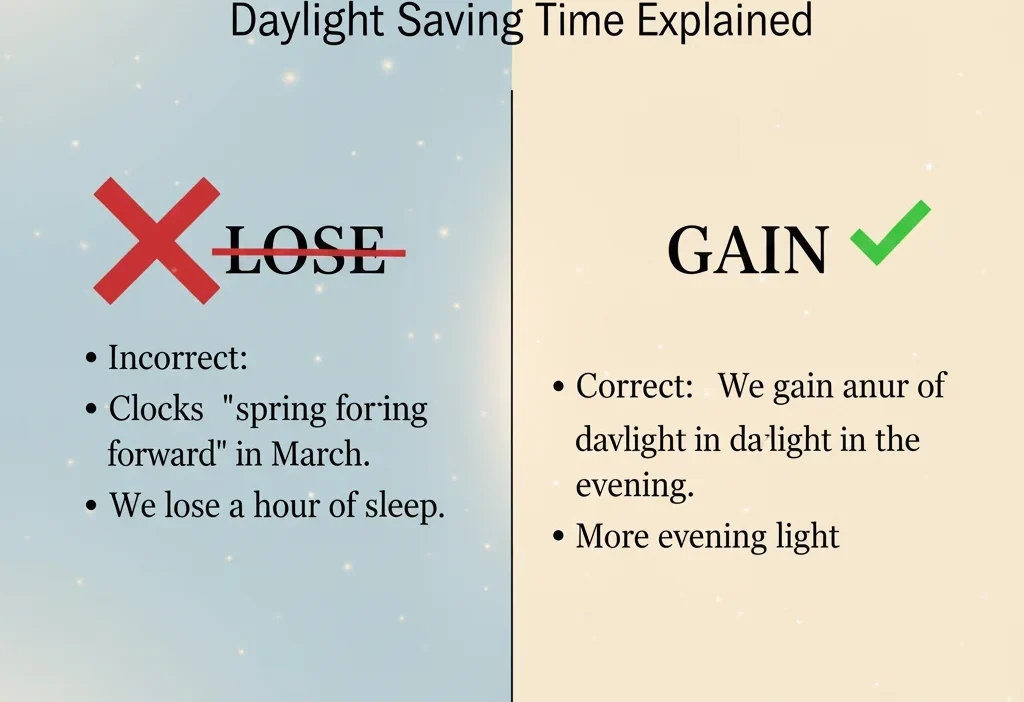
In March, during Daylight Saving Time (DST), we lose one hour.
The clock moves forward, so the night becomes one hour shorter. This is often called “spring forward.”
Now let’s explain the phrase itself — the grammar, usage, meaning, and how to use it correctly
Many people get confused when they ask: “Do we gain or lose an hour in March?”
This question appears every year because we change the time during Daylight Saving Time (DST). But the English phrase itself also confuses people. It includes two opposite words: gain OR lose, which makes learners unsure about which one is correct and when to use it.
In this complete guide, you will learn:
- What “gain” means
- What “lose” means
- The difference between gain vs lose in this phrase
- How to use the question correctly
- Simple examples even a 4th-grade student can understand
- Common mistakes and how to fix them
- Memory tricks to remember the rule
- A quick recap, FAQs, and a short quiz
By the end, you will clearly understand whether we gain or lose an hour in March — and how to use these words correctly in English
🟦 What Does “Gain” Mean?
Gain means to get something, receive something, or have more of something.
It is a verb.
✔ Simple Meaning
Gain = you get extra.
✔ 3 Easy Examples
- I gained a point in the game. (I got more points.)
- We gained time because we finished early.
- When clocks go back, we gain an hour of sleep.
✔ Mini-Story
Imagine you find a bonus cookie in your lunchbox. You didn’t have it before, but now you do.
You gained a cookie.
You got more.
That’s exactly how gain works.
🟦 What Does “Lose” Mean?
Lose means to have less, misplace something, or something gets taken away.
It is also a verb.
✔ Simple Meaning
Lose = you have less than before.
✔ 3 Easy Examples
- I lost my pen. (Now I have none.)
- We lost time because the bus was late.
- When clocks go forward, we lose an hour.
✔ Mini-Story
Imagine you had 10 minutes to play outside, but a teacher calls you in early.
You lost time — now you have less free time.
This is what lose means.
🟦 The Key Difference Between “Gain” and “Lose” in This Phrase
The question “Do we gain or lose an hour in March?” is asking:
Do we get extra time OR do we lose time when the clock changes?
During March (DST start):
✔ The clock moves forward
✔ We lose one hour
✔ The night becomes shorter
🟩 Comparison Table
| Word | Meaning | When It Happens | Easy Example |
|---|---|---|---|
| Gain | Get more | Clock moves back | “We gain an hour in November.” |
| Lose | Have less | Clock moves forward | “We lose an hour in March.” |
⭐ Quick Tip
Spring forward = lose an hour.
Fall back = gain an hour.
🟦 Common Mistakes and How to Avoid Them
❌ Mistake 1: Confusing gain with lose
Incorrect:
“We gain an hour in March.”
Correct:
“We lose an hour in March.”
Why?
Because the clock moves forward, skipping one hour.
❌ Mistake 2: Using “lost” instead of “lose” in the question
Incorrect:
“Do we lost an hour in March?”
Correct:
“Do we lose an hour in March?”
Why?
Because do + base verb is the rule.
❌ Mistake 3: Writing the question with confusing order
Incorrect:
“Do we lose or gain hour in March?”
Correct:
“Do we gain or lose an hour in March?”
Why?
The natural order places the positive word first, then the negative.
🟦 When to Use “Gain”
Use gain when:
✔ You get extra time
✔ You receive more of something
✔ Time or clocks move backward
✔ You end up with more than before
✔ Simple Example Sentences
- We gain an hour when Daylight Saving Time ends.
- I gained extra time because the class ended early.
- You gain experience when you practice.
- We gain daylight in spring evenings.
- Moving the clock back means we gain sleep.
⭐ Memory Hack
Gain = grow.
Both words start with G.
If something grows, you gain it.
🟦 When to Use “Lose”
Use lose when:
✔ Time is taken away
✔ You end up with less
✔ Clocks move forward
✔ Something disappears
✔ Simple Example Sentences
- In March, we lose an hour because the clock jumps forward.
- I lose time when I forget my keys.
- You lose a chance if you don’t try.
- We lose sleep when the night becomes shorter.
- If you don’t save your work, you might lose your progress.
⭐ Memory Hack
Lose = less.
Both words start with L.
If you have less, you lose something.
🟦 Quick Recap: Gain vs Lose
Here is a simple review:
- Gain = get more
- Lose = get less
- March = lose an hour (spring forward)
- November = gain an hour (fall back)
- Gain = G = Grow (more)
- Lose = L = Less (less)
🟦 Advanced Tips (Optional)
✔ Word Origin
- Gain comes from Old Norse “geyna,” meaning “to increase.”
- Lose comes from Old English “losian,” meaning “to be deprived.”
✔ Formal Writing
Use the phrase correctly in essays:
- “During March, we lose an hour due to Daylight Saving Time adjustments.”
✔ Online Writing
People often use the wrong verb because the phrase looks similar.
Always check if the clock is moving forward or backward.
🟦 Mini Quiz: Test Yourself
Fill in the blanks:
- In March, we ____ an hour.
- When clocks go back, we ____ an hour.
- Lose means to have ____ time.
- Gain means to get ____ time.
- “Do we gain or lose an hour in March?” — The answer is: we ____ an hour.
(Answers: 1-lose, 2-gain, 3-less, 4-more, 5-lose)
🟦 5 Helpful FAQs
1. Do we gain or lose an hour in March?
We lose an hour because the clock moves forward.
2. What does “gain an hour” mean?
It means you get extra time — usually when clocks go back.
3. Why do we lose an hour in March?
Because of Daylight Saving Time, the clock skips one hour.
4. Is “lose” spelled L-O-S-E, not L-O-O-S-E?
Yes!
Lose = have less.
Loose = not tight.
5. How can I remember the difference?
Think: Lose = Less, Gain = Grow.
🟦 Featured Image Suggestion
A simple side-by-side visual showing:
“Spring Forward = Lose an Hour”
“Fall Back = Gain an Hour”
Conclusion
Now you clearly understand the difference between gain and lose, especially in the question:
“Do we gain or lose an hour in March?”
The answer is simple: We lose an hour because the clock moves forward.
By learning the meanings of both words and seeing them in real examples, you can now use them confidently in everyday English. Keep practicing, stay curious, and remember — every small step makes your English stronger.

Oliver Thorne is a passionate digital storyteller and content strategist at WordContrast.com. With years of experience in SEO writing and online marketing, he specializes in transforming complex ideas into clear, engaging articles. Oliver loves exploring the latest trends in technology, productivity, and digital culture—helping readers stay informed and inspired in today’s fast-moving world.