
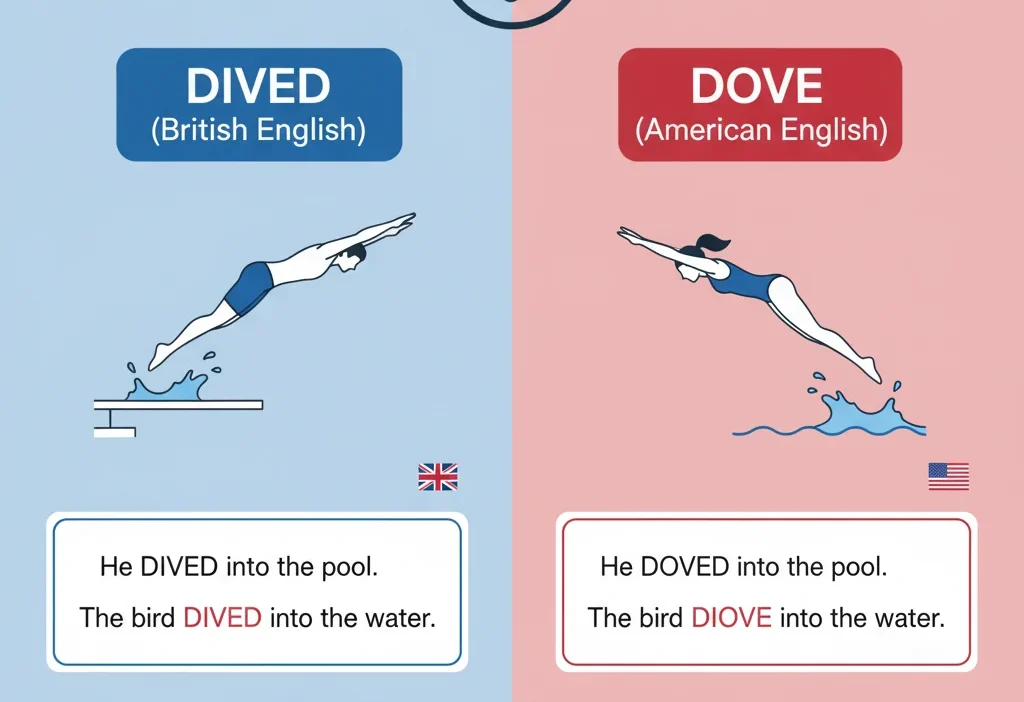
Do you ever wonder whether to say “He dived into the pool” or “He dove into the pool”? You’re not alone! Many English learners — and even native speakers — get confused between dived and dove.
Both words come from the verb “to dive,” meaning to jump headfirst into water or to move downward quickly. But the tricky part is deciding which past tense form is correct.
In this simple guide, you’ll learn:
- What dived and dove each mean
- The difference between dived and dove
- When to use each correctly
- Common mistakes and how to fix them
- Easy examples anyone can remember
By the end, you’ll never hesitate again when choosing between dived or dove — promise.
What Does Each Word Mean?
Let’s start with the basics.
1. Dived — The Traditional Past Tense
Dived is the original and traditional past tense of dive.
It’s the form used in British English and is accepted in all types of writing.
✅ Meaning: to jump or move headfirst into water or something similar.
Examples of “dived”:
- She dived into the pool to save her toy.
- The dolphin dived deep into the ocean.
- He dived under the bed to find his missing sock.
Part of Speech: Verb (past tense of “dive”)
2. Dove — The American Alternative
Dove is the modern past tense of dive, mostly used in American English.
It became popular in the 1800s and is now common in both casual and formal U.S. English.
✅ Meaning: same as dived — to jump or move downward quickly, especially into water.
Examples of “dove”:
- The kids dove into the lake during summer camp.
- He dove to catch the ball before it hit the ground.
- The bird dove from the sky to grab its prey.
Part of Speech: Verb (past tense of “dive”)
The Key Difference Between Dived and Dove
Both words mean the same thing and are grammatically correct.
The only difference lies in regional preference — dived in British English, dove in American English.
Here’s a simple comparison table:
| Feature | Dived | Dove |
|---|---|---|
| Usage | British English | American English |
| Meaning | Jumped or plunged downward | Jumped or plunged downward |
| Grammar Form | Regular past tense | Irregular past tense |
| Example | She dived into the pool. | She dove into the pool. |
| Formality | Common in formal writing | Common in everyday speech |
💡 Quick Tip to Remember:
If you use “drived” for “drive,” it sounds wrong — you say “drove.”
That’s why Americans started saying “dove” (like drove) instead of dived.
But both are fine — just stay consistent!
Common Mistakes and How to Avoid Them
Here are some typical mix-ups:
❌ Incorrect: He have dove into the pool.
✅ Correct: He has dived (or has dove) into the pool.
🧠 Why?
After has or have, we use the past participle form.
Both dived and dove can serve as past participles, but dived is more traditional in this case.
❌ Incorrect: She dove in the project last year.
✅ Correct: She dove into the project last year.
🧠 Why?
The correct phrase is “dive into” — not in.
When to Use Dived
Use dived when:
- You’re writing or speaking British English
- You want to sound more formal
- You prefer traditional grammar forms
Examples:
- The frog dived into the pond.
- The swimmer dived off the diving board.
- The submarine dived below the surface.
- The child dived under the blanket to hide.
- The bird dived straight into the water.
📘 Memory Hack:
Remember “dived” is like “walked” — a regular past tense form.
When to Use Dove
Use dove when:
- You’re speaking American English
- You’re writing a story or dialogue with a natural, modern tone
- You want a smoother, less formal sound
Examples:
- She dove into her homework as soon as she got home.
- The lifeguard dove into the pool to rescue the child.
- He dove for cover during the storm.
- The cat dove under the table when it heard thunder.
- The boy dove into his video games right after dinner.
💡 Memory Hack:
Think: drive → drove, dive → dove!
That’s how most Americans remember it.
Quick Recap: Dived vs Dove
- ✅ Both mean the same thing.
- 🏴 Dived = British English (formal, traditional).
- 🇺🇸 Dove = American English (modern, casual).
- ✏️ Both are correct — just be consistent in your writing.
Easy rule to remember:
If you’re in the U.S., use dove.
If you’re in the U.K. or writing formally, use dived.
Advanced Tips: Grammar & History
- Historically, “dived” was the only correct past tense form until the 19th century, when Americans started using “dove.”
- Linguists call this analogy-based change — people made dive → dove to match drive → drove.
- In formal writing (essays, exams, academic work), dived is safer because it’s universally accepted.
- In casual speech or storytelling, dove sounds more natural and modern.
- In British publications or the Oxford English Dictionary, dived is preferred, but dove is listed as an alternative.
Mini Quiz: Test Your Understanding
Fill in the blanks with the correct word — dived or dove.
- The dolphin _______ deep into the sea.
- She _______ under the table to grab her phone.
- The kids _______ into the pool after lunch.
- The submarine _______ to avoid detection.
- He _______ headfirst into the project with excitement.
✅ Answers:
- dove/dived
- dove/dived
- dove
- dived
- dove
(Both forms work — it depends on your English style!)
FAQs About “Dived” vs “Dove”
1. Is “dove” grammatically correct?
Yes. Dove is correct in American English and widely accepted in modern usage.
2. Is “dived” wrong?
Not at all! Dived is the original and still the preferred form in British and formal English.
3. Can I use both “dived” and “dove” in the same text?
It’s better to pick one style (American or British) and stay consistent throughout your writing.
4. What’s the past participle of “dive”?
Traditionally, it’s dived, but dove can also serve as the past participle in U.S. English.
5. Which should I use for school essays?
Use dived — it’s accepted everywhere and sounds more formal.
Conclusion
Now you know that both dived and dove are correct — they just belong to different styles of English.
When writing, choose one form and stick to it. If you’re learning English, start with dived since it’s always correct in every country.
Keep practicing, reading, and writing in English daily — small steps make a big difference in mastering grammar!

Henry Vale is a tech-savvy content creator at WordContrast.com, known for his in-depth guides and how-to articles. With a background in digital media and a passion for innovation, Henry focuses on simplifying technology for everyday users. His mission is to empower readers with clear, actionable knowledge they can use to improve their digital lives.