English can be tricky — especially when two words look or sound similar but mean completely different things. Words like then and than, or lose and loose, confuse even native speakers!
In this friendly guide, you’ll learn how to classify and categorize these confusing English pairs. We’ll explain their meanings, show easy examples, and share memory tips so you’ll never mix them up again.
By the end, you’ll understand:
- What each word means
- The difference between similar-sounding words
- How to use them correctly in real life
Let’s make English easy — step by step!
🧩 What Does “Classify and Categorize” Mean?
Before we jump in, let’s understand the title itself.
- Classify means to group things by type or category. Example: We classify animals into mammals, birds, and reptiles.
- Categorize means almost the same — to arrange by shared features. Example: We categorize books by genre (mystery, romance, fantasy).
Here, we’ll classify and categorize English word pairs that often confuse learners — so you can clearly see how each works.
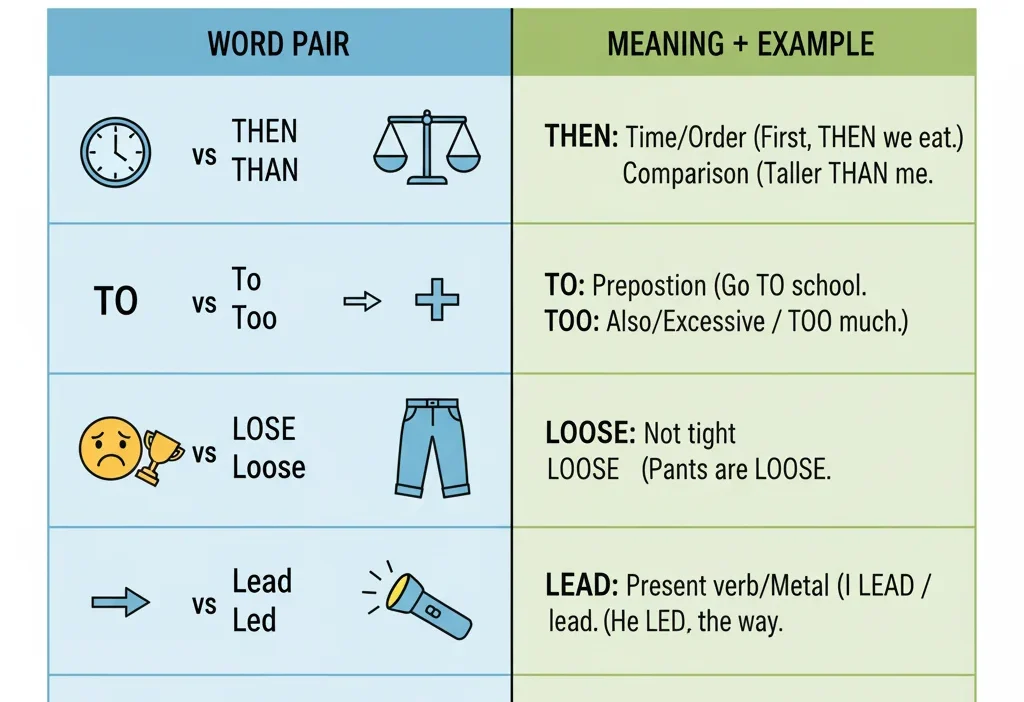
🅰️ Then vs Than
🔹 Meaning and Usage
| Word | Part of Speech | Meaning | Example |
|---|---|---|---|
| Then | Adverb | Refers to time or order of events. | “I ate breakfast, then went to school.” |
| Than | Conjunction | Used for comparison. | “She is taller than her brother.” |
🧠 Quick Tip
➡️ Then = Time ⏰
➡️ Than = Comparison 📏
✍️ Examples
- I finished my homework, then watched TV.
- This bag is heavier than that one.
- We’ll go to the park, then eat ice cream.
Common Mistake:
❌ “I’m taller then you.”
✅ “I’m taller than you.”
🅱️ To vs Too
🔹 Meaning and Usage
| Word | Part of Speech | Meaning | Example |
|---|---|---|---|
| To | Preposition | Shows direction, purpose, or action. | “I’m going to school.” |
| Too | Adverb | Means also or excessively. | “I want to come too.” / “It’s too hot.” |
🧠 Quick Tip
➡️ Too has an extra “o” because it means extra or also.
✍️ Examples
- I’m going to the market.
- She’s coming too!
- It’s too loud in here.
- He wants to learn English.
Common Mistake:
❌ “I want to go too the store.”
✅ “I want to go to the store.”
🅾️ Lose vs Loose
🔹 Meaning and Usage
| Word | Part of Speech | Meaning | Example |
|---|---|---|---|
| Lose | Verb | To misplace or not win. | “Don’t lose your keys!” |
| Loose | Adjective | Not tight or free. | “This shirt is loose.” |
🧠 Quick Tip
➡️ Lose has one “o” because you lose something (it’s gone).
➡️ Loose has two “o’s” — it’s open or free.
✍️ Examples
- I don’t want to lose my wallet.
- These shoes are too loose.
- Don’t lose hope!
- The dog got loose and ran away.
Common Mistake:
❌ “Don’t loose your bag.”
✅ “Don’t lose your bag.”
🪶 Lead vs Led
🔹 Meaning and Usage
| Word | Part of Speech | Meaning | Example |
|---|---|---|---|
| Lead | Verb (present) / Noun | To guide or be in charge; also a metal. | “She will lead the team.” / “The pipe is made of lead.” |
| Led | Verb (past) | Past tense of “lead.” | “She led the team yesterday.” |
🧠 Quick Tip
➡️ Lead (pronounced “leed”) = now
➡️ Led = past
✍️ Examples
- I will lead the group tomorrow.
- He led the project last year.
- The pencil contains lead.
- Our teacher led us to success.
Common Mistake:
❌ “He lead the game.”
✅ “He led the game.”
🧭 Affect vs Effect
🔹 Meaning and Usage
| Word | Part of Speech | Meaning | Example |
|---|---|---|---|
| Affect | Verb | To influence or change something. | “The rain can affect your mood.” |
| Effect | Noun | The result or outcome. | “The effect of the rain was refreshing.” |
🧠 Quick Tip
➡️ Affect = Action (Verb)
➡️ Effect = End result (Noun)
✍️ Examples
- The weather can affect my energy.
- The effect of exercise is better health.
- Lack of sleep affects your focus.
- The new rule had a big effect on students.
Common Mistake:
❌ “The medicine had no affect.”
✅ “The medicine had no effect.”
77+Does Car Insurance Cover the Car or the Driver? Insurance Facts 2025
🧾 Quick Recap: Common Confusing Word Pairs
| Word Pair | Key Difference | Example |
|---|---|---|
| Then vs Than | Time vs Comparison | “Finish work, then rest.” / “She’s taller than me.” |
| To vs Too | Direction vs Also/Extra | “Go to school.” / “I’m coming too.” |
| Lose vs Loose | Misplace vs Not tight | “Don’t lose your key.” / “My shirt is loose.” |
| Lead vs Led | Present vs Past | “I lead today.” / “I led yesterday.” |
| Affect vs Effect | Verb vs Noun | “It will affect you.” / “That’s the effect.” |
💡 Advanced Tips: Origins and Writing Use
- Then comes from Old English “thænne,” meaning at that time.
- Than came from “thanne,” used in comparisons.
- Lose vs Loose evolved from similar Old Norse words — one verb, one adjective.
- Lead and Led confuse writers because lead (metal) sounds like led (past tense).
- In formal writing (like essays), mixing affect and effect changes meaning completely — always check if you’re describing an action or a result.
🪶 Pro Tip for Bloggers & Students:
Use mnemonic tricks or flashcards to remember differences. You can also create mini-sentences (like “Affect is Action”) to memorize faster.
🧩 Mini Quiz: Test Your Knowledge
Fill in the blanks 👇
- I wanted to go, but it was raining, _____ I stayed home.
- She’s smarter _____ her brother.
- Don’t _____ your wallet!
- The shirt is too _____ for me.
- He _____ the team to victory yesterday.
- The new law will _____ everyone’s life.
- The new law had a strong _____ on the economy.
- I’m going _____ the library.
- May I come _____?
(Answers: 1. then, 2. than, 3. lose, 4. loose, 5. led, 6. affect, 7. effect, 8. to, 9. too)
❓ FAQs
1. What is the main difference between Then and Than?
Then is about time, while than is used for comparison.
2. How do I remember To and Too?
Think of the extra “o” in too — it means extra or also.
3. Is Lose a verb or adjective?
Lose is a verb (you can lose something). Loose is an adjective.
4. Which is correct: Lead or Led in past tense?
The past tense of lead is led, not lead.
5. What’s the difference between Affect and Effect in simple words?
Affect is the action, and effect is the result.
🏁 Conclusion
English is full of pairs that look or sound alike but mean very different things. By learning how to classify and categorize examples like then vs than or affect vs effect, you make writing and speaking clearer and smarter.
Keep practicing with short sentences and check your spelling when you write. The more you use these words correctly, the easier it becomes! 🌱
✨ Remember: Mistakes help you learn — every time you fix one, your English grows stronger.

Marianne Solace is a lifestyle and personal-growth writer for WordContrast.com. Her work blends inspiration with practicality, offering thoughtful insights on wellness, creativity, and mindful living. When she’s not writing, Marianne enjoys journaling with a cup of coffee, exploring art museums, and helping others find balance through the written word.