Have you ever written a name like Chris’ and then wondered if it should be Chris’s instead? You’re not alone!
Many English learners (and even native speakers) get confused when adding apostrophes to names that already end with “s.”
This guide will explain everything you need to know — the difference between Chris’ and Chris’s, their meanings, correct usage, grammar rules, and easy examples.
By the end, you’ll know exactly when to use each form — and you’ll never second-guess your punctuation again!
What Does Each Form Mean?
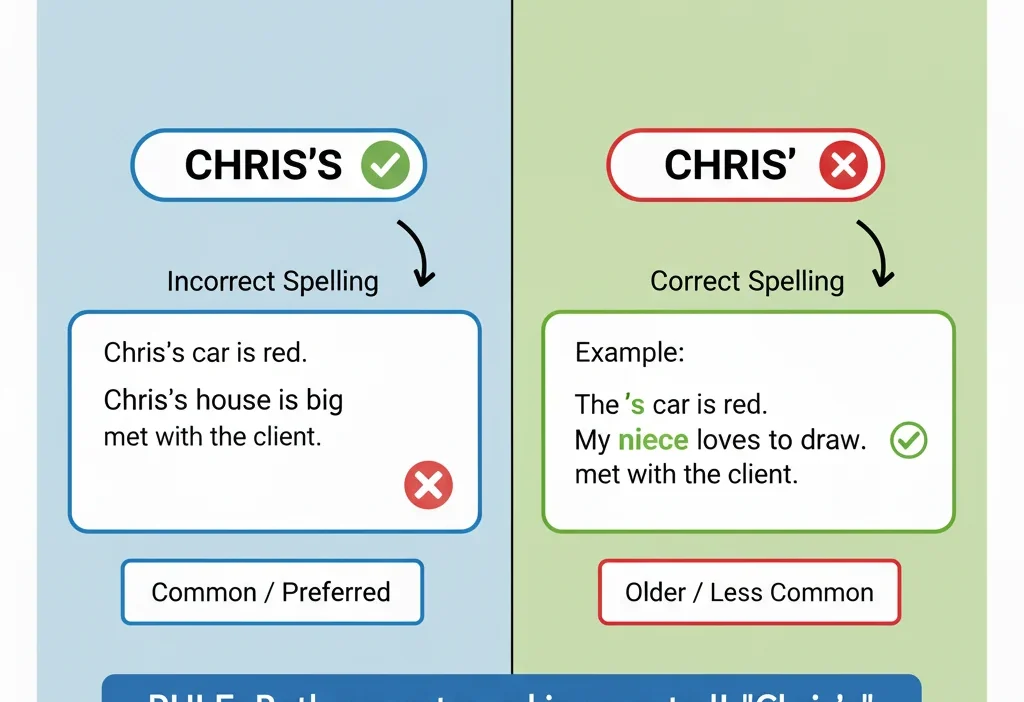
Let’s start simple. Both Chris’ and Chris’s show possession — that something belongs to Chris.
But the difference depends on which style guide or grammar tradition you follow.
1. Chris’s (Traditional and American English)
Adding ’s after a name (even if it ends in “s”) is the standard American English rule.
You pronounce it with an extra “iz” sound, like Chris-iz.
Meaning: Something belongs to Chris.
✅ Examples:
- That is Chris’s book.
- Chris’s car is parked outside.
- I went to Chris’s birthday party.
So, in these sentences, Chris’s means “belonging to Chris.”
2. Chris’ (Simplified or British English Style)
Some writers — especially in British English — prefer to add only an apostrophe (‘) after names ending in “s.”
This is often used for style, simplicity, or pronunciation reasons.
Meaning: It also means something belongs to Chris (same as Chris’s).
✅ Examples:
- That is Chris’ notebook.
- Chris’ dog is very friendly.
- We’re going to Chris’ house later.
So both forms are correct, but they follow different style rules.
The Key Difference Between Chris’ and Chris’s
Here’s a quick look at how they differ 👇
| Feature | Chris’s | Chris’ |
|---|---|---|
| Grammar Style | Traditional / American English | British English or Simplified Style |
| Pronunciation | “Chris-iz” | “Chris” |
| Usage Rule | Add ’s to all singular nouns | Add only ’ if noun ends with “s” |
| Example | Chris’s jacket is new. | Chris’ jacket is new. |
| Common In | U.S. schools, formal writing | U.K. writing, news, journalism |
💡 Quick Tip:
If you’re writing for American English, use Chris’s.
If you’re following British English, Chris’ is fine.
Common Mistakes and How to Avoid Them
Even though both forms look simple, people often make small errors. Let’s fix them!
| ❌ Incorrect | ✅ Correct | 💬 Why |
|---|---|---|
| Chris birthday is tomorrow. | Chris’s birthday is tomorrow. | You forgot the possessive apostrophe. |
| The car belongs to Chris’s. | The car belongs to Chris. | Don’t add ’s after “to.” Only use it for ownership. |
| Chris’s are my friends. | Chris and his friends are coming. | ’s doesn’t make plurals; it shows possession. |
🔑 Remember:
Use ’s only to show that something belongs to Chris, not to make a plural.
When to Use Chris’s
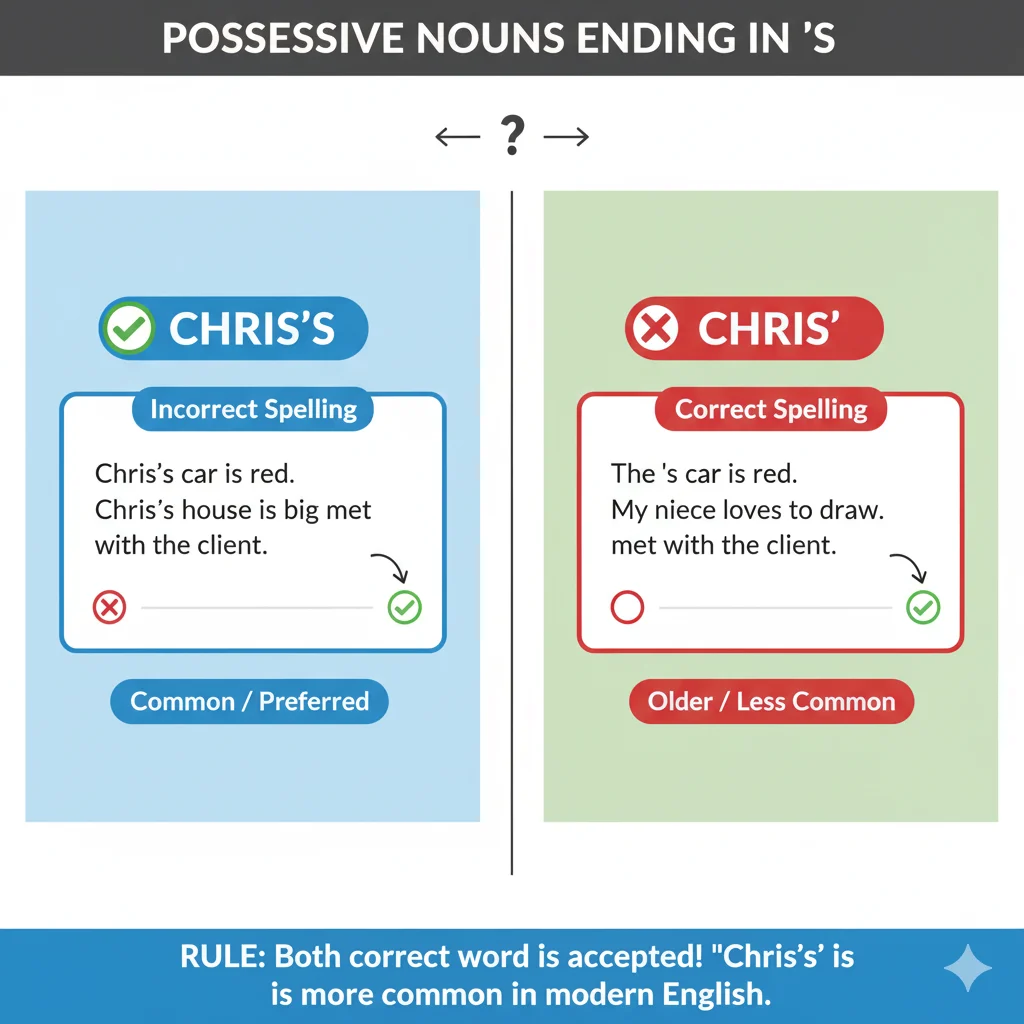
Use Chris’s in the following cases — especially if you follow American grammar or formal English rules.
✅ Examples:
- Chris’s homework is on the table.
- We visited Chris’s parents yesterday.
- I borrowed Chris’s pen.
- That’s Chris’s favorite movie.
- Chris’s performance was amazing!
📘 Memory Hack:
If you pronounce an extra “iz” sound naturally when speaking, use Chris’s.
Example: “Chris’s car” sounds like “Chris-iz car.”
When to Use Chris’
Use Chris’ when:
- You follow British English or journalistic writing (like in newspapers).
- You prefer a simpler look without extra letters.
- You want to match the style of other names ending in “s.”
✅ Examples:
- We stayed at Chris’ cottage last weekend.
- That is Chris’ responsibility.
- Chris’ team won the match.
- I saw Chris’ reaction to the news.
- Chris’ dog loves to play fetch.
💡 Quick Trick:
If the word ends in s and the next word starts with “s”, using only an apostrophe can make reading easier.
Example: “Chris’ song” is smoother than “Chris’s song.”
Quick Recap: Chris’ vs Chris’s
Here’s your short and simple summary:
- Both mean the same (showing possession).
- Chris’s = American English (traditional rule).
- Chris’ = British or simplified form.
- Both are correct, but be consistent in your writing.
- Always add the apostrophe — never write “Chris book.”
🧠 Easy Rule:
If unsure, always go with Chris’s — it’s accepted everywhere.
🚗 Uber or Lyft: Which One Is Cheaper 2025
Advanced Tips
- In academic or formal essays, style guides like Chicago Manual of Style and MLA prefer Chris’s.
- In Associated Press (AP) or journalistic writing, Chris’ is often used.
- For spoken English, both sound natural, but Chris’s is clearer.
- Never confuse possessive with plural — Chris’s means “belonging to Chris,” while Chrises (rarely used) would mean “more than one person named Chris.”
📚 Bonus:
The rule applies to other names too:
- James’s / James’
- Charles’s / Charles’
- Ross’s / Ross’
Choose one style and use it consistently!
Mini Quiz: Test Yourself!
Fill in the blanks with Chris’ or Chris’s.
- _______ guitar sounds amazing.
- We’re going to _______ house for dinner.
- _______ dog barked all night.
- Have you seen _______ new car?
- _______ performance was the best of all.
✅ Answers:
- Chris’s / Chris’
- Chris’s / Chris’
- Chris’s / Chris’
- Chris’s / Chris’
- Chris’s / Chris’
(Both are correct — just stick to one style!)
FAQs About Chris’ vs Chris’s
1. Is Chris’ or Chris’s correct?
Both are correct. Chris’s is used in American English, while Chris’ is used in British or journalistic writing.
2. How do you pronounce Chris’s?
It’s pronounced “Chris-iz.”
3. Can I use Chris’ in school essays?
Yes, if your teacher or style guide allows it. But Chris’s is usually preferred in formal writing.
4. What if the name already ends in “s”?
You can write Chris’s or Chris’ — just be consistent throughout your text.
5. Is Chris’s plural?
No. Chris’s shows possession (belonging to one Chris). The plural of “Chris” would be Chrises, which is rare.
Conclusion
Now you know the truth — both Chris’ and Chris’s are correct, but your choice depends on the style of English you use.
Use Chris’s for American grammar, and Chris’ for British or journalistic writing.
The key is consistency — once you pick one form, stick to it!
Keep practicing, and soon, possessive apostrophes will be second nature to you.
Every small grammar win brings you one step closer to mastering English! 🌟

Marianne Solace is a lifestyle and personal-growth writer for WordContrast.com. Her work blends inspiration with practicality, offering thoughtful insights on wellness, creativity, and mindful living. When she’s not writing, Marianne enjoys journaling with a cup of coffee, exploring art museums, and helping others find balance through the written word.