
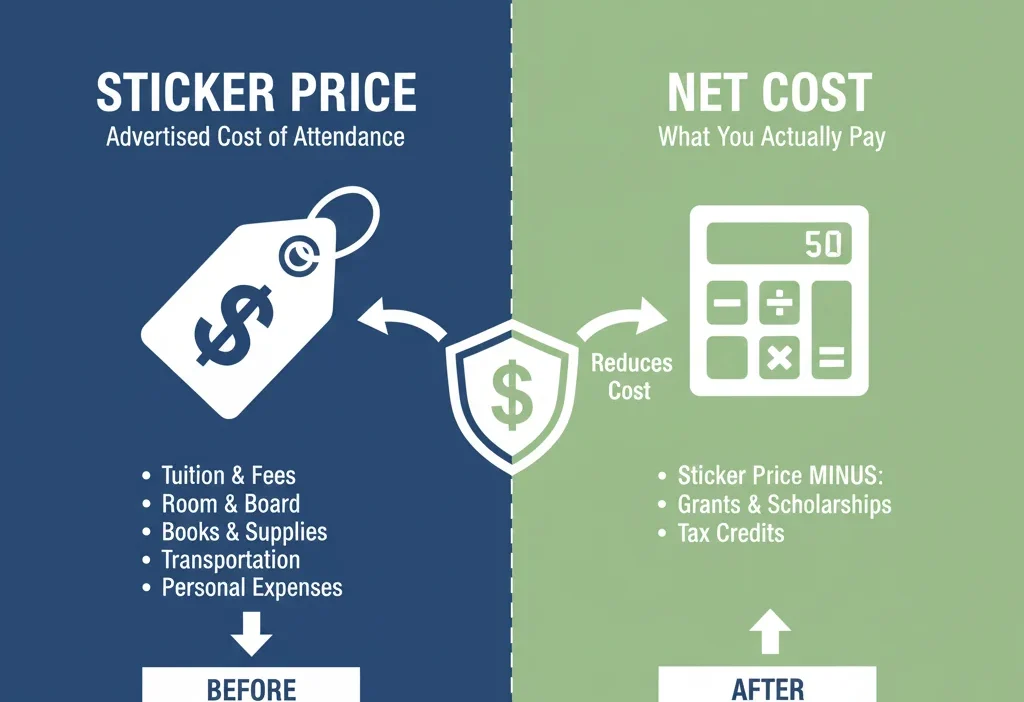
Net costs are almost always lower than sticker prices in higher education because financial aid, grants, scholarships, and discounts reduce the amount students actually pay. The sticker price is the “official price,” while net cost is the “real cost” after aid.
Many students and parents get confused when comparing net costs or sticker prices for higher education. These two terms look similar, but they mean very different things. Because of this, people often make the wrong decision about college affordability.
In this simple guide, we will explain the difference between net costs and sticker prices, why colleges show two different prices, and how to know which number matters for your budget. Every explanation is written in easy, child-friendly language, so even a class-4 student can understand clearly.
By the end, you will learn:
- What net cost means
- What sticker price means
- Why net costs are usually much lower
- How to use each term correctly
- Real-life examples, tables, tips, and a quick quiz
Let’s make this topic simple, friendly, and stress-free!
What Does “Sticker Price” Mean?
Simple Definition
The sticker price is the official full price of a college. It includes tuition, fees, housing, meals, and sometimes books. Think of it as the “price tag” you see on an item in a store.
Part of Speech
Noun (a thing)
Easy Examples
- “The sticker price of the college was $40,000 per year.”
- “Parents got scared when they first saw the sticker price.”
- “The website showed the sticker price, but not what students usually pay.”
Mini Story
Imagine seeing a new phone with a price tag of $1,000. But when you go to the counter, you get a discount, a festival offer, and a voucher. You pay only $600.
That $1,000 is the sticker price — the official number, before any help.
What Does “Net Cost” Mean?
Simple Definition
The net cost is the real amount you pay after subtracting scholarships, grants, discounts, and financial aid. It is usually much lower than the sticker price.
Part of Speech
Noun (a thing)
Easy Examples
- “After aid, the student’s net cost was only $18,000.”
- “Your net cost changes depending on your family income.”
- “Two students may have the same sticker price but different net costs.”
Mini Story
Think of buying a shirt. The price is $30. But you have a coupon worth $10. So you pay only $20.
That $20 is your net cost — the true cost after discounts.
Key Difference Between Net Costs and Sticker Prices
Below is a simple comparison table:
| Feature | Sticker Price | Net Cost |
|---|---|---|
| What it means | Official full price | Real price after aid |
| Who pays it | Almost nobody | Actual students |
| Includes aid? | No | Yes |
| Higher or lower? | Always higher | Always lower |
| Use case | Marketing, public info | Budgeting, planning |
| Example | $40,000 | $15,000 |
Quick Tip to Remember
Sticker price = Scary price
Net cost = What you actually pay
Common Mistakes and How to Avoid Them
❌ Mistake 1: Thinking sticker price is the amount you must pay
Correct: Most students pay the net cost, not the full sticker price.
❌ Mistake 2: Comparing colleges using only sticker prices
Correct: Always compare net costs, because discounts vary.
❌ Mistake 3: Believing all students have the same net cost
Correct: Net cost depends on income, grades, scholarships, and more.
When to Use “Sticker Price”
Use sticker price when you are talking about:
- A college’s official full fee
- Price before scholarships
- The number printed on brochures
- Advertised cost on college websites
Example Sentences
- “The sticker price looks high, but you won’t pay that much.”
- “College A has a sticker price of $50,000 per year.”
- “Parents often panic when they see the sticker price.”
- “Sticker prices help people compare basic costs.”
- “The sticker price doesn’t include aid.”
When to Use “Net Cost”
Use net cost when referring to:
- The true price after aid
- What families actually pay
- Financial planning
- Comparing real affordability
Example Sentences
- “Your net cost depends on your financial aid package.”
- “College B has a low net cost even if its sticker price is high.”
- “Always check net cost before choosing a college.”
- “Scholarships reduce your net cost.”
- “Net cost is better for budgeting.”
Memory Hack
Sticker price = Before help
Net cost = After help
Quick Recap: Net Cost vs Sticker Price
- Sticker price = full official price
- Net cost = real cost after aid
- Sticker price is always higher
- Net cost is what really matters
- Compare colleges using net cost, not sticker price
Why Are Net Costs Lower Than Sticker Prices? (Simple Explanation)
Here’s why net costs are almost always lower:
1. Financial Aid
Colleges give financial help based on income.
2. Scholarships
Students with good grades, sports skills, or talents get discounts.
3. Grants
Government or college grants reduce cost without repayment.
4. Tuition Discounts
Private colleges often cut prices to attract students.
5. Special Programs
Some students get reduced fees based on location or major.
Advanced Tips (Optional)
🌿 1. Historical Origin
Colleges started using sticker prices as “full listed prices,” similar to stores.
📝 2. Use in Exams or Essays
Students should write:
“Net cost reflects actual payment after aid, while sticker price represents the published price before aid.”
💬 3. Online Misuse
People often confuse the two on social media, causing fear or misinformation.
Mini Quiz
Fill in the blanks:
- The ______ price is the official full cost before aid.
- Your ______ cost is what you actually pay after discounts.
- Sticker prices are always ______ than net costs.
- Financial aid reduces your ______ cost.
- Comparing colleges is easier when using ______ cost.
(Answers: sticker, net, higher, net, net)
5 FAQs
1. Which is lower: net cost or sticker price?
Net cost is almost always lower because it includes scholarships and financial aid.
2. Why do colleges list sticker prices if no one pays them?
Sticker prices help standardize fees, but real payments depend on aid.
3. What affects your net cost?
Income, grades, scholarships, family situation, and special programs.
4. Do two students at the same college have the same net cost?
No. Each student gets a different aid package.
5. Which number should I look at when choosing a college?
Always compare net costs, not sticker prices.
Conclusion
Understanding whether net costs or sticker prices are lower for higher education — and why — can save families from confusion and fear. Sticker prices are the official published costs, but net costs show the real amount students pay after aid. This guide helps you use both terms correctly, compare colleges wisely, and feel confident in planning for education.
Keep practicing these terms, and you’ll get better at understanding college pricing every day.

Marianne Solace is a lifestyle and personal-growth writer for WordContrast.com. Her work blends inspiration with practicality, offering thoughtful insights on wellness, creativity, and mindful living. When she’s not writing, Marianne enjoys journaling with a cup of coffee, exploring art museums, and helping others find balance through the written word.