Do you ever get confused between ambience and ambiance? You are not alone! These two words sound almost the same and are often used interchangeably. Both refer to the feeling, mood, or atmosphere of a place, but their spelling and slight usage differences can confuse English learners.
In this guide, you will learn what each word means, the key differences, correct usage, and real-life examples. By the end, even beginners will feel confident using these words in writing and speaking. Whether you’re describing a cozy café or a lively party, this article will make it easy to choose the right word every time.
What Does Each Word Mean?
Ambience
Meaning: Ambience refers to the atmosphere or mood of a place.
Part of Speech: Noun
Examples:
- The restaurant had a romantic ambience with soft lights.
- I love the relaxing ambience of this library.
- The hotel lobby’s ambience makes guests feel welcome.
Think of ambience as the “vibe” you feel around you.
Ambiance
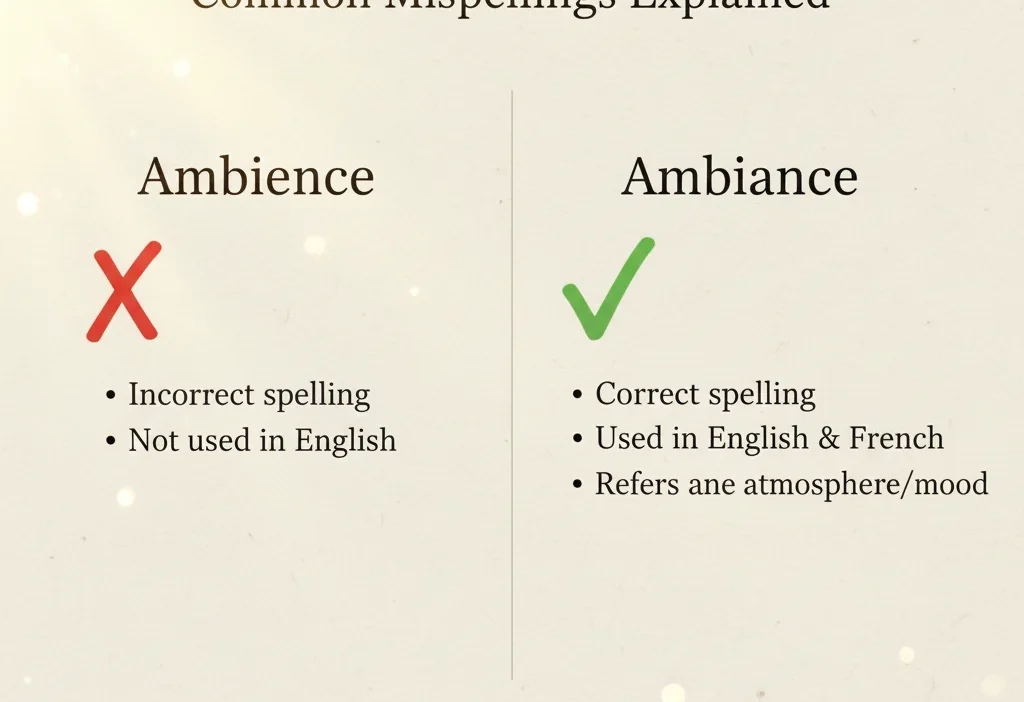
Meaning: Ambiance is simply an alternative spelling of ambience. It is more common in American English, while ambience is often used in British English.
Part of Speech: Noun
Examples:
- The party’s ambiance was energetic and cheerful.
- Candlelight adds a warm ambiance to any room.
- The spa’s calm ambiance helped me relax instantly.
Remember: ambiance is a “fancier” American spelling of the same idea.
The Key Difference Between Ambience and Ambiance
| Feature | Ambience | Ambiance |
|---|---|---|
| Meaning | Mood or atmosphere of a place | Same as ambience |
| Usage | More common in British English | More common in American English |
| Example Sentence | The café had a cozy ambience. | The café had a cozy ambiance. |
Quick Tip: If you are writing for an American audience, use ambiance. For British or international English, use ambience.
Common Mistakes and How to Avoid Them
- Incorrect: The party had a nice ambians.
Correct: The party had a nice ambience. - Incorrect: I love the ambians of this coffee shop.
Correct: I love the ambiance of this coffee shop.
Why mistakes happen: People try to spell the word the way it sounds. Fix it by remembering: the correct forms are ambience (UK) and ambiance (US).
When to Use Ambience
Use ambience in these situations:
- Describing the feel of a place in writing or speech
- Talking about restaurants, hotels, cafes, or parties
- When writing in British English
Examples:
- The ambience of the bookstore was quiet and cozy.
- I enjoy the relaxing ambience of the park.
- The theater’s ambience made the play more exciting.
- She decorated the room to create a cheerful ambience.
- The café’s soft music adds to its peaceful ambience.
When to Use Ambiance
Use ambiance when:
- Writing for American audiences
- Describing atmosphere in daily life or social settings
- Wanting a slightly “modern” or “fancy” feel
Examples:
- The hotel lobby had a welcoming ambiance.
- The dinner party’s ambiance was full of laughter.
- Candlelight created a romantic ambiance in the room.
- The spa has a soothing ambiance with calming scents.
- Bright lights gave the shop a lively ambiance.
Memory Hack: Think of ambiance = America, ambience = Britain.
Quick Recap: Ambience vs Ambiance
- Both words mean the mood or atmosphere of a place.
- Ambience → British English
- Ambiance → American English
- Use them depending on your audience or style.
- Common mistake: spelling them like they sound (ambiens, ambians) – avoid this.
- Tip: When in doubt, pick ambiance for US writing, ambience for UK writing.
Advanced Tips
- Origin: Both words come from the French word ambiance, meaning “surroundings” or “atmosphere.”
- Formal writing: Both are acceptable in essays, reports, or professional writing, but consistency matters.
- Online/ texting: Misspelling can confuse readers and appear unprofessional.
Mini Quiz
Fill in the blanks with ambience or ambiance:
- The restaurant’s cozy _______ made the evening enjoyable.
- I love the lively _______ at music festivals.
- Candlelight adds a warm _______ to the room.
- The library’s quiet _______ helps me focus.
- The spa’s soothing _______ relaxed everyone.
FAQs
1. Are ambience and ambiance the same?
Yes, they have the same meaning. Only spelling and regional preference differ.
2. Which is correct, ambience or ambiance?
Both are correct. Use ambience for British English, ambiance for American English.
3. Can I use ambiance in formal writing?
Yes, it is widely accepted, especially in American English.
4. Why do people confuse these words?
They sound the same and mean the same, so spelling mistakes are common.
5. How do I remember the difference?
Think: ambiance = America, ambience = Britain.
Conclusion
Now you know the difference between ambience and ambiance! You’ve learned their meanings, correct usage, and even tricks to remember them. Practice using them in everyday situations—like describing a café, party, or spa—and your English will sound confident and polished. Keep exploring words like this, and every day your vocabulary and grammar will improve. Remember, even small steps make a big difference!