Have you ever wondered whether you should say “a historic event” or “an historic event”? You’re not alone!
Many English learners — and even native speakers — get confused about this small but tricky difference.
Both “a” and “an” are correct in different situations, but when it comes before words like historic, people often argue which one sounds right.
In this article, you’ll learn the meaning, grammar rule, and correct usage of both forms — “a historic” and “an historic.”
We’ll explain it step by step using simple English, real-life examples, and easy tips so that even a fourth-grader can understand.
By the end, you’ll know exactly which article to use before “historic” and why — plus, you’ll be able to avoid one of the most common grammar mix-ups in English!
📘 What Does Each Word Mean?
Before choosing between “a historic” and “an historic,” let’s understand what the word historic means.
🔹 “Historic” Meaning:
Historic means something very important or famous in history.
Part of Speech: Adjective (it describes a noun)
Examples:
- It was a historic victory for the team.
- The country celebrated a historic moment of peace.
- That speech became a historic turning point in politics.
Now that we know what historic means, the question is — should we say “a historic” or “an historic”?
⚖️ The Key Difference Between “A Historic” and “An Historic”
The main difference depends on how the word “historic” is pronounced, not just written.
| Expression | Used When | Example Sentence | Correctness |
|---|---|---|---|
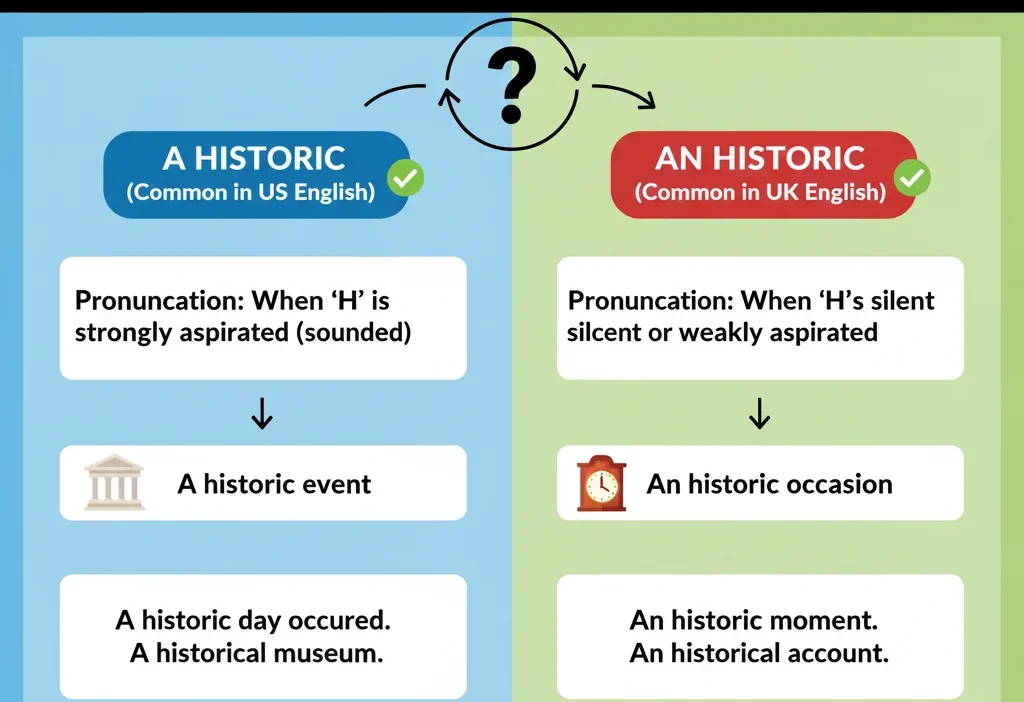
| A historic | When “historic” starts with a strong h sound (like “hi-story”) | It was a historic day for science. | ✅ Modern English (most common) |
| An historic | When “historic” is pronounced with a soft or silent h (like “istoric”) | It was an historic moment for the nation. | ✅ Older/British English (less common) |
🧠 Quick Tip to Remember:
If you pronounce the h sound clearly — say “a historic.”
If the h is silent or very soft — say “an historic.”
❌ Common Mistakes and How to Avoid Them
Let’s look at a few common errors people make:
| ❌ Wrong | ✅ Correct | Explanation |
|---|---|---|
| It was an historic match. (in American English) | It was a historic match. | Americans pronounce the “h,” so “a” is correct. |
| It was a historic event. (in old British writing) | It was an historic event. | In older British English, “h” was softer, so “an” sounded smoother. |
| We will visit an historic city tomorrow. | We will visit a historic city tomorrow. | In modern English, “a” fits better with the strong “h” sound. |
Why it happens:
People get confused because English pronunciation and spelling don’t always match. Historically, when “historic” was pronounced “istoric,” “an” sounded smoother. But now, most people pronounce the “h” — so “a historic” is correct in modern English.
🕰️ When to Use “A Historic”
You should use “a historic” when you clearly pronounce the “h” in “historic.”
✅ Examples:
- It was a historic win for the school.
- The scientists made a historic discovery.
- She visited a historic building in London.
- That speech was a historic moment for equality.
- Today marks a historic step toward peace.
💡 Memory Hack:
If you can hear the “h” sound, use “a.”
Say it out loud: “A historic” (you can hear the “h” in “hi”).
🕰️ When to Use “An Historic”
You may use “an historic” in:
- Formal or old-fashioned British writing
- Historical speeches or literature
- When the h is soft or barely pronounced
✅ Examples:
- It was an historic day for our ancestors.
- The Queen gave an historic address to the nation.
- They signed an historic agreement at midnight.
- Historians call it an historic achievement.
⚠️ Note:
Modern grammar experts recommend “a historic” for most writing, especially in American and modern British English.
However, “an historic” is still acceptable in formal or traditional British contexts.
🧭 Quick Recap: A Historic vs An Historic
Let’s make it super simple:
| Rule | Correct Form | Example |
|---|---|---|
| “Historic” starts with a strong h sound | ✅ A historic | A historic day for science |
| “Historic” has a soft or silent h (British or old-fashioned) | ✅ An historic | An historic event in London |
| Everyday modern writing | ✅ A historic | A historic moment for our country |
🪄 Easy Trick:
If you can say “a history,” then you should also say “a historic.”
💬 Advanced Tips: History, Origin, and Style
- The use of “an historic” started centuries ago when the h sound in words like hour, honor, and historic was often silent.
- Over time, pronunciation changed, but many formal writers kept the older version.
- Today, grammar guides like the Associated Press (AP) and Oxford Dictionaries prefer “a historic.”
- Using “an historic” can sound elegant or traditional, but it’s less common in modern English writing and speech.
🧾 In exams, essays, and official writing: Always use “a historic.”
🧠 Mini Quiz: Test Yourself!
Choose the correct form — a historic or an historic:
- It was ___ moment I’ll never forget.
- The scientists made ___ discovery yesterday.
- The king gave ___ speech in 1800.
- That was ___ event for our generation.
- They celebrated ___ occasion with joy.
<details> <summary>✅ Answers</summary> 1. a historic 2. a historic 3. an historic 4. a historic 5. a historic </details>
🧾 FAQs About “A Historic” vs “An Historic”
1. Which is correct: “a historic” or “an historic”?
Both can be correct, but “a historic” is the preferred modern form.
2. Why do some people still say “an historic”?
It’s a traditional British form from when the “h” in “historic” was pronounced softly or silently.
3. Is “an historic” wrong in British English?
No. It’s old-fashioned but still acceptable in formal British writing.
4. Should students use “an historic” in exams?
No — teachers and grammar tests usually prefer “a historic.”
5. What’s the easiest way to remember?
If you can hear the “h” sound, always use “a.”
🏁 Conclusion
So now you know — the difference between “a historic” and “an historic” is all about pronunciation, not spelling.
In modern English, the “h” in “historic” is clearly heard, so “a historic” is the correct and most common form.
However, “an historic” still appears in old or formal writing, especially in British English.
Keep this simple rule in mind:
👉 If you can hear the “h,” use a. If not, use an.
Practice this in your daily writing, and soon you’ll never get confused again!
Keep learning — every small grammar win makes your English stronger and more confident.

Henry Vale is a tech-savvy content creator at WordContrast.com, known for his in-depth guides and how-to articles. With a background in digital media and a passion for innovation, Henry focuses on simplifying technology for everyday users. His mission is to empower readers with clear, actionable knowledge they can use to improve their digital lives.